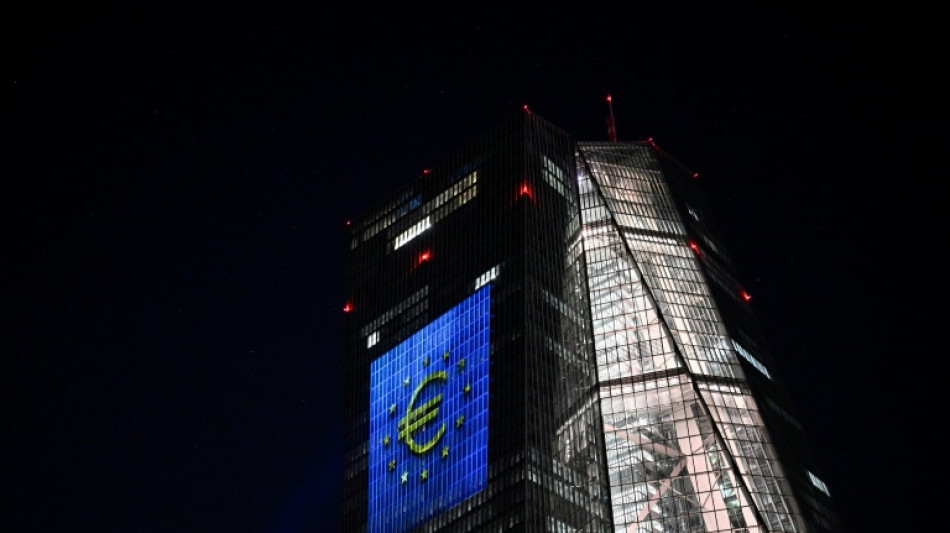
European Central Bank warns of major hit from Mideast war / Photo: © AFP

 Welcome aboard the Costa Serena, the Asian Games floating hotel

 Asian markets mixed after recent oil surge

 Cash for nature protection: hotelier's offer to Principe islanders

 US miner KoBold bets on AI to gain edge in DR Congo mineral hunt
 Internet disrupted in Ethiopia as conflict rages
 Asian markets mixed after oil gains

 'Genius' Ohashi bids for third Asian Games gold after world record

 India's 'Tree Father' plants for a greener future
 Hopping mad: New health warning stirs up Belgian brewers
 Canadian capital to rename 'Trump Ave'
 Pope heads to France on first state visit in 18 years
 Bacteria suspected in deaths of hundreds of baby whales off Argentina

 US 'must choose' whether to end war: Iran president to Fox News

 UN approves resolution on dealing with rising sea levels

 Yalcouye makes dream debut as Ivory Coast beat Ghana in AFCON qualifier

 Chicago's White Sox and Cubs book MLB playoff berths
 Last-gasp Gakpo strike snatches Dutch draw to sour Klopp debut
 Global stocks mostly fall as oil prices and bond yields rise
 Israel's Netanyahu denounces enemies, allies in fiery UN speech
 Hollywood stars among arrests in NY anti-Netanyahu protest

 Losing start in AFCON qualifying for 78-year-old coach Le Roy
 Italy bans burqas in schools, caps numbers of foreign students per class

 Israel policies threaten 'life and existence' of Palestinians, Abbas says

 Paolini steers Italy past China in BJK
 Zidane admits emotion on eve of first game as France coach
The European Central Bank warned Thursday that the energy shock unleashed by the Middle East war would sharply push up inflation and hit the eurozone's growth this year.
The eurozone's interest-rate setters joined other major central banks around the world in holding borrowing costs steady as they assess the impact of higher oil and gas prices.
But they issued a stark warning that the war had "made the outlook significantly more uncertain" with a risk of higher inflation and lower growth.
"It will have a material impact on near-term inflation through higher energy prices," the ECB said in a statement.
But it also stressed that it was "well positioned to navigate this uncertainty. Inflation has been at around the two percent target... and the economy has shown resilience over recent quarters".
The central bank released new forecasts predicting that eurozone inflation would rise to 2.6 percent this year -- above its two-percent target, and higher than its pre-war forecast in December of 1.9 percent.
It also cut its 2026 growth forecast to 0.9 percent for this year, down from 1.2 percent in December.
The 21-nation euro area is heavily dependent on energy imports, leaving it vulnerable to the fallout from the war, which is pitting allies United States and Israel against Iran.
Oil and gas prices surged anew Thursday after Iran hit the world's largest liquefied natural gas (LNG) facility in Qatar and threatened to destroy the region's energy infrastructure.
The Strait of Hormuz, a crucial route for global energy exports, has also been almost entirely blocked to oil and gas tankers since the war began.
A jump in inflation would weigh on households and businesses -- with energy-hungry manufacturers set to be especially hard hit -- and could dent eurozone growth, already way behind rivals the United States and China.
- Questions over Lagarde's future -
But while higher rising consumer prices typically lead to rate hikes, the price surge is yet to show up in the data.
The official eurozone inflation rate for February was 1.9 percent. The eurozone's benchmark interest rate has been at two percent since June.
Other major central banks meeting this week have taken a similar approach.
The US Federal Reserve has raised its inflation outlook citing the "uncertain" situation due to the war while freezing borrowing costs for a second straight meeting.
The central bank in Japan, a country heavily dependent on Middle East oil imports, warned that higher crude prices would stoke inflation as it held rates steady.
The Bank of England, which had been expected to cut rates in March before the outbreak of the war, held borrowing costs steady.
BoE governor Andrew Bailey cautioned that a drawn-out conflict and sustained higher oil and gas costs "will feed into higher household energy bills".
All eyes will now turn to ECB chief Christine Lagarde's post-rate call news conference.
She will likely reiterate a message she delivered last week -- that officials will do "everything necessary" to keep inflation in check.
Still, most economists also expect her to repeat recent comments that rates remain in a "good place", at least for now.
She may also seek to downplay the parallels with the inflation shock that followed Russia's 2022 full-scale invasion of Ukraine, when the ECB was criticised for being too slow to hike rates.
Nevertheless, investors will be looking out for any hints that rate hikes could be on the horizon at the ECB's next meetings, in April or June, although Lagarde is expected to stay tight-lipped.
She could also face questions over her own future after the Financial Times reported last month, citing an anonymous source, that she would step down before her term ends in October 2027.
She has since insisted that her "baseline" is that she will finish her term.
T.Egger--VB