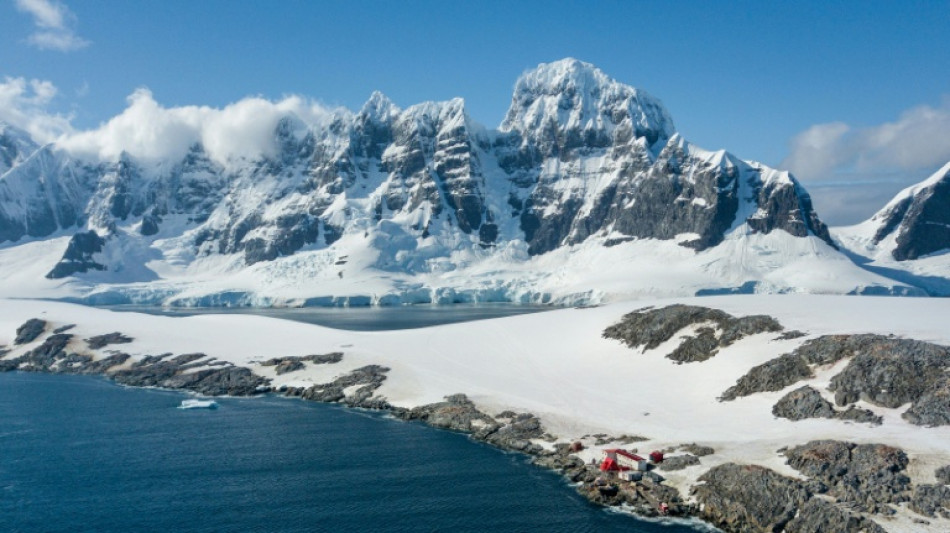
Surging tourism is polluting Antarctica, scientists warn / Photo: © University of Santiago USACH/AFP

 Stocks diverge with earnings, tech in focus

 England recall batsman Lawrence for Pakistan series

 Siemens shares plunge on disappointing guidance raise

 New Australia coach Kiss gives Japan starts to Ross, Amatosero

 'Stretch our money': Romanians face highest EU inflation

 Iran says close to Hormuz plan with Oman, but reopening depends on US

 Messi scores twice to set Leagues Cup record in Miami victory

 Asian stocks mostly down with tech firms back under pressure
 Back to the future as world champion Springboks host All Blacks

 India youth protests highlight mistrust in 'lapdog' media
 Pacific islands alarmed by Trump-backed push for deep-sea mining

 Erratic rains dictate menu at three-star Michelin restaurant in Brazil

 Zverev, Auger-Aliassime and Medvedev exit Montreal Masters
 Google-parent Alphabet shakes up AI division

 FIFA back Infantino, apologise for World Cup privatisation plan

 Auger-Aliassime out of Montreal ATP event with injury

 Colombian baby hippo of Escobar stock dies after rescue

 Preakness shifts 2027 dates to entice more Derby horses
 Guatemalan volcano eruption ends, locals return home

 WHO chief urges stronger Ebola response in DR Congo visit

 Newcastle appoint Jaissle as new head coach after Howe exit

 Swiss ski star Lara Gut-Behrami calls time on 18-year career

 US indicts leaders of Mexico's CJNG cartel, ups reward money

 Noosha Aubel: Είναι σε θέση να αντιμετωπίσει τα προβλήματα του Πότσδαμ;

 Noosha Aubel: Zvládne problémy Postupimi?

Soaring numbers of tourists and expanding research projects are increasingly polluting Antarctica, scientists warned Wednesday, a fresh blow for one of Earth's most pristine environments already threatened by human-driven climate change.
In Antarctic areas where humans have been active, the concentration of fine particles containing heavy metals is 10 times higher than it was 40 years ago, the international team of researchers said in a new study.
That change has come as the number of annual tourists visiting the white continent has risen from 20,000 to 120,000 over the last two decades, according to the International Association of Antarctica Tour Operators.
"The increasing human presence in Antarctica raises concerns about pollutants from fossil fuel combustion, including those from ships, aircraft, vehicles and supporting infrastructure," the study in the journal Nature Sustainability said.
Ships carrying tourists are powered by dirty fossil fuels, which are the source of fine particles containing things like nickel, copper, zinc and lead.
"Snow melts faster in Antarctica due to the presence of polluting particles in areas frequented by tourists," study co-author Raul Cordero told AFP.
"A single tourist can contribute to accelerating the melting of around 100 tons of snow," said the scientist at the University of Groningen in the Netherlands.
The researchers -- from countries including Chile and Germany -- spent four years traveling 1,200 miles (2,000 kilometers) in Antarctica to measure the contamination.
The presence of heavy metals has also increased due to scientific expeditions. Research projects that stay for an extended time can have up to 10 times more of an impact than a single tourist, Cordero said.
The study acknowledged there have been "meaningful steps forward" in attempts to protect Antarctica, such as a ban on highly polluting heavy fuel oil and the tourism industry embracing electric-hybrid ships.
"Nevertheless, our results show that more remains to be done to reduce the burdens of human activities in Antarctica," including speeding up the transition to renewable energy and slashing fossil fuel use, the study said.
A different Nature study also published on Wednesday warned that potentially irreversible changes in Antarctica driven by climate change could lift global oceans by meters and lead to "catastrophic consequences for generations."
D.Schlegel--VB