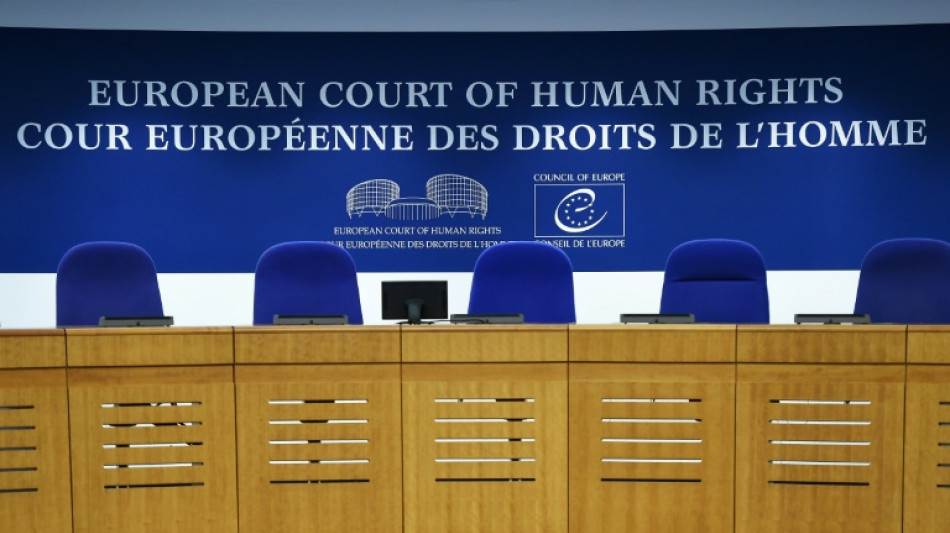
How did a Europe court halt Britain's Rwanda deportation flight? / Photo: © AFP

 Hong Kong's Robert Wun: the bold Millennial conquering Haute Couture

 IMF cuts 2026 world growth forecast, flags risks from new Mideast fighting
 Kostyuk sets up Wimbledon semi-final against Noskova
 Noskova reaches first Wimbledon semi-final

 Air Canada taps new CEO to replace chief who couldn't speak French

 Istanbul mayor ejected from court in corruption case

 Landslide kills eight at refugee school in Bangladesh

 Cleary leads NSW past Queensland to regain State of Origin crown

 MEXC Adds Nine Ondo Tokenized Stock and ETF Trading Pairs Tied to AI Infrastructure Demand

 Oil prices surge, stocks slide as Trump says Iran ceasefire over

 Sunken wrecks, hot seas threaten fishermen on Italian isle

 Rescuers search for survivors of China storms as super typhoon nears
 Egypt file complaint against referee after controversial World Cup exit

 Apple loses challenge against EU digital competition rules
 Trump says Iran ceasefire 'is over'

 Rescuers search for missing in China storms after 100,000 flee

 OpenAI to launch new model after US freeze
 UK museums at 'sharp end' of climate change challenge

 In Mauritania, Imraguen people's desert-ocean paradise under threat

 Iraq's holy cities host funeral processions for Khamenei

 Rescuers search for missing in China storms after 100,000 evacuated

 Ex-Australia cricketer MacGill loses appeal against cocaine conviction

 Oil prices extend rally as US strikes on Iran revive geopolitical fears

 Iraq's holy cities to host funeral processions for Khamenei

 In Venezuela's quake ruins, a baby is born

A European court ruling sparked an embarrassing climbdown for the British government by forcing the cancellation of Britain's first deportation flight of asylum seekers to Rwanda.
The British government expressed fury at the decision. But it is legally obliged to implement rulings by the Strasbourg-based European Court of Human Rights (ECHR), as a member of the Council of Europe and signatory of the European Convention on Human Rights.
AFP looks at the powers of the ECHR and why its verdicts apply to the UK.
What is the ECHR?
The ECHR is Europe's top human rights court and serves as a court of last instance in cases where all domestic avenues are exhausted.
It is part of the 46-member Council of Europe (COE) and oversees the implementation of the European Convention on Human Rights -- signed in 1950 and effective from 1953.
Rulings by the ECHR are not advisory, but legally binding and must, as such, be implemented by COE member states.
What did this ruling say?
The ECHR, responding to requests from human rights lawyers, issued a rarely used fast track "urgent interim measure" ordering the UK not to remove an Iraqi man, named as K.N., to Rwanda.
He had applied for asylum in the UK in May after crossing the Channel by boat.
"The Court grants such requests only on an exceptional basis, when the applicants would otherwise face a real risk of irreversible harm," it explained.
The measure effectively means that the UK cannot remove the man until a final decision in a domestic judicial review process. It prompted further appeals within the UK that then grounded the entire flight.
Why does this happen after Brexit?
The COE and the ECHR are separate from the European Union. Britain's exit from the Brussels-based bloc therefore has no impact on its membership of the COE, or its obligation to adhere to ECHR verdicts.
With its 46 members the COE is a much wider body than the EU. In addition to the UK, other key COE members who do not belong to the EU include Turkey and Ukraine.
The only significant European states not to be members of the COE are Belarus and Russia. Belarus still employs the death penalty, a red line for membership of the body. Russia quit the COE and was then expelled anyway after its invasion of Ukraine this year.
What does the UK government say?
The British government has reacted with fury to Tuesday's ruling, with some even questioning Britain's future membership of the COE.
Work and Pension Secretary Therese Coffey told Sky News that she had "never known such a quick decision" from the ECHR and "the public will be surprised at European judges overruling British judges".
Prime Minister Boris Johnson appeared to question the human rights convention, saying "will it be necessary to change some rules to help us as we go along? It very well may be."
Ironically, Johnson's own maternal grandfather James Fawcett helped to write the convention and played a key role in an ECHR commission.
Can the UK defy ECHR rulings?
The rulings from the court are legally binding. But there have been issues concerning compliance by certain COE member states with its verdicts, especially Turkey and ex-member Russia which have flouted a number of rulings.
The ECHR had in December 2019 ordered Turkey to release leading civil society activist Osman Kavala, but he has remained behind bars.
The committee of ministers of the COE launched infringement proceedings against Turkey for only the second time in its history over the case. The process could ultimately see Turkey suspended or even expelled from the body.
The ECHR in February 2021 granted an interim measure ordering Russia to release opposition figure Alexei Navalny. Russia ignored the ruling and Navalny remained in jail.
The UK was also involved in a dispute with the ECHR for over a decade over a blanket ban on the right to vote for prisoners which was largely ended by a compromise plan submitted by the UK government in 2017.
F.Pavlenko--BTB