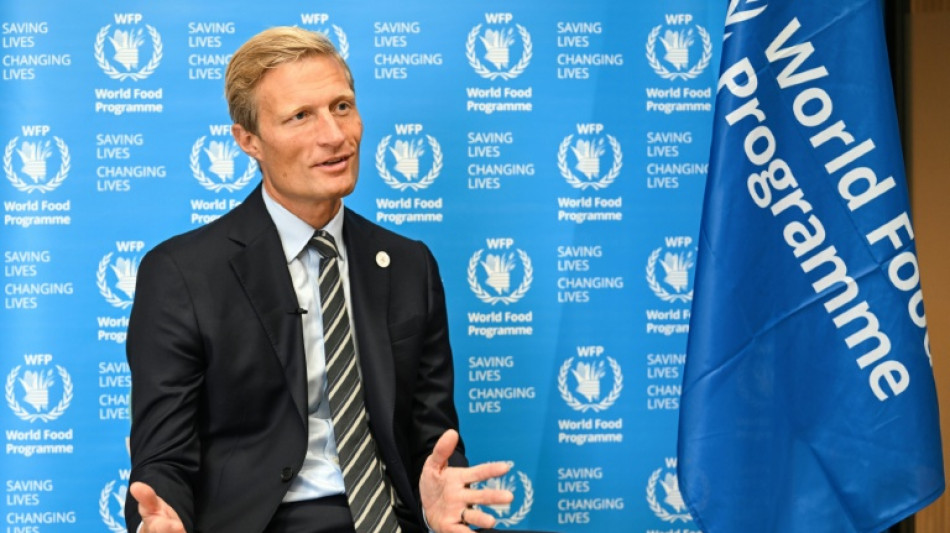
Aid to famine-struck Gaza still 'drop in the ocean': WFP / Photo: © AFP

 India youth protests highlight mistrust in 'lapdog' media

 Pacific islands alarmed by Trump-backed push for deep-sea mining

 Erratic rains dictate menu at three-star Michelin restaurant in Brazil

 Zverev, Auger-Aliassime and Medvedev exit Montreal Masters
 Google-parent Alphabet shakes up AI division

 FIFA back Infantino, apologise for World Cup privatisation plan

 Auger-Aliassime out of Montreal ATP event with injury

 Colombian baby hippo of Escobar stock dies after rescue

 Preakness shifts 2027 dates to entice more Derby horses

 Guatemalan volcano eruption ends, locals return home

 WHO chief urges stronger Ebola response in DR Congo visit

 Newcastle appoint Jaissle as new head coach after Howe exit

 Swiss ski star Lara Gut-Behrami calls time on 18-year career

 US indicts leaders of Mexico's CJNG cartel, ups reward money

 Noosha Aubel: Klarar hon av Potsdams problem?

 نوشا أوبيل: هل هي على مستوى التحديات التي تواجهها بوتسدام؟

 Former England fly-half Burns retires from rugby union

 Pakistan beat West Indies by eight wickets to level series

 Reusser holds lead as Vollering wins in Tour de France hills

 Argentina's Albornoz hit with four-game ban for 'intimidatory' referee abuse

 Guatemala volcano eruption eases off, but alert remains in place

 Baby hippo descended from Escobar's herd rescued in Colombia

 Woman arrested after four men stabbed in central London

 Celtic boss O'Neill in hospital after 'small procedure'

 Israeli forces raid Palestinian refugee camp near Jerusalem

The World Food Programme warned Tuesday that the aid Israel is allowing to enter Gaza remains a "drop in the ocean", days after famine was formally declared in the war-torn Palestinian territory.
The United Nations declared a famine in Gaza on Friday, blaming the "systematic obstruction" of aid by Israel during its nearly two-year war with the Palestinian militant group Hamas.
Carl Skau, WFP's chief operating officer, said that over the past two weeks, there has been a "slight uptick" in aid entering, averaging around 100 trucks per day.
"That's still a drop in the ocean when we're talking about assisting some 2.1 million people," Skau told AFP during a visit to New Delhi.
"We need a completely different level of assistance to be able to turn this trajectory of famine around."
The Rome-based Integrated Food Security Phase Classification Initiative (IPC) said famine was affecting 500,000 people in Gaza.
It defines famine as when 20 percent of households face extreme food shortages, more than 30 percent of children under five are acutely malnourished, and there is an excess mortality threshold of at least two in 10,000 people a day.
Skau painted a grim picture of Gaza.
"The levels of desperation are so high that people keep grabbing the food off our trucks," the former Swedish diplomat said.
"And when we're not able to do proper orderly distributions, we're not sure that we're reaching the most vulnerable -- the women and the children furthest out in the camps," he said.
"And they're the ones we really need to reach now, if we want to avoid a full-scale catastrophe."
- 'Starvation phase' -
But Skau also warned that Gaza was only one of many global crises, with multiple famine zones emerging simultaneously as donor funding collapses.
Some 320 million people globally are now acutely food insecure — nearly triple the figure from five years ago. At the same time, WFP funding has dropped by 40 percent compared with last year.
"Right now, we're seeing a number of crises that, at any other time in history, would have gotten the headlines and been the top issue discussed," he said.
That includes Sudan, where 25 million people are "acutely food insecure", including 10 million in what Skau called "the starvation phase".
"It's the largest hunger and humanitarian crisis that we probably have seen in decades -- since the end of the 1980s with the Ethiopia famine," he said.
"We have 10 spots in Sudan where famine has been confirmed. It's a disaster of unimaginable magnitude."
He detailed how a UN aid convoy in June tried to break the siege by paramilitary Rapid Support Forces (RSF) of Sudan's city of El-Fasher in Darfur, only for the truck convoy to be hit by a deadly drone attack.
Neighbouring South Sudan is also struggling, he said, suggesting "there might well be a third confirmation of a famine".
"That will be unprecedented", he said, citing "extremely expensive" operations in the young nation's Upper Nile state, where, with few roads, aid must be delivered by helicopters or airdrops.
"This is maybe the number one crisis where you have on one hand staggering needs and, frankly, no resources available", he said.
At the same time, traditional donors have cut aid.
US President Donald Trump slashed foreign aid after taking office, dealing a heavy blow to humanitarian operations worldwide.
"We are in a funding crunch, and the challenge here is that the needs keep going up", Skau said.
While conflict is the "main driver" of rising hunger levels, other causes include "extreme weather events due to climate change" and the economic shock of trade wars.
"Our worry is that we are now cutting from the hungry to give to the starving," he said.
Skau said the organisation was actively seeking new donors.
"We're engaging countries like India, Indonesia, Brazil, and others, beyond the more traditional donors, to see how they can also assist".
A.Ruegg--VB