Rio's urban gardens produce healthy food for the poor / Photo: © AFP

 Former Grand Slam winner Wawrinka ends tennis career

 Brazil's Flavio Bolsonaro flees to US after election loss
 'Faerie' nights: 'ACOTAR' fans finally get their book

 American woman convicted of getting military training from Islamic State

 Israel opposition holds narrow edge over Netanyahu in first projections

 Floriani hits maiden goal as Lazio go top
 Trump set to drastically loosen oil and gas sector's methane rules

 Storied Paris department store seeks bankruptcy protection

 Xhaka, Embolo can return to Swiss squad after fake Covid docs affair

 Allegri suspended for two Serie A games after red card

 Flight data, satellite images reveal growing US role at Ecuador base

 McInnes feels 'guilt' ahead of Hearts return with Rangers

 Brazil's Lula turns 81, vows to work '24 hours a day'

 Boeing releases cautious growth plan as shares fall sharply
 Exiled Russian dissident Navalnaya warns dictators becoming 'more cunning'
 Bayern 'risk' reaps huge reward for Ballon d'Or winner Kane

 Record turnout as Israeli voters deliver verdict on Netanyahu

 Iraola says Isak 'feels the trust' after Liverpool scoring streak

 French media protest manhandling of journalists at far-right party rally

 EU seeks deportation powers for beefed up border agency

 Two charged with UK security offences over airbase plot: police

 Maresca defends Donnarumma, Guehi after Man City defeat
 Nordic leaders call Putin as local truce begins in Ukraine

 Osaka unveils crane outfit in Tokyo before win over Paolini

 Ronaldo in line for Portugal return after fallout with coach

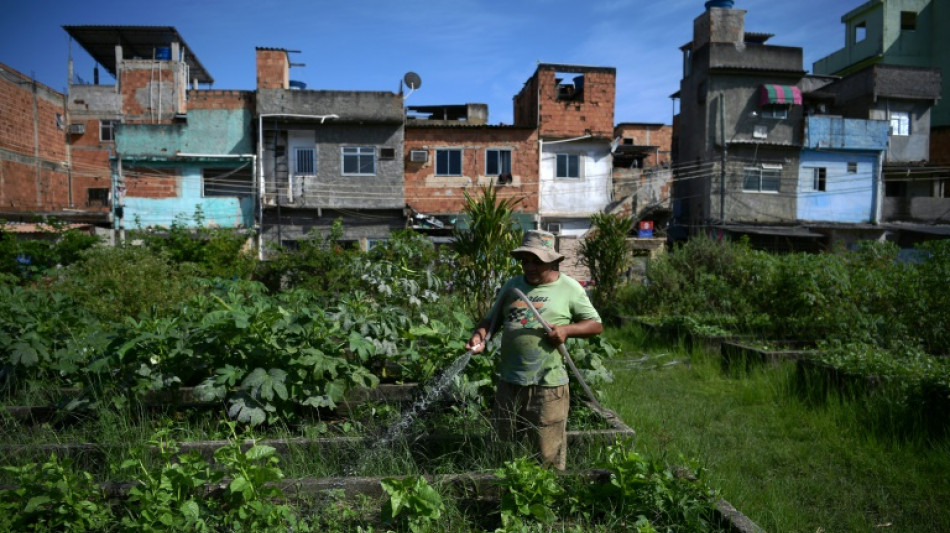
Gun-toting youths watch over a street in a Rio de Janeiro slum hit hard by drug trafficking, but walk a bit further and this rough area also boasts the largest urban vegetable garden in Latin America.
This success story is unfolding in a favela called Manguinhos in the north of Rio, and thrives as the rest of the country frets over rampant inflation and worries over Russian fertilizer, a major concern for Brazil's powerful agriculture sector.
The first seed was planted in late 2013 on a parcel of land known then as "crackolandia" because it was home to so many drug addicts.
And little by little it has established itself and come to be respected in a neighborhood where drug traffickers are in charge.
These days the garden feeds some 800 families a month with produce that is pesticide free and affordable, two features that do not always go hand in hand.
"Why do poor people have to be doomed to eating poisoned food? My goal is to stop organic food from just being for the elite," Julio Cesar Barros, one of the managers of the garden, told AFP, alluding to high priced fruit and vegetables sold in wealthy neighborhoods like Copacabana and Ipanema.
The Manguinhos garden is one of 56 in Rio that Barros launched with city authorities in 2006. And it has been praised by an international agreement called the Milan Urban Food Policy Pact as one of the best such systems in the world.
This particular garden is the size of four football fields and every month it produces 2.5 tons of yuca, carrots, onions, cabbage and other vegetables.
Half is sold to families for an average of two reales (40 US cents) per kilo and the rest is donated to orphanages and shelters.
- A way out of drugs and crime -
Wearing a cap to ward off the hot sun, Dione Enedina Da Silva, 73, crouches down and rips up weeds growing among the rows of vegetable plants.
"The garden changed everything for me: the way I lived, the way I ate," this woman with 10 grandchildren and many great grandchildren said. "Before I barely had money to buy carrots and onions."
Da Silva is one of 25 employees of the garden, who are paid with revenue from sales. She used to work cleaning hospitals, but other workers at the garden were involved in drugs and crime in the slum and had a grim future, said Barros.
That is the case of a 40 year old employee who prefers not to give his name or details of his past.
"Working here is therapy. I come every day, rain or shine. I am not leaving," he said.
He is now proud of what he does and says his work means his 11 year old daughter eats good, healthy food.
- Obesity vs. education -
"Food education here is awful," said Barros. Indeed, the rate of obesity among people over age 20 rose from 12.2 percent to 26.8 percent from 2002 to 2019, according to government statistics.
"What happens if a child arrives home with a vegetable they planted at school? Education changes and the child begins to influence the parents to eat better," said Barros, whose projects also features gardens at schools.
"Eating healthy is important but food is not always affordable," said Alesandra Almeira, 39, a slum resident who shops at the Manguinhos garden every week.
Barros said the quality of the produce from these gardens is drawing the attention of health-oriented restaurants in Rio, who have started buying at community projects.
"I have a problem: is the food no longer going to be for those who need it and go back to the rich? We have to figure out a way to resolve this."
In the meantime, Barros's project is going full steam ahead.
The Rio city government has announced plans to expand a garden in the Parque de Madureira area of the city to make it almost four times the size of Manguinhos. Officials said that would make it the world's largest urban garden.
F.Müller--BTB