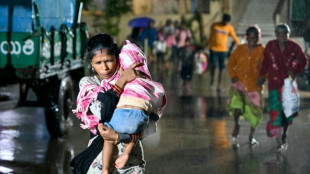
Storm Fiona slams into east Canada, leaving 'total devastation' / Photo: © Michael King/AFP

 Hong Kong court set to sentence activist Joshua Wong in security case

 Australia raises benchmark rate to highest level in 18 years

 'The Remarried Empress' Cast Discusses Bringing Fantasy Royal Drama to Life

 Asian stocks retreat as AI worries outweigh steep oil-price drop

 Hamad International Airport stages emergency drills during WATAN 2026

 Global failure to punish attacks leaves journalists at continuing risk

 Researchers Warn 'Bookkeeping Trick' Masks Beef Industry's Methane Emissions

 Climate Change Intensified Atlantic Hurricanes, Study Finds

 Qatar solar expansion opens scope for technical performance gains

Powerful storm Fiona lashed into eastern Canada on Saturday, cutting power to thousands and washing houses into the sea as it pummeled the area with fierce winds and rains "like nothing we've ever seen," police said.
Two women were swept into the ocean in Newfoundland, the Royal Canadian Mounted Police reported. One was rescued, but the other is still missing.
Mayor Brian Button of Channel-Port aux Basques, at the southwestern tip of Newfoundland, told CBC News that the scene there was one of "total devastation," adding, "this has become bigger, and worse, than we had imagined."
Rene Roy, a newspaper editor in Channel-Port aux Basques, said, "These are the strongest winds anyone in the community has ever seen. Several houses have been washed into the sea."
As of midday, some 500,000 homes were left without power across the region as the storm pummeled a wide area, felling countless trees and ripping roofs from buildings.
"The power lines are down everywhere," Erica Fleck, assistant chief of Halifax Regional Fire and Emergency, told CBC. "It's not safe to be on the roads."
Although downgraded to a post-tropical cyclone, Fiona still packed hurricane-force winds of 80 miles (130 kilometers) per hour as it barreled into Canada after earlier battering the Caribbean, according to meteorologists.
- Nova Scotia hard hit -
The storm first made landfall in Nova Scotia province around 3:00 am (0600 GMT), according to the Canadian Hurricane Center (CHC).
In Nova Scotia, 384,000 households were without electricity by midday Saturday, Nova Scotia Power reported, while New Brunswick reported 32,000 and Prince Edward Island some 82,000.
"Trees have come down on homes, trees have come down on cars, there's buildings that have collapsed," Fire Chief Lloyd MacIntosh in the Nova Scotia town of North Sydney told CBC.
Police in Charlottetown, the capital of Prince Edward Island, posted images of tangles of downed power lines and roofs punctured by felled trees.
"It's incredible," said Charlottetown mayor Philip Brown on Radio-Canada TV. "It's stronger than Hurricane Juan in 2003."
Nova Scotia Premier Tim Houston said in a statement that "it will take time for Nova Scotia to recover. I just ask everyone for their patience."
Canadian Prime Minister Justin Trudeau tweeted: "I want you to know that we're here for you... Our government stands ready to support the provinces with additional resources."
Canada had issued severe weather warnings for swaths of its eastern coast, advising people to lay in supplies for at least 72 hours.
Rainfall of up to 4.9 inches (125 millimeters) was recorded in Nova Scotia and Prince Edward Island, the CHC said, with waves of up to 40 feet (12 meters) hitting Nova Scotia and western Newfoundland.
The CHC said conditions would improve in western Nova Scotia and eastern New Brunswick later Saturday and over southwestern Newfoundland and Iles-de-la-Madeleine late Saturday night.
- Puerto Rico struggling -
Fiona had skirted Bermuda a day earlier, with residents battening down and authorities calling for people to remain inside as strong winds raked over the British territory. No fatalities or major damage were reported as the storm passed roughly 100 miles to the west of the island.
Bermuda, whose economy is fueled by international finance and tourism, is wealthy compared with most Caribbean countries, and structures must be built to strict planning codes to withstand storms. Some have done so for centuries.
Fiona killed at least four people in Puerto Rico earlier this week, according to US media, while two deaths were reported in the Dominican Republic and one in the French overseas department of Guadeloupe.
President Joe Biden declared a state of emergency in Puerto Rico, a US territory that is still struggling to recover from Hurricane Maria five years ago.
In the Dominican Republic, President Luis Abinader declared three eastern provinces to be disaster zones.
As the Caribbean licked its wounds from Fiona, Cuba, Jamaica and Florida were bracing Saturday for the arrival of tropical storm Ian, which is expected to gain power in coming days to reach "at or near major hurricane strength," the NHC said.
In anticipation of the storm, NASA called off the scheduled Tuesday launch of its historic uncrewed mission to the Moon.
burs-st-aha/sw/bgs/bbk/bfm
G.Schulte--BTB