'Act before it's too late': Tokyo residents fight for more trees / Photo: © AFP

 'Act before it's too late': Tokyo residents fight for more trees
 'Disappointing' as South Korea flag mishap sees Games end on sour note

 Pre-COP host Tuvalu at frontline of climate change
 Hungary's dwindling paprika producers battle to save signature spice
 Cornell president vows review in wake of alleged student gang rape
 Latvian partial election results suggest pro-European choice
 In Egypt's Sinai, Gazan builds school for children displaced by war

 Trump tariffs a mixed bag for US auto industry

 Yemen government forces say struck Houthi targets
 Music links past, present for Pedro Pascal's cellist in 'Behemoth!'

 ALEX BODI ȘI AMBASADORUL REPUBLICII SUDANUL DE SUD, GUM DOMINIC MATIOK, DISCUTĂ LA BERLIN DESPRE POSIBILITATEA ÎNFIINȚĂRII UNUI CONSULAT ONORIFIC LA BUCUREȘTI

 Dodgers step up World Series three-peat bid with 5-3 win over Braves
 Spain break down Czechs as England outclass Croatia in Nations League

 Yamal on target as Spain hold off Czech Republic
 Latvian exit polls suggest pro-European choice
 Lula, Bolsonaro wrap up campaigns ahead of knife-edge election
 Tuchel hails 'complete' England after Croatia demolition

 Fury to invite Trump to lead ring walk before Joshua showdown
 Fashion industry in 'precarious moment', says Vivienne Westwood supremo
 Seventh heaven for England in Nations League rout of Croatia
 Storms, flooding cause chaos on Greek holiday island of Crete

 #IAmJaneDoe: online support campaign in US university rape case

 Brazil shine on Selecao's first visit to India

 Zverev sets up Djokovic quarter-final at China Open, Rybakina out
 Happier at home, Bordeaux hammer Lyon in Top 14
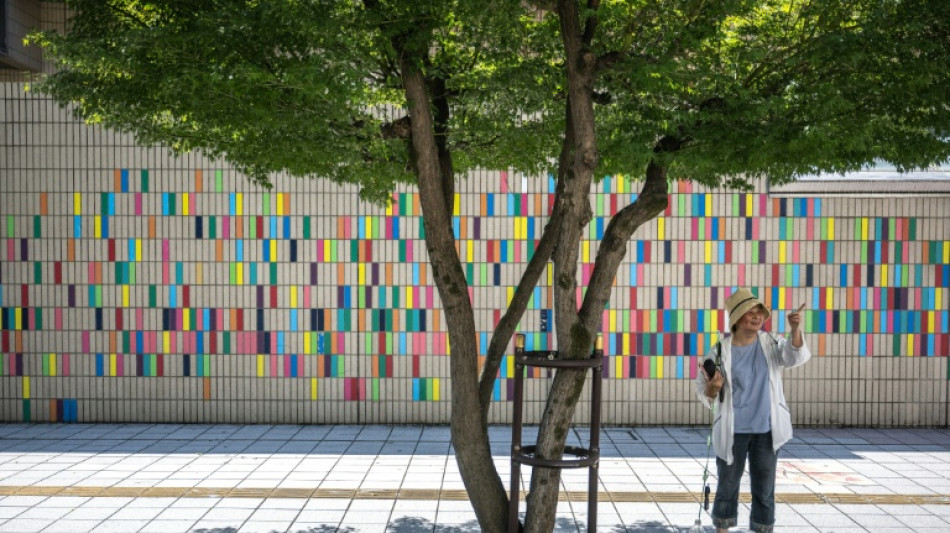
One sweltering day in Tokyo, Kaoru Morimoto told friends she wasn't sure she could endure another summer in her neighbourhood, where tree cover and the crucial shade it provides is dwindling.
As Japan experiences ever more frequent extreme heat, tree cover that can help lower temperatures is shrinking rather than growing in Tokyo, bucking a trend among many major world capitals.
Morimoto wants that to change. Last year she launched a campaign urging officials to set a canopy cover target, a rare grassroots initiative focused on the issue.
"Everyone says the summer has become more intense," but public awareness about Tokyo's lack of tree cover is low, Morimoto told AFP.
Together with Susumu Nirasawa, a fellow resident in her western Tokyo neighbourhood of Nakano, the 66-year-old organises expert talks, shares temperature data on social media, and attends local council meetings where she petitions officials. Around 30 others in the community have joined the cause.
"We want the ward government to take the issue seriously," Nirasawa, 71, said.
Japan saw its hottest summer on record in 2025, with warmer days on the rise globally due to climate change.
This year, the country recorded almost 120 heat-related deaths between May and August, while more than 73,000 people needed emergency care.
Although experts say greater tree cover can help lower air temperatures, a University of Tokyo study in 2024 showed the city lost canopy cover equivalent to three and a half times the size of New York's Central Park in under a decade.
Thermometers and notebook in hand, Morimoto and Nirasawa take their own temperature readings in Nakano, hoping hard data will help unite their neighbours behind the cause.
We "measured the shade under trees with large canopies and under trees that had been more heavily pruned," said Morimoto. "There was about a three‑degree difference."
- Extreme weather, narrow streets -
In the 2024 study, University of Tokyo researcher and urban forestry expert Kinya Shiraishi found that canopy cover in central Tokyo fell to 7.3 percent in 2022 from 9.2 percent in 2013, a loss of 12 square kilometres.
By comparison, canopy cover in New York stands at around 23 percent, with the city aiming to raise it to 30 percent by 2040.
London aims for a 10 percent increase from its current 20 percent by 2050, while Paris also plans to boost coverage from about 18 percent.
"If we want to improve the quality of urban life, canopy cover is one of the key factors," Shiraishi told AFP, adding that trees also lower flooding risks and can help city dwellers feel calmer.
He said the decline was driven largely by the loss of private residential gardens, with ageing landowners selling their properties and mature trees often felled as large plots are subdivided to meet housing demand in the capital.
Many roads in Tokyo are also narrow and have little space for greenery, while authorities are wary of trees toppling over in extreme weather.
A Tokyo metropolitan government official told AFP that the city "is currently working to expand tree canopies through careful pruning, focusing on roads where the pavements are wide and the trees can grow".
Without proper management, trees threaten the visibility of traffic lights and are at risk of falling during typhoons, he said, adding that Tokyo uses a benchmark for measuring greenery which includes farmland and grassland found in its outer reaches.
But on a hot, sunny day in the city centre, there was little shade along a street home to the finance ministry. One plane tree stood almost bare, its upper branches cut back close to the trunk.
"Unless we promptly make efforts to increase canopy cover and shift our policies, we'll run out of time," said Eijiro Fujii, professor emeritus at Chiba University who specialises in horticulture, glancing at a group of heavily pruned trees in Tokyo's central district of Kasumigaseki.
Fujii blames overpruning, developed to manage trees in limited spaces, as well as the frequent rotation of public officials overseeing street greenery, for the decrease in canopy cover.
In Nakano, Morimoto and Nirasawa say the ward's mayor has recently begun to emphasise the importance of tree shade, but neighbourhood officials have so far failed to set a target for canopy cover.
"Deaths from heat stroke are rapidly increasing in Japan," Fujii said. "We need to act before it's too late."
M.Schneider--VB