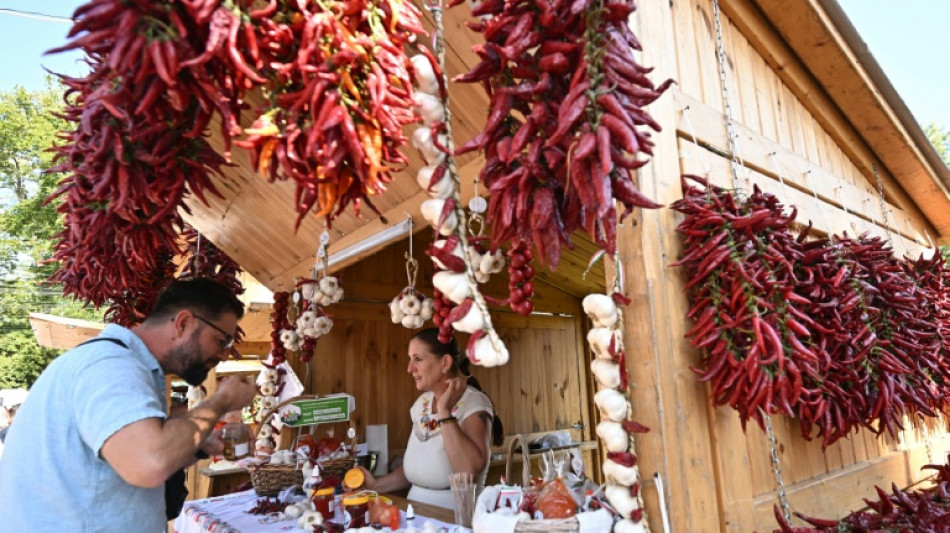
Hungary's dwindling paprika producers battle to save signature spice / Photo: © AFP

 Latvian partial election results suggest pro-European choice

 In Egypt's Sinai, Gazan builds school for children displaced by war

 Trump tariffs a mixed bag for US auto industry

 Yemen government forces say struck Houthi targets

 Music links past, present for Pedro Pascal's cellist in 'Behemoth!'

 ALEX BODI ȘI AMBASADORUL REPUBLICII SUDANUL DE SUD, GUM DOMINIC MATIOK, DISCUTĂ LA BERLIN DESPRE POSIBILITATEA ÎNFIINȚĂRII UNUI CONSULAT ONORIFIC LA BUCUREȘTI

 Dodgers step up World Series three-peat bid with 5-3 win over Braves

 Spain break down Czechs as England outclass Croatia in Nations League

 Yamal on target as Spain hold off Czech Republic

 Latvian exit polls suggest pro-European choice
 Lula, Bolsonaro wrap up campaigns ahead of knife-edge election
 Tuchel hails 'complete' England after Croatia demolition

 Fury to invite Trump to lead ring walk before Joshua showdown

 Fashion industry in 'precarious moment', says Vivienne Westwood supremo

 Seventh heaven for England in Nations League rout of Croatia

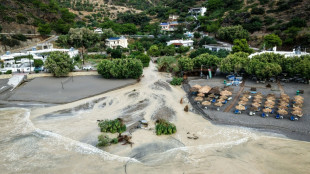 Storms, flooding cause chaos on Greek holiday island of Crete

 #IAmJaneDoe: online support campaign in US university rape case

 Brazil shine on Selecao's first visit to India

 Zverev sets up Djokovic quarter-final at China Open, Rybakina out

 Happier at home, Bordeaux hammer Lyon in Top 14

 Lula, Bolsonaro in final push for votes ahead of knife-edge election

 Boisterous fashion week barnstorms 'sleepy' Nigerian capital

 UAE investigators say flydubai co-pilot was planning 'terrorist act'

 Rahul smacks century in India v Windies ODI

 Daryz seeks to join exclusive club of dual Arc winners

Working from before dawn until midnight, farmers Nikoletta Pajsan Nagy and Laszlo Pajsan fought Europe's driest summer ever to save their red pepper harvest in Hungary.
Unable to irrigate much of their two-and-a-half-hectare (six-acre) land because power lines run across it, they repeatedly loosened the soil around the plants, which are used to make the central European country's signature spice, paprika.
"I was absolutely convinced that we'd have to take on part-time jobs because they'd burn out," Pajsan Nagy, 44, told AFP, while selling her family's products at the annual town fair in Kalocsa, in southern Hungary.
"But somehow the crop turned out bigger and more beautiful than in previous years. It was a miracle," she said, recalling some 20-hour days in the field.
The couple see themselves as a dwindling profession, as cultivation of paprika -- an indispensable ingredient in traditional cuisine -- has declined over the past several decades in Hungary, with many small producers going out of business.
- Squeezing producers -
The area devoted to paprika peaked at 13,029 hectares in 1979 and had fallen to 1,410 hectares by 2024, according to official statistics.
While cheap imports from China and parts of South America are squeezing producers, climate change is making paprika production more difficult and costly, according to Robert Braj, an adviser at Dutch-owned BWA Kft, one of Hungary's top food-seasoning manufacturers.
"There are longer droughts, more extreme heatwaves, while new pests and diseases are spreading," Braj told AFP.
Along with some other EU nations, Hungary experienced its driest summer since records began in 1901 and its second-hottest on record, according to national weather service HungaroMet.
Labour shortages are also a problem.
At the fair, paprika seller Agnes Toth recalled picking up peppers as a child, taking part in the family business.
"Back then, we grew paprika on six hectares. Now it's around three hectares because there aren't enough seasonal workers to harvest it by hand," the 44-year-old told AFP.
"A family couldn't make a living from this anymore... Everyone has a full-time job. I'm a teacher, my brother is a firefighter," she said.
Hungary's Agriculture and Food Economy Ministry told AFP it seeks to strengthen producers' competitiveness, but it is yet to announce any new measures.
- 'A wonder' -
At last month's annual fair in Kalocsa, one of Hungary's main paprika-growing regions, the aroma of meat stews and fish soups laced with the vibrant scarlet spice filled the air as teams poured generous amounts into their cauldrons at a cooking contest.
"For us Hungarians, paprika is a wonder," one of the competitors, local fast-food restaurant owner Imre Zseni said, while stirring a beef stew.
Booths were adorned with strings of dried red peppers -- the raw ingredient used to make paprika -- recalling a sight once common on houses in the surrounding countryside every autumn.
Originating from the Americas, peppers found their way to Hungary's sun-drenched, fertile river plains around Kalocsa and Szeged in the 16th century.
The two historic paprika-production centres are now recognised with the EU's protected designation of origin status.
Ethnographer Imre Romsics said paprika became an important symbol of Hungarian identity during the 19th century, "alongside costume, folk art and other traditions".
But younger generations cook fewer traditional Hungarian recipes, and they prefer food "that is faster and easier to prepare," according to specialist Braj.
E.Gasser--VB