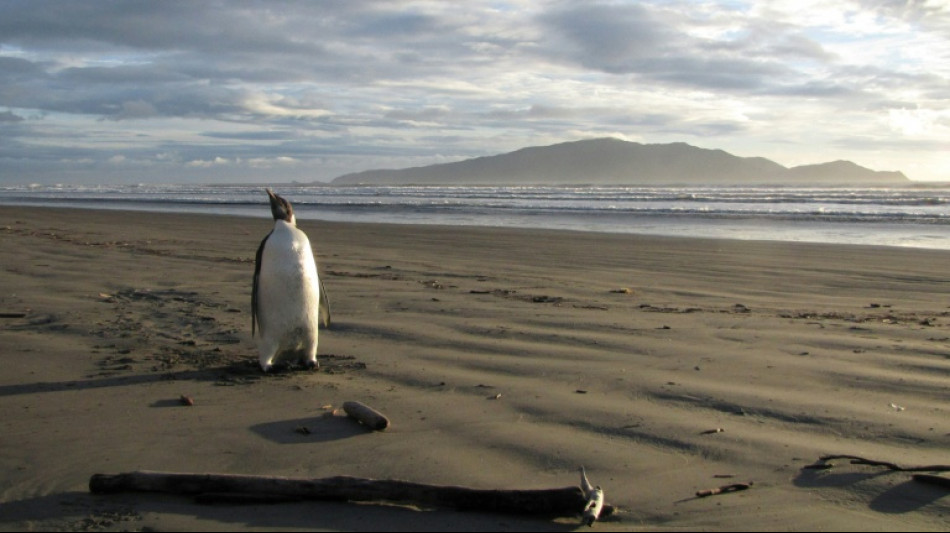
Ice melt threatens emperor penguins during annual moult: researchers / Photo: © DEPARTMENT OF CONSERVATION/AFP

 IR-MED and Dice Technologies Announce collaboration to Evaluate and Advance Pressure-Injury Prevention Platform in Japan

 Watts, Pitt, Cruz to light up Spain's top film festival

 Sweden expels Iran embassy employee over anti-Jewish threats

 Toogood Gold's Table Mountain Sits in the Shadow of a Nevada Gold Rush

 MEXC July–August Security Report: 38.66M USDT in Risk Funds Intercepted, Futures Insurance Fund Hits 792M USDT

 'Breathing toxin every day': Indonesians choked by haze feel helpless

 Stocks edge higher ahead of US Fed rate call

 Philippines ex-leader Duterte makes first in-person ICC appearance

 2027 Formula One calendar includes Monaco sprint race

 Palestinians are the real victims, Thunberg tells Ed Sheeran

 Hashim Thaci: From 'George Washington of Kosovo' to Hague convict

 Amnesty says Iran committed 'crimes against humanity' in crackdown on 2022 protests

 EU to ban social media for under 13s, curb access until 15

 Philippines ex-leader Duterte makes first appearance at ICC

 EU chief pitches 'associate member' status for Canada

 English village votes to 'secede' from UK over asylum centre plan

 Wildfires push endangered Sumatran elephants to brink: Indonesian NGO

 Stocks head higher as traders prepare for Fed decision

 English village votes to 'secede' from UK over asylum centre

 Hong Kong unveils plan to align economy with China's goals

 Brazilian voters the latest to eye Bukele security model with envy

 EU chief hosts Canada's Carney in push to 'deepen' alliance

 EU chief to unveil social media, gaming curbs for under-15s

 Saudi says Houthis target Mecca, warn of 'red line'

 Asian stocks stutter as traders prepare for Fed decision

Emperor penguins shed all their feathers once a year, a precarious ritual that may have become deadly as climate change pushes them into shrinking patches of Antarctic sea ice, researchers said Wednesday.
The flightless birds moult during summer, relying on stored fat to survive for several weeks until their waterproof coat grows back so they can swim and hunt in icy waters again.
Researchers from the British Antarctic Survey, analysing seven years of satellite images, accidentally discovered several moulting colonies along the extremely remote coastline of an area known as Marie Byrd Land.
As sea ice melted, the penguins were forced onto smaller spaces in increasingly large and tightly packed groups, the UK polar research organisation said in a statement.
In 2025, only 25 small groups of penguins were visible in the satellite images, it said. Prior to 2022, more than 100 groups had been spotted in the same region.
"While we don't know for sure what happened to those penguins, we know they can find new suitable breeding sites after ice loss, so it's possible they have established new moulting sites elsewhere," said Peter Fretwell, lead author and mapping expert at the British Antarctic Survey.
"But also it's possible that huge numbers of penguins perished after entering the Southern Ocean before they had replaced their waterproof feathers," Fretwell said.
"If this has happened, the situation for emperors as a species is even worse than we thought."
The researchers said that if emperor penguins are forced into the ocean before their feathers are replaced, they face exhaustion from increased energy use, hypothermia and increased risk from predators.
- Ice at record low -
Emperor penguin populations have shrunk by almost a quarter as global warming transforms their icy habitat, the British Antarctic Survey said in research published last year.
During the January-March Antarctic summer, emperor penguins from the Ross Sea in West Antarctica migrate as much as 1,000 kilometres (620 miles) to Marie Byrd Land to moult on stable sea ice, the researchers said Wednesday.
It is one of the few areas that historically retains its fast ice -- sea ice attached to the coast -- throughout the year.
The moulting process takes about four to five weeks and the penguins cannot go in the freezing water during that time.
The extent of Antarctic Sea ice fell to record lows between 2022 and 2024, accompanied by a drastic decrease in fast ice, the British Antarctic Survey said.
In the region they observed, sea ice coverage fell from a 50-year average of 500,000 square kilometres -- roughly the size of Spain -- to 100,000 square kilometres in 2023. Only 2,000 square kilometres of fast ice were left near the coast.
During those years, the sea ice broke before the penguins had finished moulting, raising fears that many may not have survived, the scientists said.
The survey's previous study found that some emperor penguin colonies lost all their chicks in recent years as the ice broke, plunging hatchlings into the sea before they were old enough to cope with the freezing ocean.
At current rates of warming, there is a 45 percent chance the species will become extinct by the turn of the century, the survey said.
K.Hofmann--VB