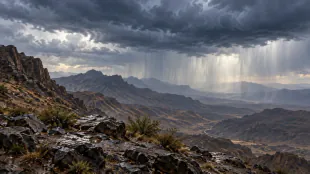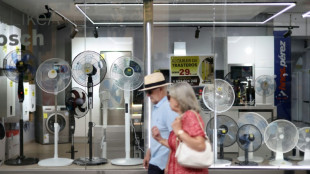
World not ready for rise in extreme heat, scientists say / Photo: © AFP

 IR-MED and Dice Technologies Announce collaboration to Evaluate and Advance Pressure-Injury Prevention Platform in Japan
 Watts, Pitt, Cruz to light up Spain's top film festival
 Sweden expels Iran embassy employee over anti-Jewish threats
 Toogood Gold's Table Mountain Sits in the Shadow of a Nevada Gold Rush

 MEXC July–August Security Report: 38.66M USDT in Risk Funds Intercepted, Futures Insurance Fund Hits 792M USDT

 'Breathing toxin every day': Indonesians choked by haze feel helpless

 Stocks edge higher ahead of US Fed rate call

 Philippines ex-leader Duterte makes first in-person ICC appearance

 2027 Formula One calendar includes Monaco sprint race

 Palestinians are the real victims, Thunberg tells Ed Sheeran

 Hashim Thaci: From 'George Washington of Kosovo' to Hague convict

 Amnesty says Iran committed 'crimes against humanity' in crackdown on 2022 protests

 EU to ban social media for under 13s, curb access until 15

 Philippines ex-leader Duterte makes first appearance at ICC

 EU chief pitches 'associate member' status for Canada

 English village votes to 'secede' from UK over asylum centre plan

 Wildfires push endangered Sumatran elephants to brink: Indonesian NGO

 Stocks head higher as traders prepare for Fed decision

 English village votes to 'secede' from UK over asylum centre

 Hong Kong unveils plan to align economy with China's goals
 Brazilian voters the latest to eye Bukele security model with envy

 EU chief hosts Canada's Carney in push to 'deepen' alliance

 EU chief to unveil social media, gaming curbs for under-15s

 Saudi says Houthis target Mecca, warn of 'red line'

 Asian stocks stutter as traders prepare for Fed decision

Nearly 3.8 billion people could face extreme heat by 2050 and while tropical countries will bear the brunt cooler regions will also need to adapt, scientists said Monday.
Demand for cooling will "drastically" increase in giant countries like Brazil, Indonesia and Nigeria, where hundreds of millions of people lack air conditioning or other means of beating the heat.
But even a moderate increase in hotter days could have a "severe impact" in nations not used to such conditions like Canada, Russia and Finland, said scientists from the University of Oxford.
In a new study, they looked at different global warming scenarios to project how often people in future might experience temperatures considered uncomfortably hot or cold.
They found "that the population experiencing extreme heat conditions is projected to nearly double" by 2050 if global average temperatures rise 2C above preindustrial times.
But most of the impact would be felt this decade as the world fast approaches the 1.5C mark, the study's lead author Jesus Lizana told AFP.
"The key take away from this is that the need for adaptation to extreme heat is more urgent than previously known," said Lizana, an environmental scientist.
"New infrastructure, such as sustainable air conditioning or passive cooling, needs to be built out within the next few years to ensure people can cope with dangerous heat."
Prolonged exposure to extreme heat can overwhelm the body's natural cooling systems, causing symptoms ranging from dizziness and headaches to organ failure and death.
It is often called a silent killer because most heat deaths occur gradually as high temperatures and other environmental factors work together to undermine the body's internal thermostat.
Climate change is making heatwaves longer and stronger and access to cooling -- especially air conditioning -- will be vital in future.
- 'Dangerously underprepared' -
The study, published in the journal Nature Sustainability, projected that 3.79 billion people worldwide could be exposed to extreme heat by mid century.
This would "drastically" increase energy demand for cooling in developing nations where the gravest health consequences would be felt. India, the Philippines and Bangladesh would be among biggest populations impacted.
The most significant change in "cooling degree days" -- temperatures hot enough to require cooling, such as air conditioning or fans -- were projected in tropical or equatorial countries, particularly in Africa.
Central African Republic, Nigeria, South Sudan, Laos and Brazil saw the biggest rise in dangerously hot temperatures.
"Put simply, the most disadvantaged people are the ones who will bare the brunt of this trend our study shows for ever hotter days," urban climate scientist and research co-author Radhika Khosla told AFP.
But wealthier countries in traditionally cooler climates also "face a major a problem -- even if many do not realise it yet", she added.
Countries like Canada, Russia and Finland may experience steep drops in "heating degree days" -- temperatures low enough to require indoor heating -- under a 2C scenario.
But even a moderate rise in hotter temperatures would be felt more acutely in countries not designed to withstand heat, the authors said.
In these countries, homes and buildings are usually constructed to maximise sunshine and reduce ventilation, and public transport runs without air conditioning.
Some cold-climate nations may see a drop in heating bills, Lizana said, but over time these savings would likely be replaced by cooling costs, including in Europe where air conditioning is still rare.
"Wealthier countries cannot sit back and assume they will be OK -– in many cases they are dangerously underprepared for the heat that is coming over the next few years," he said.
L.Wyss--VB