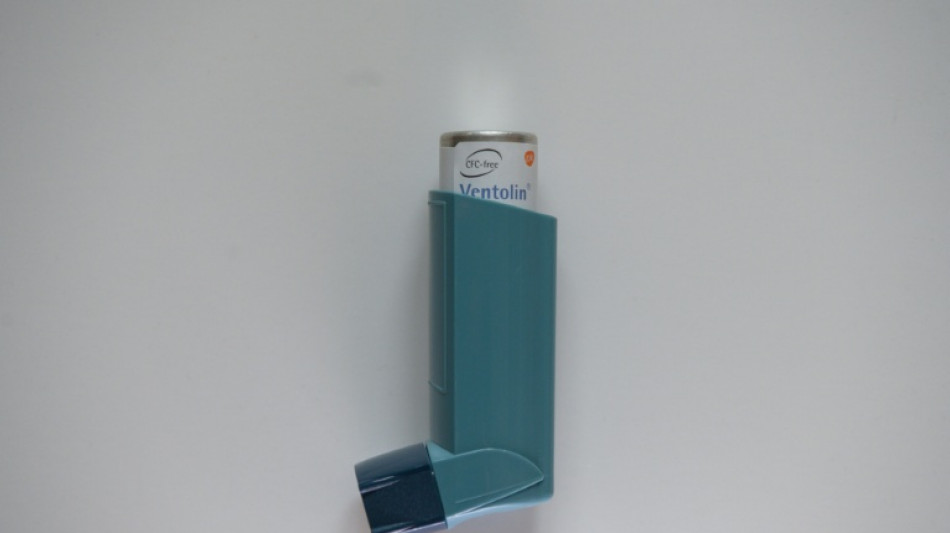
Common inhalers carry heavy climate cost, study finds / Photo: © AFP/File

 BASIS.pro Expands On-Chain Infrastructure with XDC Network Partnership and Zypher DAO as Auto Earn Goes Live

 Samson relishing battle with teen star Sooryavanshi for India spot

 Pickle-flavoured tart? AI inspires Japan's convenience stores

 Macau holds first closed-door national security trial

 Bank of Japan set to raise rates under pressure from inflation, US

 Zverev, Shelton back on court for Davis Cup qualifiers

 Peace is a 'dangerous' word in Russian city heading to polls

 Meta chief pushes back on AI slowdown calls

 'Resident Evil' film brings video game's ethos to the big screen

 Court orders N. Korea pay Seoul $32.5 mn for blowing up office
 US military buildup in Palau stirs war fears

 US Fed to deliver rate decision with markets betting on hike
 Saudi, Egypt demand open Red Sea as Riyadh vows response to Houthi attacks

 Capitals say hockey star Ovechkin 'was asked' to film Putin ad

 Spurs in 'tough moment' after League Cup exit as De Zerbi says sorry

 Arteta salutes 'unbelievable' Dowman after Arsenal's teen star sinks Ipswich

 Empty seats as schools reopen in Venezuela's quake-hit Guaira

 Messi set for Argentina farewell in Benin friendly

 Ton-up Brook leads from the front as England hammer Sri Lanka in 1st T20

 AI giants pursue self-regulation as safety fears mount

 Argentina begin life after Messi with Bolivia friendly

 Helen Mirren delves into Patricia Highsmith's mind in 'A Talent for Murder'

 Sanders, Bannon warn of AI dangers in rare US left-right alignment

 US Senate crypto bill collapses amid partisan deadlock

 Raptors confirm Leonard return after Clippers salary cap scandal

The inhalers people depend on to breathe are also warming the planet, producing annual emissions equivalent to more than half a million cars in the United States alone, researchers said Monday in a major new study.
Using a national drug database, researchers at the University of California, Los Angeles and Harvard analyzed global warming pollution from three types of inhalers used to treat asthma and chronic obstructive pulmonary disease (COPD) between 2014 and 2024.
The study, published in the Journal of the American Medical Association, found that inhalers used by US patients with commercial insurance and the government-run programs Medicaid and Medicare generated 24.9 million metric tons of carbon dioxide equivalent over the decade.
Metered-dose inhalers, or "puffers," were by far the most damaging, accounting for 98 percent of emissions. They use pressurized canisters containing hydrofluoroalkane (HFA) propellants -- potent greenhouse gases -- to deliver medication.
By contrast, dry powder and soft mist inhalers don't use propellants. The former rely on a patient's breath to release medicine, and the latter turn liquid into a fine spray -- making both far less harmful to the planet.
"Five hundred and thirty thousand cars on the road each year is a lot, and I think this is a really important topic because it's fixable -- there are easy ways to reduce emissions," lead author William Feldman, a pulmonologist and researcher at UCLA, told AFP.
Medically, only a small fraction of patients require metered-dose inhalers.
Very young children need spacers -- valved chambers that help deliver medicine to the lungs -- and these only work with metered-dose devices. Frail older adults with weak lungs may also need puffers because they can't generate enough inhalation force.
"But the vast majority of people could use dry powder or soft mist inhalers," Feldman said, noting that countries such as Sweden and Japan use alternative inhalers without any loss in health outcomes.
- Insurance barriers -
The slower US uptake of greener inhalers, he added, stems from insurance and market barriers.
A dry-powder version of albuterol, the most commonly used inhaler drug, exists but is often not covered by insurance, making it more expensive. Another drug, budesonide-formoterol, is widely sold in dry-powder form in Europe, which is not available in the United States.
Feldman emphasized that the goal of the research is not to blame patients but to highlight the need for policy and pricing reform.
"We absolutely do not want to stigmatize patients with asthma and COPD," he said.
"I think it's incumbent upon us as a society to get those medications to the patients in a sustainable way, and that ultimately falls to the highest levels."
A related JAMA commentary authored by Alexander Rabin of the University of Michigan and others echoed that insurers and policymakers must ensure lower-emission inhalers are affordable and accessible for all.
They warned that several new low-global-warming metered-dose inhalers are expected to launch in the US as high-priced brand-name products, "raising the risk that patients without robust insurance coverage...could be left behind."
K.Sutter--VB