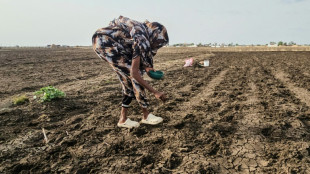
Crops under threat as surprise March heatwave hits Central Asia: study / Photo: © AFP

 'His feet are his pillars': Nepal para swimmer gives all for Asian glory

 New Zealand moves to ban social media for under-16s

 Hyundai union back in wage talks after rare full-day strike

 Shein grapples with EU backlash, but clients keep coming

 Key facts about Chinese-founded fast-fashion giant Shein

 Shein to make market debut in Hong Kong in September

 Fils tops Tiafoe to claim first ATP Masters title in Cincinnati

 Gauff powers past Pegula to win Cincinnati WTA 1000 crown

 Ukraine backers gather as war escalates, air defence runs low

 Syria says Israel talks addressed de-escalation, staying out of Israel-Turkey tensions

 Tourism boom pushes limits of Athens air traffic control

 Liga holders Barcelona crush Elche, Atletico salvage Villarreal draw

 Spain's World Cup hero Torres saves PSG's blushes at Rennes

 Swiss forward Embolo joins Atlanta United

 Former cricket captains appeal to Pakistan over Khan health care

 Latest 'Spider-Man' tops American box office for 4th weekend

 Szoboszlai's last-gasp leveller rescues Liverpool in Newcastle draw

 Landfill collapse kills 30 in Guinea

 'Unbelievable' Cherki proves his point to Man City boss Maresca

 10-man Atletico snatch Villarreal draw as Alvarez returns

 Seville, Jefferson-Wooden roar to 100m wins at Silesia Diamond League

 VW chief warns carmaker's situation 'more than critical'

 England cricketer Carse under investigation after 'nightclub incident'

 McLaren's Norris wins Dutch GP after Verstappen crash

 Giroud scores as Lille give Davide Ancelotti winning start

A surprise heatwave hit Central Asia in March, a new study published Friday showed, putting in danger crops and water supply in a largely rural region already heavily affected by the impacts of climate change.
Temperatures across the month were up to 10 degrees Celsius (50 degrees Fahrenheit) hotter in the region than the pre-industrial average, according to World Weather Attribution, a coalition of scientists that studies the impact of climate change on extreme weather events, which conducted the research.
Climate change intensified the heatwave by about 4 degrees Celsius, the group said, though cautioned that figure "is likely an underestimate."
"This is a heatwave that didn't make headlines –- it happened in spring and in a region that isn't exactly known for blistering heatwaves," said Maja Vahlberg, a technical adviser at the Red Cross Red Crescent Climate Centre who took part in the study.
The research was conducted across the five Central Asian states of Kazakhstan, Kyrgyzstan, Tajikistan, Turkmenistan and Uzbekistan.
"Our heatwave studies often detect changes of 2 to 4 degrees Celsius (35-39 degrees Fahrenheit), so 10 degree Celsius is quite frankly bonkers," said Ben Clarke from Imperial College London.
"Hotter March temperatures are impacting agriculture harvests and access to water in Central Asia, as well as people's health," said Friederike Otto, co-head of World Weather Attribution.
The melting of thousands of glaciers is a major threat to people in the landlocked region, which already suffers from water shortages.
Between 14 and 30 percent of glaciers in the Tian-Shan and Pamir -- the two main mountain ranges in Central Asia -- have melted over the last 60 years, according to a report by the Eurasian Development Bank.
The heatwave coincides with a crucial agricultural season, when almonds, apricots and cherries bloom and wheat is sowed.
Around half of all workers in Tajikistan and Uzbekistan are employed in agriculture, which makes up one-fifth of the region's economy.
In particularly hot spots, temperatures hit 30 degrees Celsius -- highly unusual for March.
Central Asia is typically characterised by exceptionally hot summers and harsh, cold winters.
Climate scientists said early heatwaves in the region would likely continue, seeing it as a trend rather than a one-off event.
"We should expect events like this often," Clarke told AFP during an online briefing.
O.Schlaepfer--VB