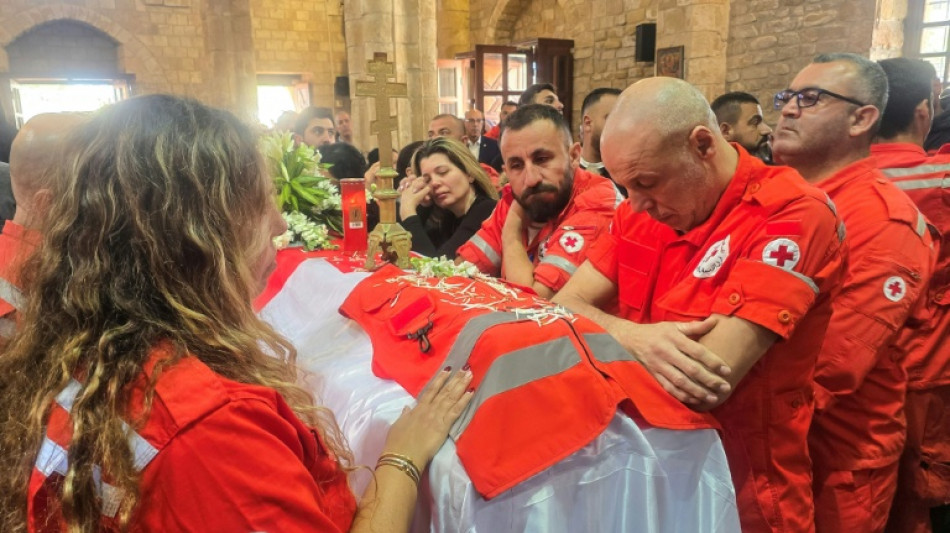
Southern Lebanon paramedics risk deadly Israeli strikes to do their work / Photo: © AFP

 South Korean leader says told Trump sanctions on North are 'ineffective'

 Stocks rally falters, oil rises as US-Iran talks postponed

 Indonesia to capture last-known wild Bornean rhino for IVF
 USA, Australia eye World Cup knockout rounds, Brazil in action

 Iran to lodge complaint with FIFA over World Cup restrictions

 New Zealand minister defends fishers after two orcas killed in net

 Seoul record leads most Asian markets higher, crude extends losses

 Burnham wins key UK poll, paving way for bid to challenge PM Starmer

 'Pico' Lopes -- Cape Verde defender's journey from Ireland to World Cup
 'Pretty special': captains eye Super Rugby glory in clash of top seeds

 Ivory Coast's Diomande living World Cup dream, dealing with tragedy

 Australia seek 'respect' from US amid World Cup 'layup' row

 Japan doctor-turned-author moots amputations to ease care crunch

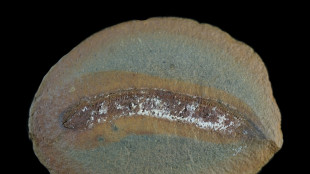 Fossils challenge assumptions on how animals adapted to land
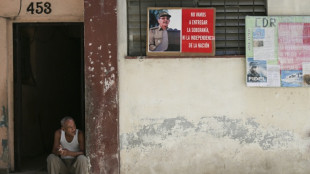
 Canada romp to first World Cup win, Switzerland thump Bosnia
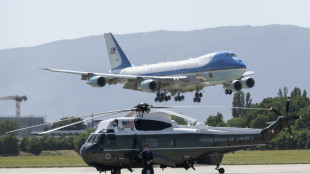
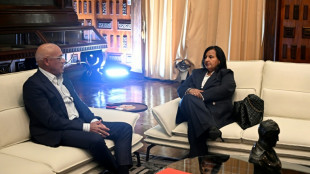 Venezuela govt, opposition hold US-backed talks on democratic transition

 Horror injury overshadows Canada's first World Cup win

 Swiss wunderkind Manzambi scores 'childhood dream' brace

 Good US Open shots not good enough for 2-over Scheffler
 Subs send Swiss to World Cup rout of Bosnia-Herzegovina

 McIlroy pleased with reduced green speeds in US Open winds

 US stocks resume upward climb as dollar advances again after Fed outlook
 Stevens seizes US Open lead with McIlroy, Aberg one back
 'Big-game' Bellingham shows his worth for England at World Cup

 Vance warns Israel against criticizing US-Iran deal

Youssef Assaf was in a Lebanese Red Cross ambulance when it was targeted by an Israeli strike near Tyre, in southern Lebanon. The 35-year-old paramedic died of his wounds two days later.
"I was called around 10:30 pm and told that he was wounded and in the hospital," his wife, Jeanne d'Arc Boutros, told AFP from northern Lebanon, where she had fled to a relative's home.
"I knew my husband is strong and can endure. I didn't react at all -- I just kept praying and repeating in my heart that nothing bad would happen to him," the 32-year-old schoolteacher said.
But Assaf died within two days. He was one of 38 Lebanese healthcare workers killed in Israeli strikes since the start of the current war on March 2, according to the health ministry.
The ministry said he died from wounds caused by an Israeli strike on their ambulance "as they were carrying out a rescue mission" after a strike.
Boutros said that when she heard the news of his death "I don't know what happened to me. I collapsed on the ground and was convulsing".
"How can they wound or kill paramedics who are saving people? They are neither armed nor affiliated with any party," the mother of three children, including a four-month-old girl, said.
The head of the Lebanese Red Cross, Georges Kettaneh, told AFP that their teams operate in southern Lebanon only after notifying the Lebanese army and UN peacekeepers, and stressed the need to secure safe access for their paramedics on the ground.
He said the Red Cross had sent a letter to the foreign ministry to contact the UN "regarding the protection of medical teams" and securing safe access routes.
– 'They are not a target' –
The repeated strikes on healthcare workers have become a source of fear and anxiety for many of them, including Mona Abou Zeid, 59, who runs a hospital in the Nabatieh area in southern Lebanon.
"The situation is very difficult… There is continuous shelling," she said.
"We are afraid for our paramedics who move around to transport the wounded," she added.
The fears of healthcare workers intensified after 12 were killed on Saturday in an Israeli airstrike that targeted a medical centre in the town of Bourj Qalawiyah in southern Lebanon.
The centre belonged to the Islamic Health Authority (IHA), a civil defence organisation affiliated with Hezbollah, the organisation said.
It is not uncommon for Lebanese political parties and religious institutions to sponsor ambulance and healthcare associations.
Fatima Shoumar's husband, a nurse, was among those killed.
She said those killed were not "military people... these people were doctors, nurses, they help children".
The Israeli military has accused Hezbollah of "extensively using ambulances for military purposes," an accusation the Lebanese health ministry described as "a justification" for crimes "against humanity".
Ramzi Kaiss, a researcher at Human Rights Watch, said the Israeli military had not provided evidence that healthcare facilities or ambulances it attacked were being used for military purposes.
Kaiss told AFP that if the Israelis have evidence that ambulances are being misused, they "must issue a warning to cease this misuse and only attack after this warning goes unheeded".
Since March 2, the health ministry has said, there have been 53 attacks on paramedics, 13 on medical centres and 30 on ambulances.
"The pattern we're seeing today is eerily similar to what we saw unfold between October 2023 and November 2024," Kaiss said, "a period during which over 220 health workers were killed".
– 'No more red lines' –
Nasser Ajram, a paramedic for a local NGO in Sidon, was gripped by anxiety despite his determination to continue his humanitarian mission.
"The day before yesterday, they struck a centre. They killed doctors and nurses… there are no more red lines," he said.
Ajram, 57, has barely seen his family and grandchildren for two weeks.
"It seems there is no protection."
For Boutros, the loss was irreparable, and her four-year-old son was asking still when his father would come home.
"I always dreamed about how we would grow old together. I would tell him how he would become an old man and I would grow old too.
"He loved basketball, skiing, hunting and the sea. He loved helping people... he did a lot in his life, and then he left."
C.Bruderer--VB