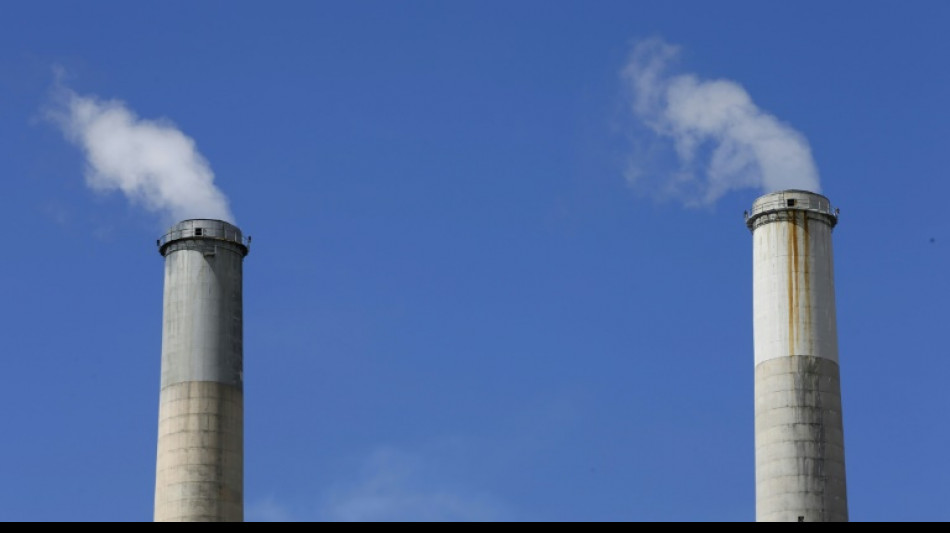
Carbon cuts 'miles short' of 2030 goal: UN / Photo: © GETTY IMAGES NORTH AMERICA/AFP/File

 Helen Mirren delves into Patricia Highsmith's mind in 'A Talent for Murder'

 Sanders, Bannon warn of AI dangers in rare US left-right alignment

 US Senate crypto bill collapses amid partisan deadlock

 Raptors confirm Leonard return after Clippers salary cap scandal

 Empty benches as schools reopen in Venezuela's quake-hit Guaira

 US judge rules Trump's name must remain off Kennedy Center

 Samson fires India to T20 series win over Afghanistan

 Carney sells Canada to global investors but says US ties still key

 Tiny English village holds 'independence' vote over asylum seeker housing

 Trump slams Supreme Court over 'horrible' mail-in ballot ruling

 Protesting shepherds, farmers clash with Romanian police

 Saudi, Egypt demand open Red Sea, as Riyadh vows to hit back against Houthis

 Foundation Lets Ledger Users Switch to Open Source Without Starting Over

 Canada remains 'most important partner' for US in 'key areas': Carney

 Carrick urges Man Utd to use derby pain as fuel against Brighton

 Turkey police detain dozens over pro-LGBTQ Istanbul rally

 'Kenya's moment' as Nairobi to host 2029 world athletics champs in African first

 China warns against space 'battlefield' after US says weapons deployed

 Denmark says Russian frigate fired flares at helicopter
 EU to propose curbing social media, online games for under 15s

 FX Junction Reaches 40,600 Members and 26 Million Trades

 Prominent Greek neo-Nazi exits prison, vows return to politics

 'Obsessed': explosive state crime inquiry grips South Africa

 Sri Lanka's javelin champ returns to 'broken' welcome

 Lake Energy Secures $80 Million for U.S. Renewable Energy Expansion

Greenhouse gas concentrations in the atmosphere reached new record highs in 2023, the UN warned on Monday, with countries falling "miles short" of what is needed to curb devastating global warming.
Levels of the three main greenhouse gases -- heat-trapping carbon dioxide, methane and nitrous oxide -- all increased yet again last year, said the World Meteorological Organization, the United Nation's weather and climate agency.
Carbon dioxide was accumulating in the atmosphere faster than ever, up more than 10 percent in two decades, it added.
And a separate report by UN climate change found that barely a dent is being made in the 43 percent emissions cut needed by 2030 to avert the worst of global warming.
Action as it stands would only lead to a 2.6 percent reduction this decade from 2019 levels.
"The report's findings are stark but not surprising –- current national climate plans fall miles short of what's needed to stop global heating from crippling every economy, and wrecking billions of lives and livelihoods across every country," said UN climate chief Simon Stiell.
The two reports come just weeks before the United Nations COP29 climate summit in Azerbaijan, and as nations prepare to submit updated national climate plans in early 2025.
"Bolder" plans to slash the pollution that drives warming will now have to be drawn up, Stiell said, calling for the end of "the era of inadequacy".
- 'Alarm bells' -
Under the 2015 Paris Agreement, countries agreed to cap global warming at "well below" two degrees Celsius above average levels measured between 1850 and 1900 -- and 1.5C if possible.
But so far their actions have failed to meet that challenge.
Existing national commitments would see 51.5 billion tonnes of CO2 and its equivalent in other greenhouse gases emitted in 2030 -- levels that would "guarantee a human and economic trainwreck for every country, without exception," Stiell said.
As long as emissions continue, greenhouse gases will keep accumulating in the atmosphere, raising global temperatures, WMO said.
Last year, global temperatures on land and sea were the highest in records dating as far back as 1850, it added.
WMO chief Celeste Saulo said the world was "clearly off track" to meet the Paris Agreement goal, adding that record greenhouse gas concentrations "should set alarm bells ringing among decision-makers".
"CO2 is accumulating in the atmosphere faster than at any time during human existence," the report said, adding that the current atmospheric CO2 level was 51 percent above that of the pre-industrial era.
- Sea levels 65 feet higher -
The last time the Earth experienced a comparable concentration of CO2 was three to five million years ago, when the temperature was two to three Centigrade warmer and the sea level was 10 to 20 metres (65 feet) higher than now, it said.
Given how long CO2 lasts in the atmosphere, current temperature levels will continue for decades, even if emissions rapidly shrink to net zero.
In 2023, CO2 concentrations were at 420 parts per million (ppm), methane at 1,934 parts per billion, and nitrous oxide at 336 parts per billion.
CO2 accounts for about 64 percent of the warming effect on the climate.
Its annual increase of 2.3 ppm marked the 12th consecutive year with an increase greater than two ppm -- a streak caused by "historically large fossil fuel CO2 emissions in the 2010s and 2020s", the report said.
Just under half of CO2 emissions remain in the atmosphere, while the rest are absorbed by the ocean and land ecosystems.
Climate change itself could soon "cause ecosystems to become larger sources of greenhouse gases", WMO deputy chief Ko Barret warned.
"Wildfires could release more carbon emissions into the atmosphere, whilst the warmer ocean might absorb less CO2. Consequently, more CO2 could stay in the atmosphere to accelerate global warming.
"These climate feedbacks are critical concerns to human society."
A.Ammann--VB