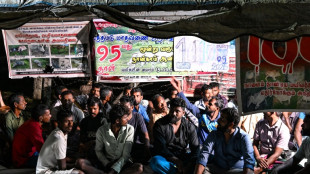
'Welcome relief': Asia producers hail EU deforestation law delay / Photo: © AFP/File

 Trump Signals Willingness to Work With Democrats After Midterm Defeat

 Qatar media bodies discuss support for humanitarian initiatives

 No. 22 UCLA defeats No. 5 Arizona 84-75 despite Kharchenkov's 38 points

 Vessel operator seeks witnesses after Vancouver grounding

 US Air Force deploys F-16 fighters to remote Aleutian base for readiness drill

 Bezos grant helps Seattle nonprofit move thousands of families toward housing

 Shrini Srivastava joins crew of Varanasi-Delhi Vande Bharat Sleeper service

 Nearly Half of Australian Workers Overqualified, Survey Finds

 RBI eases export-declaration compliance for individual service exporters

 India proposes more import entry points for drugs and medical devices

 Derek Tierney Outlines Ten-Year Strategy for National Digital Health System

 NBC’s Steve Kornacki Reveals Tech Habits Ahead of Midterm Elections

 India and Israel oppose UN draft on regional conventional arms control

 BLS Polymers shares open 65.3% above IPO price

 Capital-markets shares rally as Motilal Oswal and Angel One lead gains

 Latino Voters Defy ICE Fears, Turn Out in Record Numbers for Midterms

 ITC shares rise as analysts anticipate gradual cigarette-business recovery

 Reliance rally puts historical one-year return pattern in focus

 Kuwait edges Oman 1-0 in veterans Gulf Cup in Doha

 Saudi Aramco quarterly profit climbs 34.6% amid elevated oil prices
Producers from Malaysia's palm oil industry to Vietnam's coffee sector on Thursday welcomed a European Union decision to delay implementation of its anti-deforestation rules.
The year-long delay triggered immediate outcry from environmental groups, but the legislation had faced substantial pushback from many governments and industries.
They criticised the law, which intended to prevent the import of products that drive deforestation, for confusing rules and complex documentation requirements that they said would particularly burden small-scale farmers.
The EU's decision to delay was a relief, said Trinh Duc Minh, chair of the Buon Ma Thuot Coffee Association.
"The extension of the timeline is necessary and reasonable," he told AFP, though he noted coffee prices that rose as companies stockpiled before the deadline might now drop.
Nguyen Xuan Loi, head of Vietnamese coffee exporter An Thai Group, also hailed the news as a "positive move".
"In reality, Vietnam has been strictly managing deforestation issues," he told AFP.
"There are hardly any violations anymore."
Global Forest Watch says Vietnam's primary forest loss has fallen from a peak in 2016, but the country still lost about 16,500 hectares in 2023, with commodity-driven deforestation a leading cause.
EU imports accounted for 16 percent of deforestation linked to global trade in 2017, according to WWF.
When the law was adopted in 2023 it was hailed as a major breakthrough to protect nature and the climate.
It requires exporters of cocoa, soy, timber, cattle, palm oil, rubber, coffee -- and items derived from those products -- to certify their goods were not produced on land deforested after December 2020.
- 'Welcome relief' -
Countries including Malaysia and Indonesia have vocally opposed the new rules and the chorus of criticism grew louder as the December implementation deadline neared, with Brazil and the United States among those voicing concern.
Malaysia's Palm Oil Council welcomed the proposed delay as a "victory for common sense".
The decision is a "welcome relief for all those businesses who highlighted the need for a delay," the body's head Belvinder Kaur Sron said.
"Malaysia has over the past two years consistently provided evidence... that the implementation date of 30th December 2024 was unworkable, and the EU systems were not ready," the council added in a statement.
It called for the EU to address outstanding demands, including exemptions for smallholders, clear benchmarking criteria and accepting Malaysia's sustainable palm oil standard.
In Indonesia, the country's leading palm oil association also welcomed the delay.
"Our calls have been listened to," said its chairman Eddy Martono, who also urged the EU to accept Indonesian sustainability standards and recognise its anti-deforestation efforts.
Palm oil is one of Indonesia's top commodity exports, but also a key driver of deforestation.
The country lost nearly 300,000 hectares of primary forest in 2023, an uptick from the previous year, though still down from the 2016 peak, according to Global Forest Watch.
Indonesian environmentalists warned that the EU delay was likely to mean more unchecked deforestation.
"We can't imagine how much more land-clearing or deforestation the one-year delay could cause in West Kalimantan and other places like Papua," said Uli Arta Siagian at Indonesian environmental group WALHI.
Uli acknowledged challenges in implementing the rules, but said there was no guarantee a year-long delay would fix those.
"It should have been implemented, and then the EU could see what needs to be corrected," she told AFP.
"For us, this decision is disappointing."
L.Stucki--VB