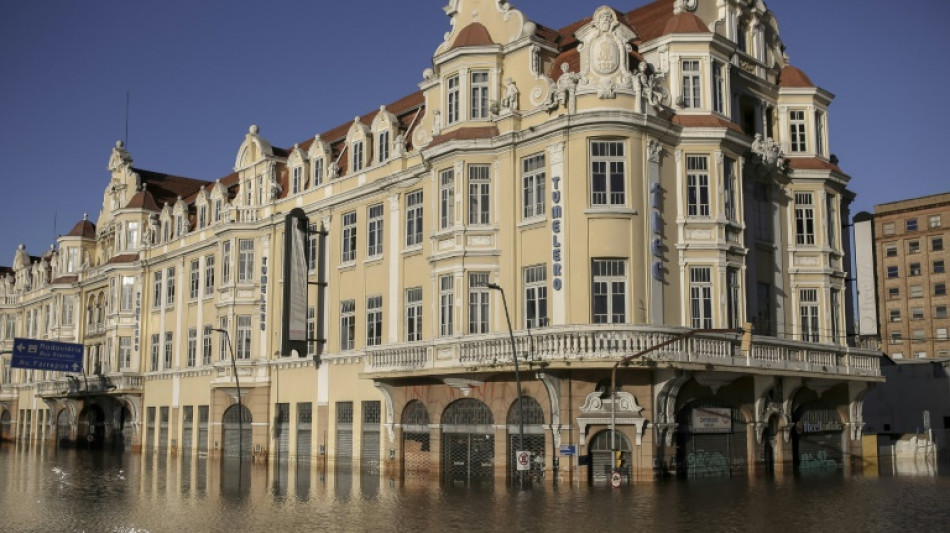
Brazil's Porto Alegre: a flood disaster waiting to happen / Photo: © AFP

 BingX Evolves into a Multi-Asset Trading Platform, Connecting Users to Global Opportunities

 Flick supporting 'self-confident' Yamal Ballon d'Or bid

 As Ballon d'Or vote nears, stars campaign for the award

 Markets on edge as US Fed meets to tackle high inflation

 International Trading Institute Expands Professional Trader Development Beyond the Master’s in Trading

 Nairobi to host 2029 world athletics championships in African first

 Ukraine winemakers defy war to make a splash at home

 Prominent Greek neo-Nazi exits prison, vows return to politics: AFP

 Saudi Arabia vows to respond 'firmly' to Houthi attacks

 'We unleashed the beast': the world's fears and hopes about AI

 Carragher sees Manchester City’s winning start as challenge to Arsenal

 Oasis fans weigh ticket costs and reunion memories ahead of 2027 tour

 EastEnders previews Kat’s grief after Zoe’s death

 US military confirms Iran war has led to munitions shortfall

 SkySail Strategies Outperforms Wall Street's 30-Year Risk Standard With Proprietary AI Inference Model

 Canada ends refugee family sponsorship exemption over integrity concerns

 Berlin's run-down public spaces at heart of election campaign

 Ribeiro and Richie among celebrity birthdays for September 20–26

 Bob Mackie, costume designer for Cher and Madonna, dies aged 87
 Mahomes makes triumphant return as Chiefs rout Broncos 31-10

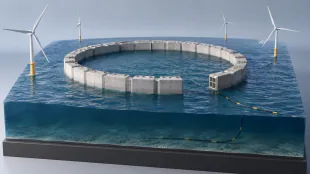 Belgium completes outer structure of offshore energy island

 Video documents rescue of injured US airman from Iran

 Asian Games: Bigger than Olympics, young stars and a cruise ship

 Asian Games set for liftoff but will have everyone have a bed?

 Most markets drop as oil extends gains ahead of expected US rate hike

Porto Alegre, the Brazilian metropolis left submerged after torrential rains, had been lulled into a "false sense" of security by a vast but aging system of flood defenses, an urban drainage engineer told AFP.
Leomar Teichmann said a network of dikes, levees and a massive wall was meant to protect about 40 percent of the capital city of Rio Grande do Sul state in southern Brazil, where 150 people have died and hundreds of thousands were forced from their homes.
Teichmann is an engineering consultant and former deputy director of water and sewerage services for Porto Alegre, a city of 1.4 million people on the banks of the Guaiba estuary.
He told AFP he had already warned in 2019 that the city was at risk.
- What does system consist of? -
"The system was designed after floods in 1967 and built in the 1970s. It includes about 65 kilometers (40 miles) of dykes and a concrete wall of 2.67 km, as well as 14 floodgates and 22 storm water pumping stations.
"It was a simple system that seemed functional, since it guaranteed the protection of the urbanized part of Porto Alegre.
"However, it was never tested in practice until November 2023, because it was only on this occasion that the level of the Jacui River exceeded three meters (10 feet), which is the level of the Maua wall," leading to flooding, he explained.
"In other words, the system stood for 51 years without the water of the Jacui River ever touching the wall."
- Why did it fail with latest floods? -
"Gate Number 14 buckled under the great pressure of the water and began to leak with great volume and speed.
"The amount of water was so great that the nearby pumping stations were quickly flooded, causing the pumps to shut down.
"The flooding caused by the gate failure was so rapid that the entire region was flooded in a few hours.
"This flood eventually caused a power outage in the flooded areas, and as a result, all the pumping stations north of the Gasometer Plant stopped working," he said, referring to an out-of-service power plant.
"There were several failures in sequence. In about 24 hours, the water level on either side of the system was exactly the same."
- What were consequences of these failures? -
"Already in 2019, I stated that the protection system installed in Porto Alegre gave the population a false sense of protection and security, because there was no way to contain water in case of failure of any of the elements that make up this system.
"It is an old system, with many points subject to failure and requiring high investments in operation and maintenance.
"Much is said about Porto Alegre, but this same type of flood protection system was built in Canoas, Sao Leopoldo and Novo Hamburgo (other municipalities in the state) where the system was also overwhelmed by the water level.
"In all these cities the water very quickly invaded areas that should have been protected and caused greater tragedies than if the system did not exist."
Teichmann explained that water spilling over the dikes moved much faster than rising river levels.
"I'm not saying that dikes are useless, but with a flood of this size, as soon as the dikes were overcome by water, the speed with which water passed to the other side of these was much higher than if the dikes did not exist."
S.Leonhard--VB