'Hostage diplomacy': longstanding Iran tactic presenting dilemma for West / Photo: © AFP/File

 Sabalenka roars back to make Berlin WTA semis
 Narvaez takes Swiss Tour third stage after 100km breakaway

 Europe swelters as temperature records tumble

 French mountain lodges worry over strained water supply

 Heatwave hits more than one in two people in France
 Zverev sets up Fritz semi at Halle Open

 Clark stumbles but still leads by two at US Open

 Ogura pulls off stunner to top Czech MotoGP practices
 Turkey bars public World Cup screening over university entrance exam

 Ebola spreading 'fast' in DR Congo, warns WHO

 The Sun may not engulf Earth after all, scientists say

 Russia signals slower rate cuts amid high Ukraine war spending

 Henry strikes as New Zealand lead England by 100 runs in 2nd Test
 Online threats, insults fuel S.Africa's anti-foreigner hate

 Clark completes first round with two-stroke US Open lead

 Italian FM cancels US visit over reported Trump comments

 Oil prices, shares steady after US-Iran talks postponed

 What did we learn from the hantavirus cruise ship scare?

 Arsenal will start Premier League title defence against Coventry

 'Alter-Ego': An Italian hospital's little robot carer

 French court confirms Moroccan football star Hakimi will stand trial for rape

 Deadly Philippines quake turns seabed into shore

 S. Korean leader says he told Trump sanctions on North are 'ineffective'

 No vaccine, conflict, mistrust: Ebola's return to DR Congo

 AI museum brings sights, sounds and smells of the rainforest

Iran since the Islamic revolution has employed the tactic of arresting Westerners in a bid to extract concessions from its foes, in a strategy of "hostage diplomacy" that has long presented Europe and the United States with a dilemma, observers say.
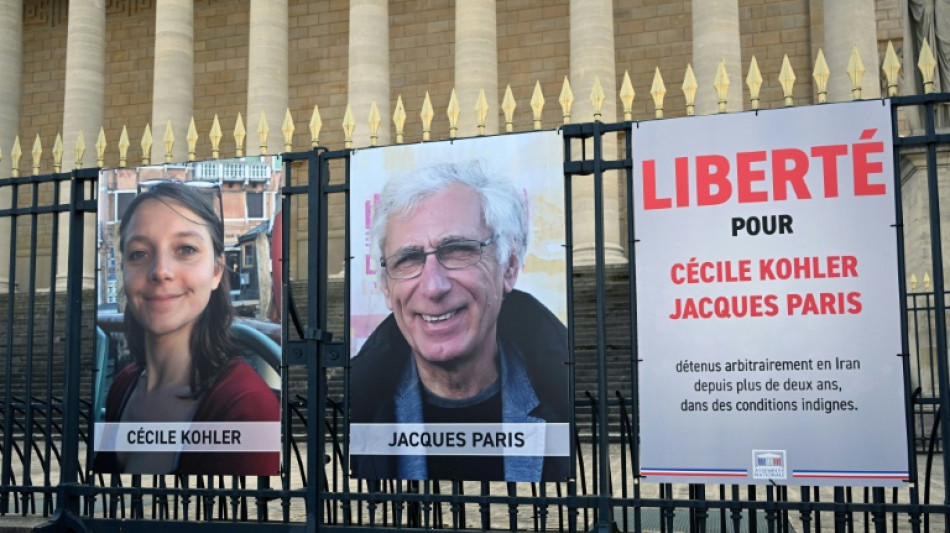
Iranian authorities this week released two French nationals, Cecile Kohler and Jacques Paris, from jail in Tehran after more than three years.
They had been convicted on charges of espionage but their families said they were innocent tourists unwittingly caught up in a wider game being played out between Tehran and the West.
France described the pair, as well as several other French nationals detained in Iran who were recently released, as "state hostages". Over the last years, dozens of Europeans and Americans have been detained in similar circumstances.
The strategy has long antecedents, going back to the seizure of the US embassy in Tehran in November 1979 by Islamist radicals in the wake of the revolution, which saw dozens of Americans held for 444 days into early 1981.
"Iran has pursued hostage diplomacy since the founding of the Islamic Republic in 1979," said Jason Brodsky, policy director of US-based think tank United Against Nuclear Iran.
"It uses hostages as pawns to extract concessions that it could not otherwise achieve from the United States and its allies," he added.
The Islamic republic denies it has any strategy of hostage taking and all foreigners jailed are convicted after due legal process.
- 'Not the only ones' -
Such concessions include unfreezing assets or the release of Iranian nationals convicted in the United States, Europe and elsewhere on charges such as sanctions violations, assassination plots, or terrorism, he said.
"What the Iranian regime is practising is state-sponsored hostage taking, also known as hostage diplomacy," added Daren Nair, a security consultant who has for years campaigned for detainees' releases worldwide.
"And the Iranian regime are not the only ones to do that. The Venezuelans do it, the Russians do it, the Chinese do it," he added.
For Clement Therme, an academic at France's Universite de Montpellier Paul-Valery, who closely follows the issue, the policy is "a pillar of Iranian foreign policy".
"Over time, there are arrests and releases, during periods of rapprochement and tension. But it's the intensity that varies, and the practice continues."
The release of Kohler and Paris, who have yet to be allowed to return to France, came after France freed on bail Iranian woman Mahdieh Esfandiari, detained in Paris on charges of spreading terror propaganda.
Tehran had explicitly linked the two cases, although the French foreign ministry has declined to comment on any deal.
- 'Piecemeal manner' -
The release of Western nationals detained in similar circumstances over the last years was often timed with Tehran receiving something in return after painstaking and ultra-secret diplomacy.
The cases of several British citizens, including dual national Nazanin Zaghari-Ratcliffe, were linked to a payment owed by the UK to Iran for tanks ordered by the ousted shah that were never delivered. That debt was eventually settled and Zaghari-Ratcliffe and two other Britons were released in 2022.
In 2023, five Americans held in Iran, including the US-Iranian businessman Siamak Namazi who had been imprisoned for eight years, were released in a scheme that saw $6 billion of Iranian assets unfrozen in South Korea.
The release of British-Australian academic Kylie Moore-Gilbert by Iran in 2020 came after Thailand freed three Iranian men jailed over a 2012 bomb plot.
But despite the recent releases, others remain held by Tehran, including Swedish-Iranian academic Ahmadreza Djalali, sentenced to death in 2017 on espionage charges his family vehemently rejects.
British couple Lindsay and Craig Foreman have been held in Iran since January on espionage charges after Iranian authorities seized the pair while they were on a round-the-world motorbike trip.
Brodsky said Europe and the United States should consider imposing a wholesale ban on travel to Iran by their nationals. But he acknowledged too that Washington and its allies had treated "this problem in a piecemeal manner" for too long.
"The US government should be working collectively with its allies to impose a range of multinational penalties on the Islamic Republic the moment any hostage from these countries is taken by the Iranian regime -- this includes sanctions and diplomatic isolation," he said.
T.Germann--VB