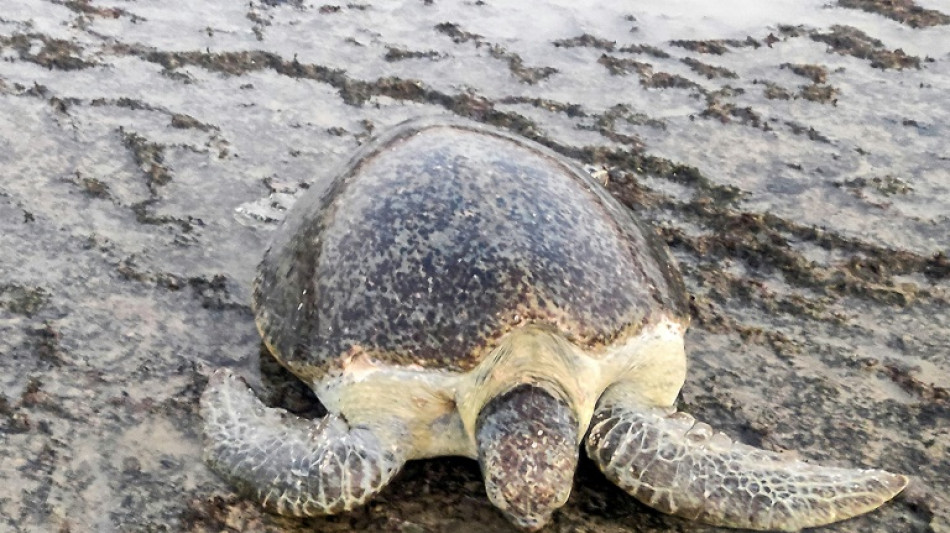
Warming beaches threaten Yemen sea turtles' future / Photo: © AFP

 Mahomes makes triumphant return as Chiefs rout Broncos 31-10

 Belgium completes outer structure of offshore energy island

 Video documents rescue of injured US airman from Iran

 Asian Games: Bigger than Olympics, young stars and a cruise ship

 Asian Games set for liftoff but will have everyone have a bed?

 Most markets drop as oil extends gains ahead of expected US rate hike
 Kate Beckinsale challenges assumptions about her beauty routine

 Sri Lanka's famed beach shack battles demolition

 Drone shot down by NATO over Lithuania

 Vserv targets ₹1,000 crore revenue by 2030 through AI expansion

 India prohibits bank fees on UPI payments up to ₹2,000

 Air India CEO summoned over alleged departure immigration lapse

 New Zealand agencies missed red flags in child kidnapping case: inquiry

 Brazil's Amazon defender Raoni has cancer

 HFCL expands planned fibre investment to ₹1,800 crore

 Emmy Awards begin as 'Widow's Bay' and 'The Pitt' vie for top prizes
 Himalayan glacier study warns of flood and water-supply risks

 Kuwait schools restore classroom routines after remote learning

 US designer Bob Mackie, known for Hollywood glamour, dies at 87

 BIS flags debt and profitability risks in AI-driven market rally

 Qatar Chamber and Maltese envoy consider business forum

 Spanish PM denies being blackmailed by Morocco

 Doha Islamic finance forum names AlRayan firms as co-lead partners

 Leeds thrash Newcastle to go third in the Premier League

 Zelensky says Ukraine ready for 'de-escalatory steps'

On a Yemeni beach, a sea turtle clambers ashore to lay eggs, which will likely be born female due to rising temperatures, creating a gender imbalance that brings the threat of local extinction.
With sands made hotter by climate change, eggs are rarely yielding male turtles, which require cooler temperatures during the incubation period.
Studies in several coastal regions of southern Yemen "have shown that there are 90 percent more female sea turtles than males", said Jamal Baouzir, director of the biodiversity department at the University of Aden.
The severe gender imbalance will continue until it brings about the complete extinction of sea turtles in Yemen "in the years to come", Baouzir said.
Environmental activist Hafiz Kelshat said the proportion of males had "decreased considerably" in recent years.
"Most baby turtles are female due to the change in temperature," he told AFP on a nesting beach in Mahra province, near the border with Oman.
This is especially the case in summer, when temperatures often top 31 degrees Celsius (88 degrees Fahrenheit) -- the point at which sea turtle eggs begin yielding females.
The gender imbalance is getting worse each year as longer periods of extreme heat hit the Arabian Peninsula, one of the world's hottest regions.
The problem is not unique to Yemen, wracked for nearly a decade by a devastating civil war which has created one of the world's worst humanitarian tragedies.
From the US state of Florida to Australia's Great Barrier Reef, male sea turtle numbers are dwindling due to climate change.
In 2018, US researchers found that rising temperatures meant most of the 200,000 green turtles in the northern Great Barrier Reef are female, compounding the threat of extinction.
- 'Busy with war' -
Yemen, wedged between the Red Sea and the Indian Ocean, boasts a rich variety of natural habitats and species, many of them found nowhere else in the world.
But its genetic diversity, and the potential for future tourism development it represents, are increasingly threatened by global warming.
Yemen ranks as one of the region's most climate-vulnerable countries, according to the Global Adaptation Initiative of the University of Notre Dame in the US state of Indiana.
Extreme heat and increasing rainfall variability leading to both drought and flash floods are among the challenges forecast for the Arabian Peninsula's poorest country.
Baouzir said that to tackle the deepening gender imbalance, authorities should create "a specialised technical team to monitor the turtles in their nesting places and place the eggs in appropriate incubators" to produce male offspring.
The provision of sun shields on beaches could also help reduce sand temperatures and boost the number of male hatchlings.
But environmental conservation has inevitably taken a back seat to the grinding civil war, which has killed hundreds of thousands of people and left the country's infrastructure in tatters.
"The current circumstances, of course, make it difficult to carry out" protection operations, Baouzir said.
An environment ministry official in the internationally-recognised government, which controls Mahra province along with much of the south, acknowledged that conservation efforts had suffered during the war with Iran-backed Huthi rebels.
"The authorities have worked on various plans including the creation of several reserves," Naif Ali bin Masaad said.
But they are "busy with the war against the Huthis and terrorist groups... so they do not assume their responsibilities" towards environmental protection, the official said.
L.Stucki--VB