Antarctic sea ice hits lowest winter maximum on record: US data / Photo: © GETTY IMAGES NORTH AMERICA/AFP

 Mahomes makes triumphant return as Chiefs rout Broncos 31-10

 Belgium completes outer structure of offshore energy island

 Video documents rescue of injured US airman from Iran

 Asian Games: Bigger than Olympics, young stars and a cruise ship

 Asian Games set for liftoff but will have everyone have a bed?

 Most markets drop as oil extends gains ahead of expected US rate hike

 Kate Beckinsale challenges assumptions about her beauty routine

 Sri Lanka's famed beach shack battles demolition

 Drone shot down by NATO over Lithuania

 Vserv targets ₹1,000 crore revenue by 2030 through AI expansion

 India prohibits bank fees on UPI payments up to ₹2,000

 Air India CEO summoned over alleged departure immigration lapse

 New Zealand agencies missed red flags in child kidnapping case: inquiry

 Brazil's Amazon defender Raoni has cancer

 HFCL expands planned fibre investment to ₹1,800 crore

 Emmy Awards begin as 'Widow's Bay' and 'The Pitt' vie for top prizes

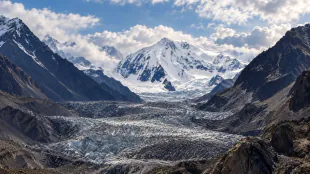 Himalayan glacier study warns of flood and water-supply risks

 Kuwait schools restore classroom routines after remote learning

 US designer Bob Mackie, known for Hollywood glamour, dies at 87

 BIS flags debt and profitability risks in AI-driven market rally

 Qatar Chamber and Maltese envoy consider business forum

 Spanish PM denies being blackmailed by Morocco

 Doha Islamic finance forum names AlRayan firms as co-lead partners

 Leeds thrash Newcastle to go third in the Premier League

 Zelensky says Ukraine ready for 'de-escalatory steps'

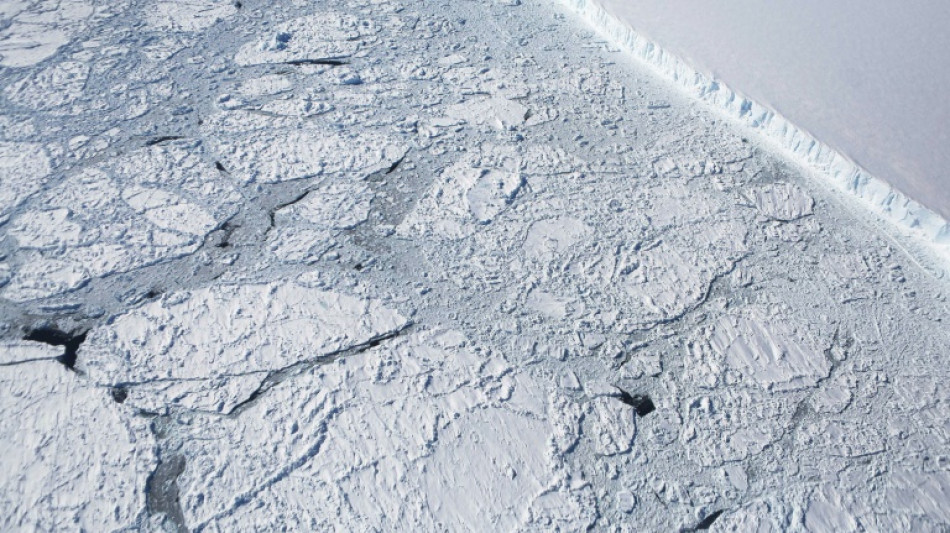
The sea ice around Antarctica likely had a record low surface area when it was at its maximum size this winter, a preliminary US analysis of satellite data showed Monday.
As the southern hemisphere transitions into spring, the US National Snow and Ice Data Center (NSIDC) said in a statement that Antarctic sea ice had only reached a maximum size of 16.96 million square kilometers (6.55 million square miles) this year, on September 10.
The ice pack typically reaches its largest size during the colder winter months, so the September 10 reading will likely remain this year's maximum.
"This is the lowest sea ice maximum in the 1979 to 2023 sea ice record by a wide margin," said the NSIDC, a government-supported program at the University of Colorado at Boulder.
At its high-point this year, the sea ice was 1.03 million square kilometers smaller than the previous record, roughly the size of Texas and California combined.
"It's a record-smashing sea ice low in the Antarctic," said NSIDC scientist Walt Meier.
He added that the growth in sea ice appeared "low around nearly the whole continent as opposed to any one region."
In February, at the height of the austral summer, the Antarctic sea ice pack had reached a minimum extent of 1.79 million square kilometers, also a record, according to the NSIDC.
The ice pack then grew back at an unusually slow pace, despite the onset of winter.
Meanwhile at the other end of the globe, where summer is drawing to a close, Arctic sea ice reached a low of 4.23 million square kilometers, the NSIDC said. It represents the sixth lowest minimum in 45 years of recordkeeping.
- Warming oceans -
For several decades, the Antarctic sea ice pack had remained stable, even expanding slightly.
But "since August 2016, the Antarctic sea ice extent trend took a sharp downturn across nearly all months" the NSIDC said.
There is debate among scientists over the cause of the shift, with some reluctant to establish a formal link with global warming. Climate models have struggled in the past to predict changes in the Antarctic ice pack.
The downward trend is "now thought to be linked to warming in the uppermost ocean layer," the NSIDC said.
"There is some concern that this may be the beginning of a long-term trend of decline for Antarctic sea ice, since oceans are warming globally."
Melting pack ice has no immediate impact on sea levels, as it forms by freezing salt water already in the ocean.
But the white ice reflects more of the Sun's rays than darker ocean water, so its loss accentuates global warming.
The loss of pack ice also exposes Antarctica's coastline to greater wave action, which could destabilize the freshwater ice cap and endanger coastal habitats. The melting land ice would cause a catastrophic rise in sea levels.
However the NSIDC notes a possibility that waves impacting the ice sheet may increase "accumulation near the coast, offsetting in part the threat of rising sea level."
R.Braegger--VB