Small islands take ocean protection case to UN court / Photo: © AFP

 Television's A-listers glitter on Emmys red carpet

 US Supreme Court blocks Trump mail-in ballot restrictions

 Dodgers clinch playoff berth in bid for third straight World Series

 Doomers and boosters: who's who in the AI wars

 GAC presents autonomous trucks and MONTX concepts at Hannover show

 EU extends Russia sanction deadline

 Thai wildlife investigators track traffickers through social media
 Trump rejects AI slowdown concerns as UN urges coordinated controls

 US judge postpones new visa rules for foreign students, journalists

 Higher wages draw migrant workers to Kashmir despite attacks

 Oil supply concerns and AI warnings weigh on global markets

 'I am the hoax buster': Trump rejects AI danger warnings
 Macklemore dropped from Ed Sheeran tour after 'free Palestine' speech

 Trump's son confirms Russian businessman paid for post-wedding festivities

 Betis beat winless Villarreal to go third

 Etihad capacity rises as war disruption weighs on annual earnings

 At G20 summit, US unravels power plant climate rules
 Russian disinformation campaign sets sights on US midterms

 England No 8 Pollock could move abroad or switch sports amid contract stand-off
 Canada makes pitch as safe place to invest in 'uncertain world'
 In-form Malen fires Roma to Serie A summit

 IOC visits Lyon amid leadership turmoil for 2030 Winter Olympics

 New York seizes 12 celeb deep-fake porn sites

 Jesse Eisenberg channels emotional intensity into 'The Debut'

 Alarm over AI grows as divided US Congress struggles to act
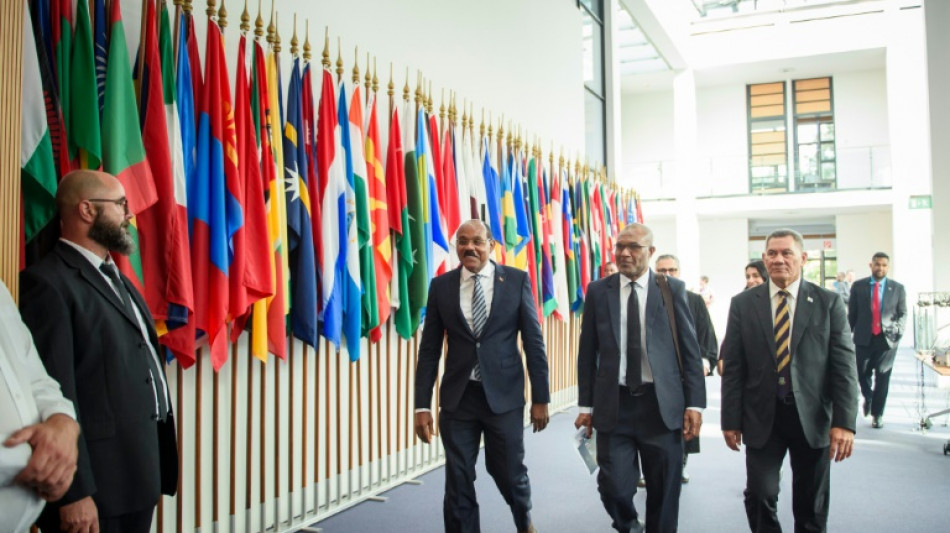
Leaders of nine small island states turned to the UN maritime court on Monday to seek protection of the world's oceans from catastrophic climate change that threatens the very existence of entire countries.
The island states are asking the International Tribunal for the Law of the Sea (ITLOS) to determine if carbon dioxide emissions absorbed by the oceans can be considered pollution, and if so, what obligations countries have to prevent it.
"This is the opening chapter in the struggle to change the conduct of the international community by clarifying the obligation of states to protect the marine environment," said the prime minister of Antigua and Barbuda, Gaston Browne.
"The time has come to speak in terms of legally binding obligations rather than empty promises that go unfulfilled," he told the court based in Hamburg, Germany.
The joint counsel representing the islands, Catherine Amirfar, said the point was to force countries to implement substantive measures against climate change.
"We're here to discuss what are the necessary, concrete, specific steps that they must take as a matter of law, not political discretion. That's key and... a big part of the answer," she told journalists.
Ocean ecosystems create half the oxygen humans breathe and limit global warming by absorbing much of the carbon dioxide emitted by human activities.
But increasing emissions can warm and acidify seawaters, harming marine life.
At the heart of the case is the international treaty UNCLOS that binds countries to preventing pollution of the oceans.
The UN treaty defines pollution as the introduction by humans of "substances or energy into the marine environment" that harms marine life.
But it does not spell out carbon emissions as a specific pollutant, and the plaintiffs argue that these emissions should qualify.
- Beyond 'charity' -
The push for climate justice won a big boost in March when the UN General Assembly adopted a resolution calling on the International Court of Justice to lay out nations' obligations on protecting the Earth's climate and the legal consequences they face for failing to do so.
The ICJ's advice is still pending but the action has opened up a new front to bind countries to pledges on reducing emissions.
The move at the UN had been led by Vanuatu, one of the island nations that brought Monday's case before the ITLOS.
Small islands like Vanuatu are particularly exposed to the impact of global warming, with seawater rises posing an existential threat.
"Just a few years -- this is all we have before the ocean consumes everything my people built across centuries," Tuvalu's Prime Minister Kausea Natano told the court.
"If international law has nothing to say about an entire country going underwater... then what purpose does it serve?" he said, pleading for a clear direction from the court.
Browne also voiced frustration at the attitude of some major nations when it comes to funding climate change mitigation or prevention.
When "large polluters contribute towards various funds, they believe it's an act of charity," he said at a press conference, adding that a successful outcome would tell them that "they have legal obligations".
- Marine heatwave -
Concrete measures, according to Vanuatu's attorney-general Arnold Loughman, could include halting deep-sea drilling for oil.
"It's time to come up with solutions and ways of stopping these countries from continuing to drill," he said.
Across the two-thirds of the planet covered by seas, nearly 60 percent of surface waters experienced at least one marine heatwave in 2022, according to the annual State of the Climate report led by scientists from the US National Oceanic and Atmospheric Administration.
This is 50 percent more than pre-industrial levels and "the highest in the modern atmospheric record and in paleoclimate records dating back as far as 800,000 years", according to the report, published this month.
The world's oceans set a new temperature record in August, with average sea surface temperatures reaching 21 degrees Celsius (69.8 Fahrenheit) for over a week, according to the EU's Copernicus Climate Change Service.
The other island states joining the ITLOS case are the Bahamas, Niue, Palau, St Kitts and Nevis, St Lucia, St Vincent and the Grenadines, while another 34 state parties will participate in the court hearing.
E.Gasser--VB