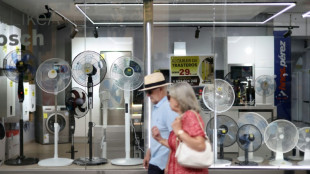
2023 likely to be hottest year on record: EU monitor / Photo: © AFP

 Television's A-listers glitter on Emmys red carpet

 US Supreme Court blocks Trump mail-in ballot restrictions

 Dodgers clinch playoff berth in bid for third straight World Series

 Doomers and boosters: who's who in the AI wars

 GAC presents autonomous trucks and MONTX concepts at Hannover show

 EU extends Russia sanction deadline

 Thai wildlife investigators track traffickers through social media

 Trump rejects AI slowdown concerns as UN urges coordinated controls

 US judge postpones new visa rules for foreign students, journalists

 Higher wages draw migrant workers to Kashmir despite attacks

 Oil supply concerns and AI warnings weigh on global markets

 'I am the hoax buster': Trump rejects AI danger warnings

 Macklemore dropped from Ed Sheeran tour after 'free Palestine' speech

 Trump's son confirms Russian businessman paid for post-wedding festivities

 Betis beat winless Villarreal to go third

 Etihad capacity rises as war disruption weighs on annual earnings

 At G20 summit, US unravels power plant climate rules

 Russian disinformation campaign sets sights on US midterms

 England No 8 Pollock could move abroad or switch sports amid contract stand-off

 Canada makes pitch as safe place to invest in 'uncertain world'

 In-form Malen fires Roma to Serie A summit

 IOC visits Lyon amid leadership turmoil for 2030 Winter Olympics

 New York seizes 12 celeb deep-fake porn sites

 Jesse Eisenberg channels emotional intensity into 'The Debut'

 Alarm over AI grows as divided US Congress struggles to act

2023 is likely to be the hottest year in human history, and global temperatures during the Northern Hemisphere summer were the warmest on record, the EU climate monitor said on Wednesday.
Heatwaves, droughts and wildfires struck Asia, Africa, Europe and North America over the last three months, with dramatic impact on economies, ecosystems and human health.
The average global temperature in June, July and August was 16.77 degrees Celsius (62.19 degrees Fahrenheit), smashing the previous 2019 record of 16.48C, the European Union's Copernicus Climate Change Service (C3S) said in a report.
"The three months that we've just had are the warmest in approximately 120,000 years, so effectively human history," C3S deputy director Samantha Burgess told AFP.
Last month was the hottest August on record and warmer than all other months except July 2023.
Climate breakdown has begun," said UN Secretary General Antonio Guterres.
"Scientists have long warned what our fossil fuel addiction will unleash," he added. "Our climate is imploding faster than we can cope, with extreme weather events hitting every corner of the planet."
Record-high global sea surface temperatures played a major role in stoking heat throughout the summer, with marine heatwaves hitting the North Atlantic and the Mediterranean Sea.
"Looking at the additional heat we have in the surface ocean, the probability is that 2023 will end up being the warmest year on record," Burgess said.
The average global temperature through the first eight months of 2023 is the second-warmest on record, only 0.01C below the benchmark 2016 level, the report added.
If the Northern Hemisphere has a "normal" winter, "we can almost virtually say that 2023 will be the warmest year that humanity has experienced," Burgess said.
- Warming oceans -
Oceans have absorbed 90 percent of the excess heat produced by human activity since the dawn of the industrial age, according to scientists.
This excess heat continues to accumulate as greenhouse gases -- mainly from burning oil, gas and coal -- build up in the Earth's atmosphere.
Excluding the polar regions, global average sea surface temperatures exceeded the previous March 2016 record every day this summer from July 31 to August 31.
The average ocean temperature has been topping seasonal heat records on a regular basis since April.
Warmer oceans are also less capable of absorbing carbon dioxide (CO2), exacerbating the vicious cycle of global warming as well as disrupting fragile ecosystems.
Antarctic sea ice remained at a record low for the time of year with a monthly value 12 percent below average, "by far the largest negative anomaly for August since satellite observations began" in the 1970s, C3S said.
Higher temperatures are likely to come: the El Nino weather phenomenon -- which warms waters in the southern Pacific and beyond -- has only just begun.
Scientists expect the worst effects of the current El Nino to be felt at the end of 2023 and into next year.
At the 2015 Paris climate summit, countries agreed to keep global temperature increases to "well below" 2C above pre-industrial levels, with an aspirational target of 1.5C.
A report by UN experts due this week will assess the world's progress in meeting the goal and will inform leaders ahead of a high-stakes climate summit in Dubai starting on November 30.
The so-called "Global Stocktake" is expected to show that countries are well behind meeting their commitments.
"Surging temperatures demand a surge in action. Leaders must turn up the heat now for climate solutions," said Guterres.
The C3S findings came from computer-generated analyses using billions of measurements from satellites, ships, aircraft and weather stations around the world.
Proxy data such as tree rings and ice cores allow scientists to compare modern temperatures with figures before records began in the mid-19th century.
L.Dubois--BTB