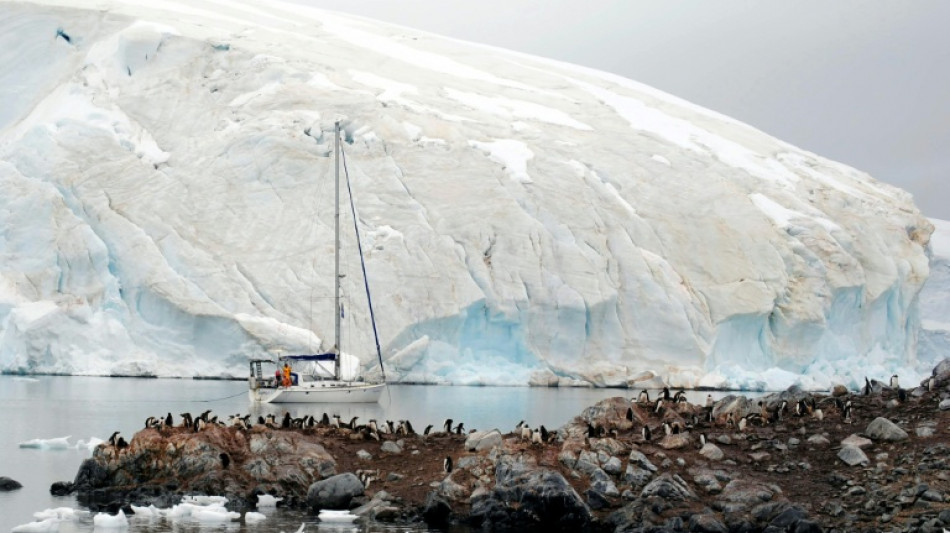
Bird flu ravaging Antarctic wildlife, scientist warns / Photo: © Chilean Antarctic Institute/AFP

 US accuses Cuba of sweeping spy campaign, aiding American left

 US stocks drop on latest Middle East fighting, tech earnings caution

 Louvre heist gallery to reopen to public on Wednesday

 World Cup champs Spain lap up adulation of a million on bus parade

 Canada faces one of its most intense fire seasons

 Mexican drug lord 'El Mayo' sentenced to life in US prison

 Spanish king hails World Cup heroes as celebration tour begins

 Mexican drug lord 'El Mayo' sentenced to life in prison

 Leasing firm SMBC orders 200 planes from Airbus and Boeing

 Zelensky faces deepening political crisis as protests dig in

 'Legendary' former Liverpool and England star Keegan dies aged 75

 Former Liverpool and England star Kevin Keegan dies aged 75

 Three things we learned from the Belgian Grand Prix

 Without Messi, Argentine team set for low-key homecoming

 Garcia departure leaves Belgium facing 'generational change'

 Scars of war linger on Syria's Saint Simeon monastery

 Plane carrying Spain's World Cup winning team lands in Madrid

 MEXC Launches 0-Fee Stock Futures Campaign With $5,000,000 SNDK Prize Pool

 Iran says fighting 'full-scale war' with US

 Swiss researchers hoard vast trove of NASA climate data

 Starmer 'proud' of achievements as Andy Burnham set to become new UK PM

 Hungary PM proposes chess great Judit Polgar for president

 Lara calls for celebration of 'father figure' Sobers

 Madrid awaits triumphant return of Spain's World Cup heroes

 Superb Spain worthy winners of World Cup dominated by superstar names

Scientists are sounding the alarm over the spread of bird flu across Antarctica, with a leading Chilean researcher telling AFP Tuesday of an observed strain "capable of killing 100 percent" of infected fauna.
Researchers have been warning in recent years of bird flu's spread on the icy continent, which hosts temporary teams of scientists but no permanent residents.
But a particularly dangerous strain of the disease was detected in April 2024 by Chilean researcher Victor Neira and his team in five skuas, a type of polar seabird.
Since then, the virus has spread to other species, with cases detected along 900 kilometers (560 miles) of coastline studied by scientists.
In a recent expedition to Antarctica, new cases were discovered in Antarctic cormorants, kelp gulls, Adelie and gentoo penguins, and Antarctic fur seals, Neira told AFP.
"The virus has completely spread throughout the Antarctic region where we have the capacity to go and study," said Neira, a scientist at the University of Chile and the Chilean Antarctic Institute (INACH).
"This disease is capable of killing 100 percent of the birds in short periods of time," he said.
"For example, in one or two days it can kill 90 percent or 100 percent of the animals in a given area."
Antarctic species are often small in total population, underscoring the risk of outbreaks.
Animals such as Antarctic cormorants and skuas number around 20,000 in total.
A global wave of bird flu has affected birds and mammals around the world since 2021, spread via bird migration.
In 2023, it killed thousands of Humboldt penguins in Chile.
M.Schneider--VB