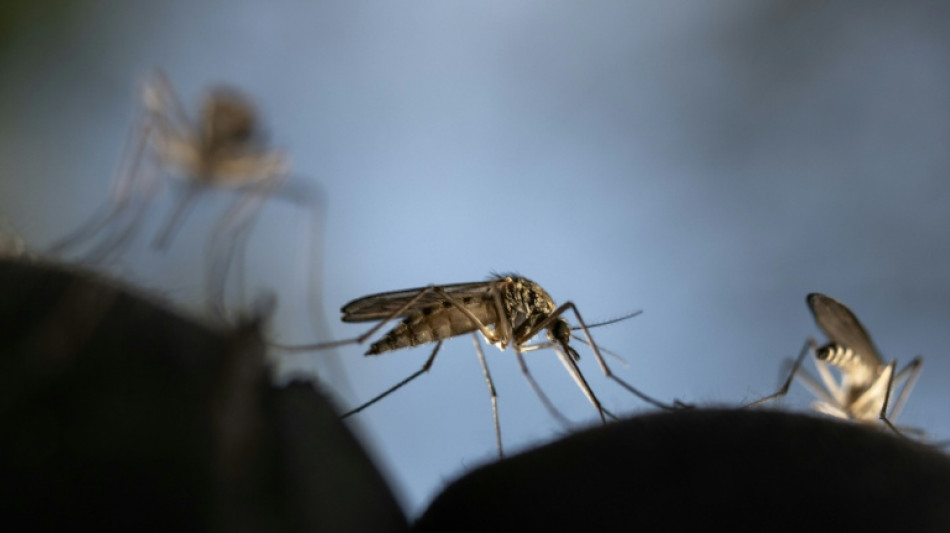
Mosquitoes can learn to love common repellent, scientists find / Photo: © AFP/File

 Colombian judge bans strikes on guerrillas if minors are present

 Khachanov shocks ailing Auger-Aliassime, Swiatek and Osaka advance at US Open

 Lone juror blocking verdict in US mother's child murder trial: defense

 'Kinda chic' - Williams sisters set to launch US Open doubles bid

 Volkswagen says cutting 100,000 jobs by end of decade

 Russia slaps curfew on charity director over army criticism

 Ailing Auger-Aliassime upset by Khachanov at US Open

 Richarlison omitted from Tottenham's Premier League squad

 How El Nino is choking the Panama Canal

 Hamilton drives his Ferrari dream at Monza

 Senegal has an IMF loan, now what?

 Auger-Aliassime upset by Khachanov at US Open

 Hugging Face, the French start-up that became AI's warehouse

 World Cup winner Llorente retires from Spain team at 31

 Osaka squeezes into US Open third round

 Apple faces £2 bn lawsuit in UK over app privacy feature

 Former champ Swiatek eases into US Open third round

 DR Congo latest to promise moving Israel embassy to Jerusalem

 War criminal Mladic's body returns to Serbia with military honours

 Pierre Cardin museum brings designer's futurist style to Venice

 Slovenian rookie Omrzel triumphs as Mas extends Vuelta lead

 British, French leaders talk migrants, EU relations

 Heading for Ferrari's home race, Leclerc still dreams of world title

 Cafe at centre of Israel culture clash agrees to shut on Sabbath

 Spacecraft bound for Mercury begins 'tricky' arrival

Mosquitoes can learn to associate the smell of the world's most common insect repellent with a tasty meal -- and after training can even prefer to bite people who have been sprayed with it, an experimental study said Thursday.
The surprising results, which were conducted "under very specific conditions" in the lab, do not "call into question the effectiveness" of the repellent DEET, lead study author Claudio Lazzari told AFP.
Since being developed in the 1940s in the United States, the chemical compound has saved many lives from the scourge of insect bites.
"It is the absolute gold standard for repellents, used by the World Health Organization to combat the transmission of mosquito-borne diseases," emphasised Lazzari, professor emeritus at the Insect Biology Research Institute at France's University of Tours.
However the world also needs to find new, more effective, environmentally friendly repellents that cause fewer allergies, he added.
That means figuring out exactly why insects are so turned off by the repellents that we do have.
"We don't know why" compounds like DEET deter mosquitoes, Lazzari admitted. Are they toxic for the little blood-suckers? Do they stop mosquitoes from tracking down our scent? Or do they just smell bad?
To find out more, the international team of scientists used a form of conditioning made famous by Pavlov's dog, which learned to associate the arrival of food with the sound of a ball.
- 'Paradigm shift' -
For the experiment, the mosquitoes were put in a fabric mesh enclosure, then presented with a bag of warm sheep's blood to observe how eagerly they fed on it.
Unsurprisingly, the Aedes aegypti mosquitoes -- which spread deadly diseases such as dengue fever, Zika, yellow fever, and chikungunya -- leapt at the chance.
When the smell of DEET was introduced, the mosquitoes moved away, which was also expected.
Next, the scientists fed the insects warm blood for 20 seconds, releasing DEET during the last 10 seconds.
That part was repeated three times before the mosquitoes were exposed to solely the scent of the repellent.
This time, more than 60 percent of the insects tried to bite the fabric -- even though there was no blood.
Then, one of the scientists offered up their hands -- one clean, the other coated with DEET -- to the trained mosquitoes to see which one they would bite.
The result was beyond doubt: the insects preferred the hand covered in repellent.
The scientists had similar results when they repeated the experiment using sugar instead of blood, because mosquitoes mostly feed on plant nectar in the wild.
"The common assumption has always been that repellents work because of their chemistry," study co-author Clement Vinauger of Virginia Tech in the United States said in a statement.
But this study shows "that it's not the chemistry of the molecule itself that is toxic" to the mosquito, instead they are repelled by how they "interpret this chemical information," Lazzari added.
"What we are showing is that the mosquito's brain can rewrite that response based on experience," Vinauger explained.
"What the insect has learned matters just as much as what the chemical does. That, I think, is a paradigm shift."
While the mosquitoes were trained relatively quickly during the experiment, in nature "very specific conditions would be needed for things to happen the same way," Lazzari emphasised.
He advised everyone to follow the instructions on their repellent, because DEET can come in a variety of concentrations.
The study was published in the Journal of Experimental Biology.
A.Ammann--VB