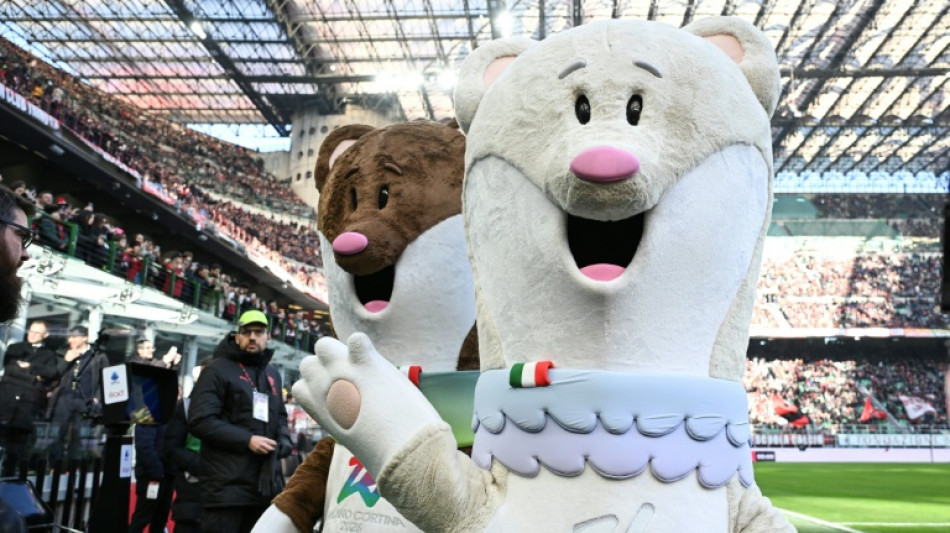
Cuddly Olympics mascot facing life or death struggle in the wild / Photo: © AFP

 India's 'Cockroach' movement vows to protest until education minister resigns

 South Korea president urges regulator action on leveraged stock funds

 For Ukraine's drones, names are part of the battle

 Countries move to ban social media for children

 Asia stocks up as chip stocks recover, oil eases
 Desperate Rohingya risk deadly voyages as trafficking surges

 French lawmakers expected to approve social media ban for under-15s

 'All these rashes': chickenpox surges in Gaza camps

 Australia's Cummins, Hazlewood, Lyon back for Bangladesh Test series

 Rubio in Philippines as US condemns 'dangerous' China actions
 Unnatural physique turns Evenepoel into a Tour de France contender

 'Sit down!' Australian politician berates dog on live TV

 Argentina squad returns, without Messi, after World Cup final loss

 New strikes as Trump warns Iran will pay for US troop deaths

 Spain stars lap up adulation of estimated two million on World Cup parade
 Business of Dance Mentees and Enola Bedard Join Shakira for the FIFA World Cup Halftime Show

 "The pain is immense," says Messi of World Cup defeat

 US judge suspends Paramount's acquisition of Warner Bros.

 Chess legend Judit Polgar rejects becoming Hungary's president

 Ceferin skipped World Cup final reportedly to show disapproval of FIFA

 Judge approved night-time Tour de France doping tests

 Chile declares state of emergency over deadly rainfall

 Kevin Keegan: The 'Mighty Mouse' who conquered Europe

 'Not another one': UK voters fatigued by seventh PM in a decade

 DeChambeau threatened to call Trump over British Open penalty: reports
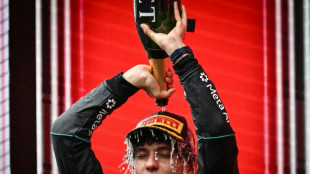
Tina and Milo, the ermine and stoat mascots of the upcoming 2026 Olympic Games in Italy, are already everywhere -– smiling on stuffed animals, posters, mugs and T-shirts.
But it's another story for their real-life counterparts –- living out of sight and under pressure in the Alps as their snow cover slowly melts away due to climate change.
Ermines and stoats are the same animal -- mustela erminea -- but with the ermine sporting its white winter coat and the stoat its brown one for summer. And while they might be the face of the Olympics, they're disappearing in Italy's Alps, according to the country's only dedicated ermine researcher.
Since 2022, University of Turin doctoral student Marco Granata has been single-handedly monitoring the sinewy, hard-to-spot mammals who inhabit the same mountain peaks where the games will take place, high in the snowy Italian Alps where their winter coats camouflage them from predators.
"The ermine is like a wild ghost. It's a small, elusive animal," Granata told AFP.
"What makes it so interesting to me is the fact that it risks disappearing from entire mountains."
- Easy targets -
The small mammal's ability to molt -- its brown coat turning to white in November -- is what Granata calls a "super power" that's allowed it to survive for thousands of years.
But now it's a liability.
"The ermine faces a mismatch when it finds itself completely white in a world that should be white but is no longer so," Granata said.
Snow cover in the Italian Alps has decreased by half in the last 100 years, according to a study published in December 2024 in the International Journal of Climatology.
With their snow camouflage gone, the white ermines now stand out starkly against their mountain backdrop, becoming easy targets for predators such as hawks, owls or foxes.
Another problem awaits when the energetic carnivores climb to higher altitudes in search of snow -- a lack of prey.
While the ermines are compelled to ascend, the snow voles and mice they depend upon for food have no need to do so, as they don't change colour.
Ski slopes also encroach on ermine habitat because of "competition for the areas where it snows the most," Granata said.
His research predicts ermine habitat in the Italian Alps will decrease by 40 percent by 2100, with ermines forced to climb by an average of 200 metres and the voles staying put.
There is little fuss made in Italy over ermines, which were once heavily hunted for their white pelts to adorn royal ceremonial robes. Scientists have paid them scant attention in recent decades, given the difficulty of gathering data on the fast-moving creatures.
The International Union for Conservation of Nature (IUCN), the world's largest environmental network, last classified the ermine in 2015 as of "least concern" on a list of potentially threatened species.
But that influential list is out of date, argues Granata, who hopes his research will lead to their protection.
"The fact that a doctoral student is the expert on a species shows how little attention has actually been paid to this species," he said.
- 'Invisible world' -
Every fall, Granata hikes Italy's Maritime Alps placing special camera traps -- plastic boxes with a motion-triggered camera inside -- that help him analyse the animal's seasonal patterns.
"You have to think like an ermine," he said, placing the box in areas where the curious mammal might go to find food.
When the snow melts, Granata collects the data from inside the boxes and watches a season's worth of videos and photos.
"It's like unwrapping a gift because you don't know what's inside... you actually see this invisible world," he said.
In one August video, an energetic stoat twists, sniffs and darts around in constant motion as he explores the box.
In October, after learning of the Games' choice of mascot, Granata launched an appeal to the Milano Cortina organisers, asking their sustainability team to help fund university research.
This week they sent a letter declining, which Granata considers a "huge missed opportunity".
The ermine, he said, isn't "just a cute little animal that roams our mountains, but a wild animal at risk of extinction".
D.Bachmann--VB