Florida hurries to catch fast-spreading snail invasion / Photo: © AFP

 US eyes offshore nuclear reactors

 The Sterling Announces Luxury Cocktail Lounge Concept and Investor Showcase in Orlando

 Inter Miami signs Brazil veteran Casemiro but MLS probes deal

 White House accuses China's Moonshot of stealing Anthropic AI

 Pogacar sweating on Yates's fitness ahead of Tour Queen stage

 Ukrainian soldiers and civilians welcome new army commander

 UK fintech Revolut valuation soars to $115 bn: source

 German FM, on Africa tour, eyes business ties amid US, China pressure

 Rubio says at ASEAN meeting he expects 'positive' US visit by China's Xi

 Philipsen wins Tour de France 17th stage

 DonnaPro Introduces AI-Trained Executive Assistants for European CEOs

 Happy birthday, George! UK prince becomes a teenager

 Oil prices jump on Mideast war, stock markets diverge

 US hits Iranian island, says war cost at $37.5 bn

 Metal mining's carbon footprint far larger than thought: study

 TokenInsight Q2 2026 Report: TradFi Momentum Lifts MEXC to No. 2 in Commodity Perpetuals

 Leonardo chief sees potential for Germany to join GCAP fighter jet project

 Louvre heist gallery reopens to public, but with nothing to steal

 Ukraine's new army chief: who is Mykhailo Drapaty?

 India student protests keep up pressure on Modi government

 Italian FA chief says in touch with Guardiola over coaching vacancy

 Cooler inflation hands new UK PM Burnham an early boost

 Bezos holds talks with group interested in buying Liverpool stake: reports

 The student movement in India challenging Modi's government

 Danish fish fossil cliffs set to gain UNESCO status

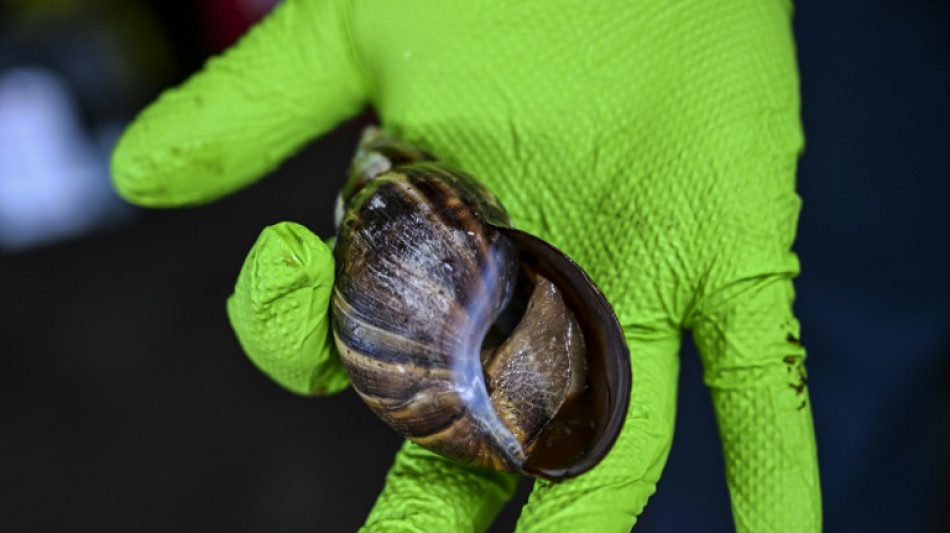
It might not be speedy, but it's big, hungry and fast at reproducing: the giant African snail, a potential health risk to humans, has once again invaded the southern US state of Florida.
Jason Stanley, a biologist with Florida's Department of Agriculture, says that the gastropod greedily "feeds on over 500 different kinds of plants."
"We're concerned with that being in our environment," he told AFP.
Since June 23, employees from his agency have been combing through the gardens of New Port Richey, a small town on Florida's west coast, where the invasive species has taken root.
A single giant African snail can lay up to 2,000 eggs each year, Stanley explains, which -- coupled with its appetite -- could spell disaster for the state's robust agriculture industry.
In a grassy plot of land in New Port Richey, Mellon, a yellow Labrador trained to sniff out the snails, walks with his handler.
He darts under a tree and sniffs around in the grass. When Mellon eventually locates a snail, he sits directly on top of it, as he's been trained to do.
Florida authorities believe that the snail, native to eastern Africa, was reintroduced to the state when someone brought it home as a pet.
Unlike other brown-tinted giant snails, this particular breed has white flesh.
"These white phenotypes are very popular in the pet trade," Stanley noted.
Through the talents of Mellon and another snail-sniffing canine, more than 1,000 giant African snails have already been caught in Pasco County, where New Port Richey is located.
Authorities are also trying to stamp out the giant snails by applying metaldehyde, a pesticide that is harmless to humans and animals, according to the state.
The Florida Department of Agriculture has established a quarantine zone within New Port Richey: no plants or other vegetation can be removed from the area to try to prevent the snails from spreading further.
- Carries harmful disease -
"Another issue with this snail is that it carries the rat lungworm, which can cause meningitis in humans," Stanley added.
That type of parasite, which has been detected among the snails caught in Pasco County, enters rats' lungs when they eat the snails and then spreads when the rodents cough.
If a human ingests one of the worms, Stanley says, it usually makes its way to the brain stem, where it can cause meningitis.
Local resident Jay Pasqua still can't believe the stir caused by the giant African snail.
In late June, a Department of Agriculture official came to his lawn mower sales and repair store in New Port Richey to flag the presence of the invasive species.
"In the beginning, it was kind of funny to see all the attention that a snail was getting," the 64-year-old told AFP.
"But (after) starting to understand the process of their growth, how they got here, and what diseases and what problems they cause, it did become a concern at that time."
He has since found dozens of the pests in his garden, although he says he hasn't seen any for three days.
The giant African snail has been eradicated from other parts of Florida twice before, first in 1975 and then again in 2021.
The latter extermination campaign took place in Miami-Dade County and was the result of 10 years of effort at a cost of $23 million.
Stanley says he's optimistic that this time will be much easier.
"So far, it's isolated in one area, and we're already surveying and treating this area. So we're very hopeful that it's not going to take that amount of time here."
J.Horn--BTB