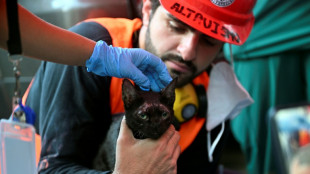
'God created it to be eaten': Jakarta's dog meat ban divides / Photo: © AFP

 Evenepoel wins Tour de France individual time-trial

 Tropical Storm Bertha strengthens, threatening Gulf coast of US

 Microsoft strikes deal for Mistral's AI computing power

 Dutch students unveil 'world-first' solar-powered ambulance

 French lawmakers set to ban social media for under-15s in European first

 UK PM Burnham unveils energy tax cut, tells ministers to cut living costs

 Pharma heavyweights clash over anti-obesity drug ads

 Hungary raids Orban's Fidesz party servers in graft probe

 General Motors lifts 2026 outlook despite hit from electric retreat

 Uproar in France over reintroduction of bee-harming pesticides

 Kuwaitis ration electricity as Iran hits power grid

 Former Man Utd boss Ferguson salutes old rival Keegan

 UK PM Burnham's new cabinet to meet as he announces tax cut
 Former MotoGP champion Quartararo to make Honda switch

 Oleksandr Syrsky, Ukraine's under-fire commander-in-chief

 New UK govt tackles cost of living with energy tax cut

 China summons Philippine ambassador over clash in disputed waters
 Panama, China renew maritime port agreement

 De Gaulle returns to unite the French -- at the cinema

 North Korea reaffirms support for Moscow over Ukraine

 South China Sea rivalry looms over ASEAN meeting

 Arrogance or pride? Argentina grapples with World Cup villain label

 Fires in Brazil's Amazon dropped to historic low in 2025

 French youth social media ban meets age check conundrum

 Lebanon's Aoun to meet Trump as pressure builds to disarm Hezbollah
Sitting at an empty Jakarta stall, Alfindo Hutagaol gobbled down some rice, green sambal and grilled dog meat -- a meal that is now banned in the Indonesian capital.
The Muslim-majority archipelago is one of a handful of countries that still permit the sale of dog and cat meat, but a campaign against the practice has been gaining ground in recent years.
While Muslims do not eat dog meat, it is popular in some of Indonesia's other communities.
This week, Jakarta's authorities announced a ban in the capital on trade for the consumption of rabies-transmitting animals, including cats and dogs.
The prohibition, with a six-month grace period before enforcement begins, was hailed by animals rights groups who have long lobbied against the trade.
But for Alfindo, who spoke to AFP before the ban was announced, "there should be no such prohibition."
"God created it to be eaten. Don't only look for the negative side, but also look for its benefits too," the 36-year-old told AFP.
Dog and cat meat are not widely consumed in Indonesia, but in some communities canine meat is considered a home remedy for dengue fever.
The trade "can't be eliminated suddenly", said another consumer, 43-year-old Sunggul Sagala, who described dog meat consumption as a "tradition" for some communities.
The Tuesday announcement by Jakarta's governor covers trade for consumption of all rabies-transmitting animals, including bats, monkeys and civets.
"This is a real example and real commitment from the Jakarta government as a global city that also advances animal welfare," said Merry Ferdinandez of the Dog Meat Free Indonesia (DMFI) coalition that lobbied for the ban.
The move does not extend to other regions where consumption remains popular, but might "encourage" similar moves, she said.
A poll commissioned by DMFI in 2021 found that 93 percent of Indonesians rejected the dog meat trade and wanted it banned.
Yet a DMFI study the following year estimated 9,500 dogs, mostly wild animals caught on the streets, were brought into Jakarta for consumption that year, mostly from West Java, where rabies is endemic.
Nationwide figures for dog and cat meat consumption are not available.
- Rabies free -
Jakarta has been officially rabies-free since 2004 -- one of 11 Indonesian provinces with that status -- and the ban was "one of the efforts" to maintain that, said the capital's food resiliency, maritime and agriculture agency head Hasudungan Sidabalok.
While it is no longer common to see dog meat sold openly either at markets or restaurants, he said 19 restaurants still serve the dish and at least two slaughterhouses are operating, expressing hope the new regulation would "minimise" such practices.
"It's not an easy step because it is a habit or perhaps a culture for certain communities, which we hope can change," he told AFP.
"The act of slaughtering or consuming dog meat... is still risky as it can transmit rabies to the slaughterers or consumers."
Jakarta's government will publicise the ban during the six-month grace period, after which violators face sanctions ranging from written warnings to revocation of business licenses.
Hasudungan said the government is preparing rules to detail further enforcement and sanctions against violators.
- Like 'drugs' -
Indonesian laws on food and animal husbandry do not explicitly ban the consumption of canine and feline meat, but a 2018 directive issued by the agriculture ministry stated that dog meat is not categorised as food.
Some regions have already imposed their own bans, leading to arrests of traders.
In the Central Javan city of Semarang, which banned the trade in 2022, authorities last year intercepted a truck carrying more than 200 dogs bound for a slaughterhouse, and arrested five people.
In Jakarta, increased oversight by authorities has already effectively forced the trade underground.
Restaurants that once openly advertised dog meat dishes no longer do so, nor will owners speak to outsiders about the trade. Meat is also no longer sold openly in markets.
The taboo around the trade means only trusted customers can buy it and the meat is now more expensive than beef, said Sunggul.
Even before the ban, "the fact is that... purchasing dog meat is like looking for drugs," he said.
There have been no explicit plans for how to deal with animals that may no longer have buyers. A similar ban on dog meat in South Korea has caused problems for traders left with animals that can no longer be sold and are not easy to rehome.
And Alfindo argues dog meat fans might even be forced to prey on Jakarta's stray dog population if the ban is enforced.
"The government should rethink the policy," he said, after finishing his dish.
N.Schaad--VB