Franco symbols mark Spanish streets 50 years after dictator's death / Photo: © AFP

 Modi vows punishment for exam fraud fuelling India protests

 Six candidates in race to lead UN set for televised debate

 Comic-Con kicks off with Marvel's return
 Dutch riders dreaming of crazy party corner of Alpe d'Huez

 Houthis target Red Sea shipping as US hits Iran
 Record-equalling Red Sox streak halted at 15 wins
 Messi-less Miami beat Fire 3-2 to spoil Lewandowski's MLS debut
 Mercedes expect Hungary challenge from Hamilton and Ferrari
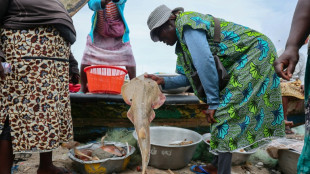 In Ghana, one man's race to save critically endangered fish
 Wilson captain, Slipper absent in Kiss's first Wallabies squad
 New Mideast fighting puts eurozone rate-setters on alert
 Venezuelans search for animal companions lost in the quakes
 Argentine Football Association says US did not detain its president

 June heatwave cost UK economy more than £1bn: study
 Google-parent Alphabet beats expectations, cloud revenue nearly doubles
 US announces civilian nuclear deal with Saudi Arabia

 Tesla shares dip after profit misses expectations
 Red Sox tie club record with 15th straight MLB win

 US eyes offshore nuclear reactors
 The Sterling Announces Luxury Cocktail Lounge Concept and Investor Showcase in Orlando
 Inter Miami signs Brazil veteran Casemiro but MLS probes deal

 White House accuses China's Moonshot of stealing Anthropic AI
 Pogacar sweating on Yates's fitness ahead of Tour Queen stage

 Ukrainian soldiers and civilians welcome new army commander

 UK fintech Revolut valuation soars to $115 bn: source

Fifty years after the death of General Francisco Franco, thousands of monuments, plaques and street names honouring the dictator remain in place across Spain -- a legacy some believe has lingered far too long.
From imposing neoclassical arches to quiet plazas named after regime loyalists, remnants of Franco's nearly four-decade rule are still etched into the public landscape.
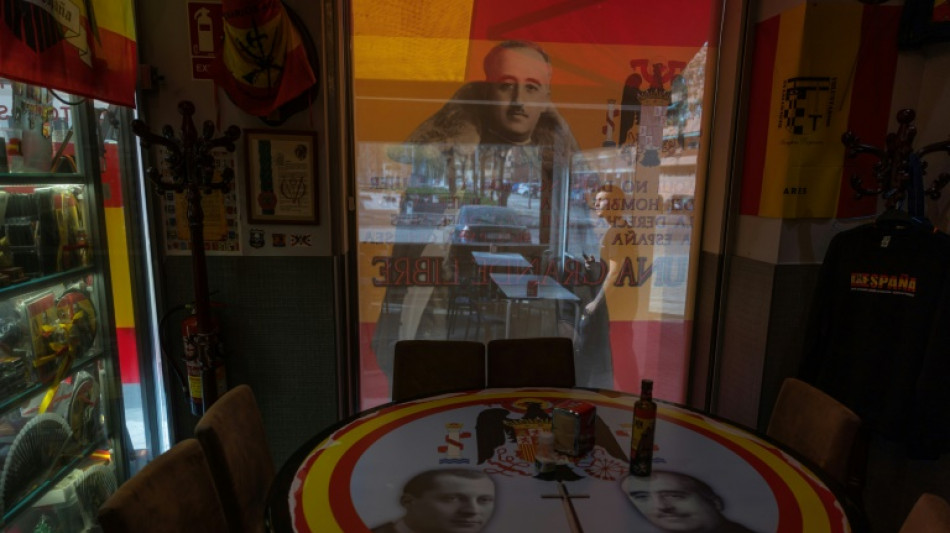
Even some bars and restaurants still display his image, celebrating the man whose regime executed, imprisoned and silenced dissenters during Spain's 1936-1939 civil war and the dictatorship that followed until his death in 1975.
"There are more than 6,000 of these symbols still standing," said Eduardo Espana, co-founder of the website Deberia Desaparecer ("It Should Disappear"), created in 2022 to track what he calls illegal vestiges of the dictatorship.
"It's incomprehensible that a democratic country would preserve such monuments," he added, calling the figure "staggering".
Standing near Madrid's 50-metre (164-foot) tall Victory Arch, built in the 1950s to celebrate the victory of Franco's fascist-backed nationalists in the civil war, Espana points to what he sees as an unresolved trauma.
"This isn't just a piece of architecture. It's a monument to repression," the 34-year-old said.
The arch, located in a busy roundabout, is one of the most prominent symbols of the Franco regime still standing, along with the grandiose Valley of the Fallen, a vast underground basilica and mass burial complex for Franco's supporters killed in combat.
- Franco's remains relocated -
After Franco's death, Spain underwent a transition to democracy.
But a sweeping amnesty law passed by parliament in 1977 shielded both former regime officials and anti-Franco activists from prosecution.
Many symbols of the dictatorship remained untouched.
Efforts to reckon with the past have gained traction in recent decades.
In 2007, then-Socialist Prime Minister Jose Luis Rodriguez Zapatero introduced the "Historical Memory Law", requiring public institutions to remove Francoist iconography from public spaces.
That momentum gathered pace in 2018 when Prime Minister Pedro Sanchez, also a Socialist, took office.
The following year, his government exhumed Franco's remains from the Valley of the Fallen and relocated them to a more discreet family vault to prevent his tomb from becoming a shrine for far-right supporters.
In 2022, a new "Democratic Memory Law" was introduced, to honour victims of the dictatorship and pressure local governments to eliminate regime symbols.
Across Spain, change began to take hold.
In the northwestern region of Galicia and the Canary Islands, crosses honouring Francoist soldiers have been removed.
Under pressure from public prosecutors, the northern city of Santander renamed 18 streets tied to the regime.
And in the southern city of Malaga, an inventory of Francoist symbols is underway.
- 'Think for themselves' -
Not everyone agrees with this removal campaign.
Among the best-known dissenters is Chen Xianwei, a Chinese immigrant who runs a bar in central Madrid named "Una, grande y libre" or "One, great and free" -- Franco's motto for Spain.
"Governments shouldn't tell people what to think," said Chen, who moved to Spain in 1999.
His establishment, filled with busts, flags and posters glorifying the dictator, stands as a controversial tribute to the past.
The law is "manipulating history", Chen said. "People can think for themselves."
Some historians, too, are uneasy with the push to erase symbols. They argue for a more nuanced, educational approach.
"Covering up the remains of a painful past isn't the best way to process or understand it," said Daniel Rico, an art history professor at the Autonomous University of Barcelona and author of "Who's Afraid of Francisco Franco?"
"Removing monuments as if we were children afraid of a coat of arms seems authoritarian," he said.
Rico advocates contextualisation over erasure -- installing plaques that explain the history rather than scrubbing it from public view, for example.
Espana disagrees, arguing that these symbols cause ongoing harm.
"History should be taught in schools" and not in public spaces, he said.
"If we stop teaching, that's when the memory of these events disappears."
B.Baumann--VB