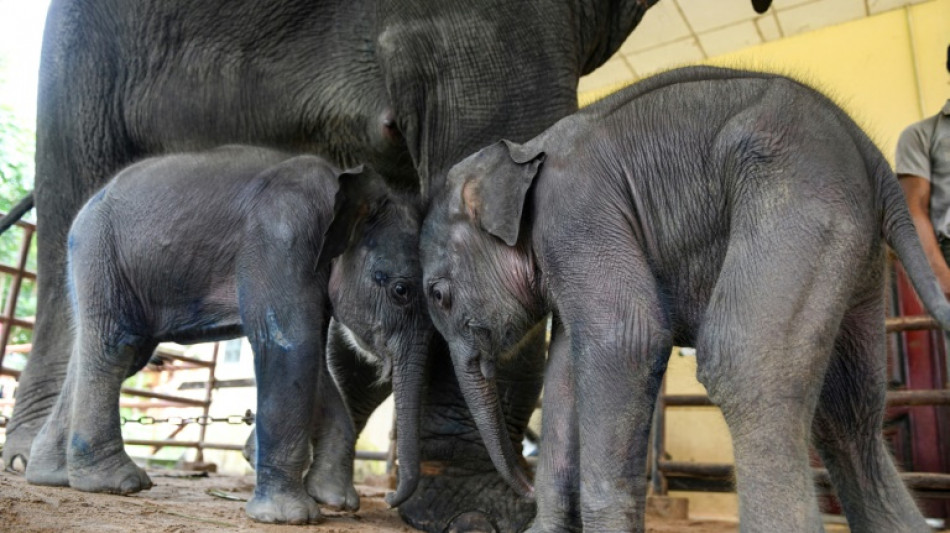
Rare twin elephants take first steps in Myanmar / Photo: © AFP

 Saudi PIF Retains Top Sovereign Wealth Fund Brand Title for Third Year

 Phoenix Weekend Guide: Sangria Socials, Pie Markets, and New Brunch Spots

 Trent Perry’s Late Heroics Lift No. 7 UCLA Past Cal State Fullerton

 2027 Hyundai Elantra Review: Brutalist Design and Expanded Dimensions

 Malta Maritime Forum Study Reveals €1 Billion Economic Contribution Amid Growth Concerns

 China Condemns Chile-Belgium Joint Bid for High Seas Treaty Headquarters

Baby elephant twins born last week on a timber camp in Myanmar are thriving after a wobbly first few days in the world, officials told AFP on Thursday.
Pearl Sint was born a few minutes before her brother Kyaw Pearl last week at the 60-acre Wingabaw elephant camp in the Bago region operated by state-run Myanmar Timber Enterprise.
At about two feet and six inches tall, the pint-sized twins were around four inches shorter than the average calf, said Myo Min Aung, the camp's assistant manager.
This meant they were not tall enough to reach their mother's teat and feed.
"We helped them by putting small wooden blocks under their front legs and bringing their heads up to their mother's breast," he said.
On the third day, they were able to feed themselves and quickly showed their personalities.
"The little male likes to wander around and play with humans rather than stay with his mother," said Myo Min Aung.
"He is not feeding as much as the female little one does."
Another official at the camp, who did not want to give his name, said he hoped the twins would not take after their father, a bull elephant named Aye Htike.
"He was badly behaved. He used to attack the other elephants and people," he said.
Pearl Sandar, the twins' mother, "has a kind heart", the official said.
"She doesn't attack others... we are training the twins to be well-behaved, not like their father."
The arrival of the twins takes the population of the elephant camp up to nine, the official said.
Previously around 3,000 elephants were used for labour at state timber enterprises in Myanmar, the majority dragging freshly cut trees through the dense jungle to transport hubs and mills.
But now those at the Wingabaw camp, like many others, carry humans instead of logs and earn their keep as a tourist attraction.
Fewer than 50,000 Asian elephants remain in the wild, and fewer than 2,000 of them are found in Myanmar, according 2018 figures from environmental group WWF.
"This is my first time personally experiencing an elephant twin birth," said Myo Min Aung.
"I am happy to take care of the little twin elephants, but it is also a big responsibility."
F.Mueller--VB