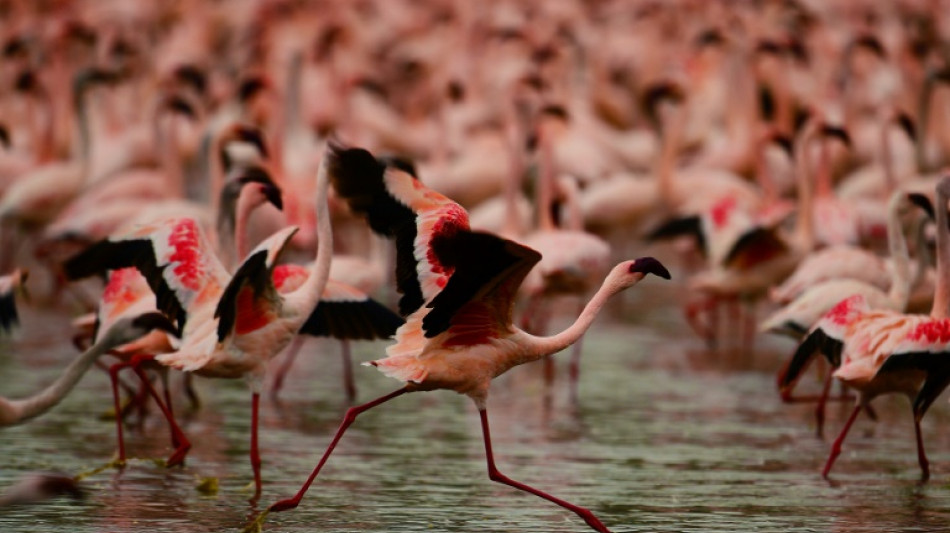
Future of Africa's flamingos threatened by rising lakes: study / Photo: © AFP

 Same-sex couple takes fight for equality to Slovakian court
 'High hopes' as Indonesian women get a football league, again

 'Expectations high' for Bordeaux-Begles' Champions Cup hat-trick bid, says Depoortere
 Rennie urges All Blacks to stay focused against 'hurting' Wallabies

 Palmeiras beat Fluminense 2-1 in Libertadores semi-final first leg

 Brewers blasts leave Dodgers on brink

 Tech stock lead rout after US inflation fuels rate hike bets

 Al-Fayed survivors say UK police missing 'bigger picture'

 Online 'witch hunt' sweeps up Asians misidentified as US rape accused

 Prospect of Bolsonaro win looms large over Brazil's Indigenous

 Freed from Belarus, founder of Lady Gaga's biggest fan site tells his story

 Behind AI's carbon footprint, a potential climate tool

 Trump's new press secretary faces scrutiny over credentials

 PSG 'got lucky' to win Man City thriller, says Luis Enrique

 Real Madrid comeback stuns Roma as Mourinho enjoys happy reunion

 Shakhtar make winning start at new Champions League 'home'

 Hat-trick hero Barcola primed to shine for Liverpool: Iraola

 Villa put six past Fenerbahce in record rout

 US stocks fall after hot inflation report as leading AI shares tumble
 Government buildings torched in violent Albanian protests

 Wall Street grills Bank of America over money laundering fine

 Mekies extends contract as Red Bull team principal until 2031
 Indonesia rescues starved orangutan from fires: officials

 Real Madrid's Vinicius banned for Clasico after red card
 Restrictions expose Ukraine's Starlink dependency in Russia war: observers
The lakes where Africa's flamingos congregate in spectacular numbers are producing less food for the iconic birds as their water levels rise, researchers said Friday, threatening the survival of a much-loved species.
Three-quarters of the world's lesser flamingos live in East Africa and more than a million birds at a time can gather at lakes in huge "flamboyances" for feeding and courtship.
But as these lakes expand to record highs, scientists have discovered they produce less of the unique algae upon which flamingos rely, putting at risk a species already in decline.
This is driving the distinctive, pink-plumed birds away from their usual habitats into unprotected areas in search of food, said Aidan Byrne, lead author of the research.
"They might be able to move elsewhere, but they could be lost from the region that they're currently in at these key feeding lakes," said Byrne, a PhD student jointly supervised by King's College London and the Natural History Museum.
Flamingos use their specialised beaks to feed on a particular type of algae that exists in salty, alkaline waters known as soda lakes.
These lakes are concentrated in Kenya, Tanzania and Ethiopia and despite being harsh landscapes, certain species -- including the flamingo and the algae they feast on -- have adapted to thrive there.
- 'Iconic species' -
But the lakes have risen to levels not seen in decades, driven in part by increased rainfall linked to climate change over the catchment areas.
This has greatly diluted the alkalinity and salinity of the water at these soda lakes.
Byrne and other researchers wanted to study the impact that had on biodiversity and found a "massive decline" in concentrations of the very algal blooms upon which flamingos survive.
Earlier studies had looked at the problem but its extent was not known until now, he said.
"We were surprised at the scale of the changes, and how much the flamingo habitats are threatened," he told AFP.
Erratic and extreme rainfall predicted for East Africa in future would only make the problem worse and "increase the threat to the species within the region", he added.
The study, published in the journal Current Biology, is the first to use satellite imagery to observe all 22 of the soda lakes that host flamingos across the East African region.
This was combined with climate records and bird observation data over more than 20 years.
The sharpest drops in algae concentrations were observed in Kenya, including at Nakuru, one of the most important flamingo feeding lakes in Africa known for hosting million-strong "flamboyances".
It expanded by roughly 90 percent between 2009 and 2022 while algal concentration halved.
Lake Bogoria and Lake Elmenteita, also tourist magnets for their brilliant flamingo displays, experienced steep declines as well.
And where algal blooms declined, so too did flamingo numbers, Byrne said, putting in doubt revenue from tourism as well.
Flamingo habitats in East Africa are protected whereas outside these ranges monitoring would be difficult and other threats -- including from humans -- could emerge, he said.
"They're just such an iconic species that are unique to these environments. If they're lost, it would be devastating," Byrne said.
P.Staeheli--VB