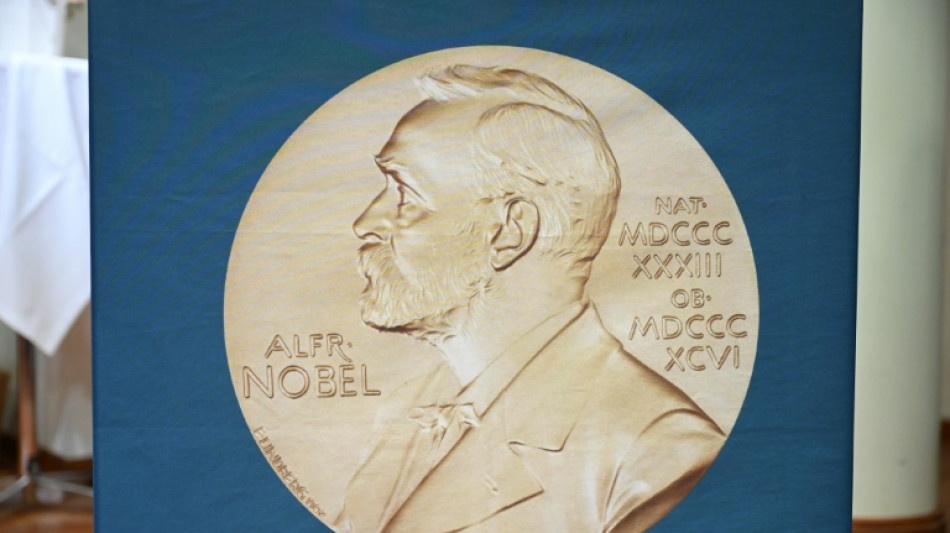
Norway playwright Jon Fosse wins Nobel in literature / Photo: © AFP

 Bugatti CEO to stop leaving keys inside cars after Chiron theft

 Starc, Lyon leave South Africa reeling

 Arsenal lose appeal against Dowman red card in shock Fleetwood defeat

 French court rules Meta must negotiate over rights payments

 Spain demands answers as rail disaster toll rises

 Garcia bids for Ryder Cup return as he confirms LIV exit

 England outlast Sri Lanka despite Rathnayake's hundred in dead rubber

 Starc strikes twice as Australia push for victory

 Does White House ask AI to shape policy? Democrats want the receipts

 Trump tees up Alaska election challenge over same-name candidate 'fraud'

 IMF says engaging with Iraq on preparing new bailout program

 Two dead in rock spire collapse at Turkey's touristic Cappadocia

 No surprise to Carrick he's still Man Utd manager

 Two dead in rock spire collapse at tourist site in Turkey's Cappadocia

 ECB holds rates steady after Lagarde says to quit early

 US economy posts strong growth, inflation stubbornly high in challenge to Trump

 What we know about Spain's deadly train crash

 ECB chief Lagarde to step down early, triggering succession race

 'Horrific' Russian drone strike kills 14 at Ukraine train station: Kyiv

 VW says 'no time to lose' to slash costs after 5.8 billion euro loss

 Australia lead by 100 after Inglis century

 Martin to ride with broken wrist in Malaysian MotoGP practice

 England forward Toney to stand trial for alleged assault in June 2028

 Warrican's five-wicket haul leads West Indies fightback in Bangladesh Test

 Oil majors reap bumper profits as Mideast war drives prices

Norway's Jon Fosse, whose plays are among the most widely staged of any contemporary playwright in the world, won the Nobel prize in literature on Thursday.
Sometimes compared to Samuel Beckett -- another Nobel-winning playwright -- his work is minimalistic, relying on simple language which delivers its message through rhythm, melody and silence.
The Swedish Academy said the 64-year-old was honoured "for his innovative plays and prose which give voice to the unsayable."
Fosse's writing is defined more by form than content, where what is not said is often more revealing than what is.
"I am overwhelmed and grateful. I see this as an award to the literature that first and foremost aims to be literature, without other considerations," Fosse said in a statement.
Speaking to Norwegian public broadcaster NRK, he said he was "surprised but also not", after his name had been mentioned in Nobel speculation for several years.
The chairman of the Nobel committee, Anders Olsson, told reporters Fosse had come to be regarded as an innovator through his "ability to evoke... loss of orientation, and how this paradoxically can provide access to a deeper experience, close to divinity".
His major works include "Boathouse" (1989), which was well-received by critics, and "Melancholy" I and II (1995-1996).
- 'Playwriting was 'made for me' -
Fosse's oeuvre, written in Norwegian Nynorsk, one of Norway's written language forms, spans a variety of genres and consists of plays, novels, poetry collections, essays, children's books and translations, the jury noted.
"While he is today one of the most widely performed playwrights in the world, he has also become increasingly recognised for his prose," it added.
Born among the fjords of western Norway, Fosse is usually seen clad in black with a few days' stubble.
He grew up in a family which followed a strict form of Lutheranism and rebelled by playing in a band and declaring himself an atheist.
He ended up converting to Catholicism in 2013.
After studying literature, he made his debut in 1983 with the novel "Red, Black" which moves back and forth in time and between perspectives.
His latest book, "Septology", a semi-autobiographical magnum opus -- seven parts spread across three volumes about a man who meets another version of himself -- runs to 1,250 pages without a single full stop.
The third volume was shortlisted for the 2022 International Booker Prize.
Struggling to make ends meet as an author in the early 1990s, Fosse was asked to write the start of a play.
"I knew, I felt, that this kind of writing was made for me," he once said in an interview with a French theatre website.
- International breakthrough -
He enjoyed the form so much he wrote the entire play, entitled "Someone is Going to Come", which gave him his international breakthrough when it was staged in Paris in 1999.
"Even in this early piece, with its themes of fearful anticipation and crippling jealousy, Fosse's singularity is fully evident. In his radical reduction of language and dramatic action, he exposes human anxiety and ambivalence at its core," Olsson said.
Fosse went on to win international acclaim for his next play, "And We'll Never be Parted", in 1994.
According to his Norwegian publisher, Samlaget, his plays have been staged more than a thousand times around the world.
His work has been translated into around 50 languages.
"I don't write about characters in the traditional sense of the word. I write about humanity," Fosse told French newspaper Le Monde in 2003.
The Swedish Academy has long been criticised for the over-representation of Western white men authors among its picks.
It has undergone major reforms since a devastating #MeToo scandal in 2018, vowing a more global and gender-equal literature prize.
Since the scandal, it has honoured three women -- France's Annie Ernaux, US poet Louise Gluck and Poland's Olga Tokarczuk -- and three men -- Austrian author Peter Handke, Tanzanian writer Abdulrazak Gurnah and Fosse.
B.Wyler--VB