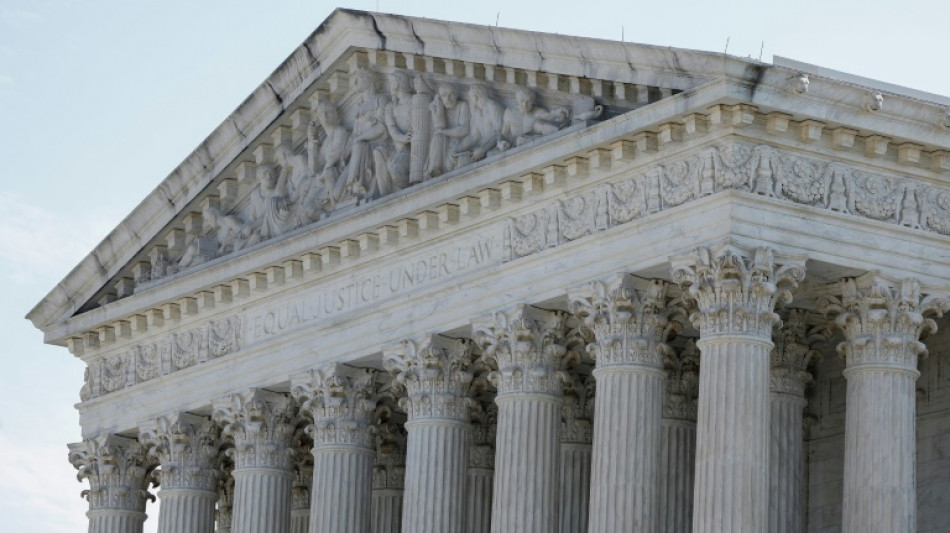
US Supreme Court curbs race-based voting maps in landmark ruling / Photo: © GETTY IMAGES/AFP/File

 Stokes falls cheaply as England collapse in New Zealand decider

 Russell bounces back to beat Antonelli in final practice

 Iran says US violated peace deal as both sides trade fire

 Injured Australian pair Leckie, Italiano out of World Cup

 Farmers fear drought as Italy's longest river runs dry

 Budapest Pride to push for equality after reversed ban

 World Cup fans get taste of American life -- at the mall

 World Cup turns New York's Times Square into global fan hub

 Lebanon, Israel and US sign trilateral framework pact

 Cape Verde extend World Cup fairytale to set up Argentina meeting

 Messi to start dead-rubber World Cup group match on bench

 US and Iran trade strikes putting new strain on Mideast ceasefire

 Maple Leafs make teen McKenna top pick in NHL Draft

 California appeals court orders Weinstein resentencing for sex assault

 Scheffler fires 60 to grab 36-hole PGA Travelers lead

 Austria's Rangnick shuts down conspiracy talk ahead of Algeria World Cup clash

 Should we fear an AI bubble bust?

 US strikes Iran sites after cargo ship attack

 Gueye double keeps Senegal's World Cup hopes alive

 US stocks recover from tech tremors as oil prices fall

 OpenAI restricts limited release of new model to US only

 Scheffler fires 60 to grab early PGA Travelers lead

 Trump blasts 'godless' Democrats in incendiary speech to evangelicals

 Venezuela earthquakes kill 920, tens of thousands missing

 Hundred hero Duckett punishes New Zealand after Stokes sparks England revival

The US Supreme Court on Wednesday sharply limited the use of race in drawing electoral districts, in a landmark decision that could reshape congressional maps nationwide and boost Republican prospects ahead of midterm elections.
In a 6–3 ruling split along ideological lines, the court struck down a map creating a second majority-Black district in Louisiana, finding it amounted to an unconstitutional racial gerrymander despite being drawn to comply with the 1965 Voting Rights Act.
The decision leaves the core of the Voting Rights Act intact but narrows how it can be used, a decision that will be seen by civil rights activists as a blow to a landmark civil rights law that has already been weakened by previous rulings over the past decade.
It was not immediately clear how much the ruling will impact the November elections for control of Congress.
Writing for the conservative majority, Justice Samuel Alito said that compliance with the law "could not justify" the use of race in this case, arguing that Section 2 of the act does not require states to draw districts primarily on racial lines.
"In sum, because the Voting Rights Act did not require Louisiana to create an additional majority-minority district, no compelling interest justified the state's use of race in creating SB8," Alito wrote.
"That map is an unconstitutional gerrymander, and its use would violate the plaintiffs' constitutional rights."
The ruling marks a significant shift in how courts interpret the balance between preventing racial discrimination and adhering to constitutional guarantees of equal protection, raising the bar for when race can be considered in redistricting.
Both the majority ruling and the dissent were read from the bench, a rare move in the high court.
Justice Elena Kagan warned that the decision would have sweeping consequences, saying it risked letting states "without legal consequence, systematically dilute minority citizens' voting power."
The case centered on an electoral map redrawn after the 2020 census to add a second district in which Black voters formed a majority, following court challenges that the previous map diluted minority voting strength.
- 'Color-blind' -
That revised map was then challenged by a group of non-Black voters who argued it relied too heavily on race, setting up a clash between efforts to enforce voting rights protections and constitutional limits on race-based decision-making.
The Supreme Court ultimately sided with those challengers, concluding that the map crossed the line into unconstitutional racial sorting.
The implications could extend far beyond a single state. Legal analysts say the ruling may make it harder to create or maintain majority-minority districts -- a key tool used for decades to ensure representation for Black and other minority voters.
Such districts have often favored Democratic candidates, meaning the decision could give Republicans an advantage in closely contested House races in November.
The case comes amid an intensifying national battle over redistricting, with both Republican- and Democratic-led states seeking to redraw boundaries in ways that could shift the balance of power in Congress.
Section 2 of the Voting Rights Act -- the provision at the center of the case -- was designed to prevent voting practices that dilute minority influence, even without explicit evidence of discrimination.
But the court's conservative majority has increasingly signaled discomfort with race-conscious remedies, suggesting they must have limits under what conservative Justice Clarence Thomas, who is Black, described as a "color-blind" Constitution.
The ruling follows a series of decisions that have chipped away at the Voting Rights Act, including a 2013 judgment that struck down a key provision requiring federal oversight of election law changes in states with histories of discrimination.
L.Stucki--VB