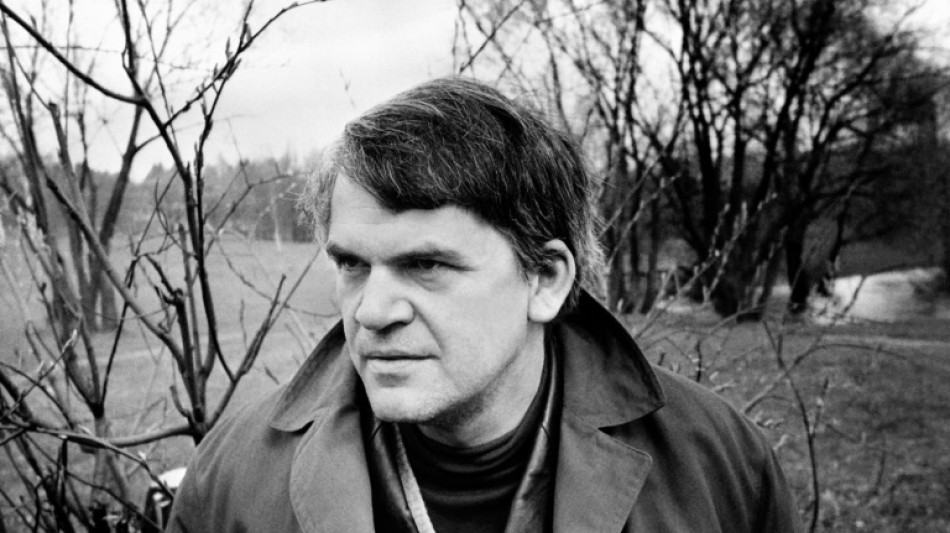
Satire and poetry: Milan Kundera took on life's absurdity / Photo: © AFP/File

 Dodgers return to Trump White House despite fan anger

 Lyles, Richardson ease into 100m semis at US athletics championships
 Salman Rushdie testifies at knife attacker's US terror trial
 World Bank confirms plan to phase out China lending by 2031

 US panel backs trendy peptides despite safety concerns

 Justice Dept withdraws NY Times subpoenas over Trump plane report

 Barcelona's De Jong returns from World Cup with torn ligament
 Albania police teargas protesters against Trump-linked resort
 US panel says to loosen restrictions on popular peptide despite safety concerns
 Verstappen swerves around future questions
 EU renews online child sex abuse detection powers
 Airbus, Boeing fly in different directions at Farnborough
 Bab al-Mandeb Strait: another key oil shipping route under threat
 Deadly wildfires in Europe force thousands to flee
 NATO to overhaul European fuel pipeline network
 US trade envoy to make tariff announcement as 10% duty soon expires

 Trump stuns Saudis by pinning nuclear deal to Israel ties
 Tough day for Ubisoft stock topped with weaker revenues
 Swelling jet fuel costs hit American Airlines outlook
 Carapaz climbs unopposed to Tour de France 18th stage win

 Sooryavanshi hits maiden 50 as India thump Zimbabwe in T20
 ECB opens door to September rate-hike as Iran war flares up
 World Bank estimates Venezuela quakes caused $19.6 bn in damage
 Italy's far-right line up to defend jeweller who killed robbers

 AI-led boom in IPOs raises concerns about a bust

Milan Kundera, the author of "The Unbearable Lightness of Being" whose dark, provocative novels delved into the enigma of the human condition, has died, a spokeswoman for the Milan Kundera Library in his native city of Brno said on Wednesday. He was 94.
"Unfortunately I can confirm that Mr Milan Kundera passed away yesterday (Tuesday) after a prolonged illness," she told AFP.
Kundera died at his apartment in Paris, France, his adoptive country where he had lived since his emigration from Communist-ruled Czechoslovakia in 1975.
"Not only Czech literature, but world literature as well has lost one of the greatest contemporary writers, and one of the most translated writers too," Tomas Kubicek, director of the Kundera library, told the public Czech TV.
Czech Prime Minister Petr Fiala said Kundera was able to "appeal to whole generations of readers across all continents" with his work.
Kundera was frequently touted as a favourite to win the Nobel Prize for literature, but he never claimed the coveted honour.
Through his characteristic satire and poetic prose, Kundera had sought to express all that is compelling and absurd about life, drawing on his own experiences of being stripped of his Czech nationality for dissent.
Life, he said in his work of criticism "Art of the Novel" (1986), "is a trap we've always known: we are born without having asked to be, locked in a body we never chose, and destined to die."
- Young rebel -
Kundera was born on April 1, 1929, in the town of Brno, in what was then Czechoslovakia. His father was a famous pianist.
He studied in Prague, where he joined the Communist Party, translated the French poet Apollinaire and wrote poetry of his own.
He also taught at a film school where his students included the future Oscar-winning director Milos Forman.
Although he professed faithfulness to Communism, the independent spirit of Kundera's writing soon got him into trouble.
He was expelled from the party in 1950, re-joined in 1956 and was expelled a second time in 1970 after the Prague Spring reform movement -- in which he was seen as playing a role -- was crushed.
- Locked out -
Kundera's first novel "The Joke", a work of dark humour about the one-party state published in 1967, led to a ban on his writing in Czechoslovakia while also making him famous in his homeland.
In 1975, he and his wife Vera went into exile in France, where he worked for four years as an assistant professor at the University of Rennes. They were stripped of their Czech nationality in 1979.
In his adopted home, where he became a citizen in 1981, his reputation and success grew as translations of his novels appeared, such as "Life is Elsewhere" (1973) set in Czechoslovakia about a poet entrapped by the Communist regime.
"The Book of Laughter and Forgetting" (1979) playfully explored through seven interlinked narratives the nature of forgetting in politics, history and daily life.
The novel was "brilliant and original," said the New York Times in 1980, "written with a purity and wit that invite us directly in; it is also strange, with a strangeness that locks us out."
Kundera was an author "fascinated by sex, and prone to sudden, if graceful, skips into autobiography, abstract rumination, and recent Czech history," said the Times reviewer, John Updike.
By far his most famous work, "The Unbearable Lightness of Being" was published in 1984 and turned into a film starring Juliette Binoche and Daniel Day-Lewis in 1987.
The novel is a morality tale about freedom and passion, on both an individual and collective level, set against the Prague Spring and its aftermath in exile.
- No going back? -
Kundera's critics say he turned his back on fellow Czechs and dissidents following his exile in France and for his decision to ban the translation of his French books into Czech.
In 2008, a Czech magazine accused him of being a police informer under Communist rule, which he denied as "pure lies".
In 2013, Kundera published his first novel after a 13-year hiatus.
"The Festival of Insignificance", about five friends in Paris, received mixed reviews, with The Atlantic noting its "near-impenetrable irony" and The Guardian deeming it a "stinker".
What Kundera "has to tell us seems to have less relevance", said the New York Times. "You can’t help wondering what his evolution would have been like if he had stayed, or stayed longer, in Czechoslovakia."
In 2019, the Czech Republic restored his nationality and in 2023 the Milan Kundera Library opened in his hometown of Brno.
O.Lorenz--BTB