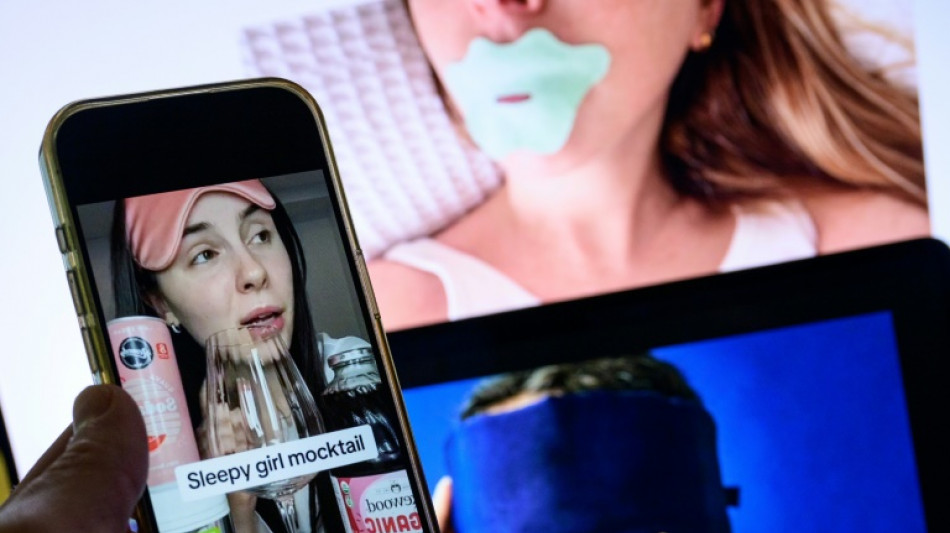
Dangerous dreams: Inside internet's 'sleepmaxxing' craze / Photo: © AFP

 Repsol says profit more than triples on higher oil prices

 TotalEnergies says profit doubled on Mideast war

 Giant swing on Swiss peak aims to boost summer tourism as Alps warm

 ASEAN to call for open straits as US-Iran war casts shadow

 AI catches up with humans to score 100% at top maths contest

 South Korea election office raided in fake turnout figures probe: investigators

 Killer whales: orcas blow fish to bits 'for fun', study finds

 Deadly wildfires force thousands from homes in parts of Europe

 Tech bounce lifts Asia stocks, oil extends gains on US-Iran fears

 Surrounded by militias, Sudanese fear endless cycle of war

 Commonwealth Games 'where champions are made' despite slimmed down model, argues president

 Trump family project in Albania has already caused 'irreparable' damage: NGOs
 Bollywood blast master keeps it real with fire and fury

 Tearful fights, edible offerings: A glimpse into the Maradona trial

 What's the deal with peptides? The hyped market under US review

 Tesla shares fall as Musk touts ambitious -- and costly -- plans

 Houthis claim Red Sea tanker strikes as US hits Iran again

 Wildfires ravage parts of southern France, Italy and Spain

 Alphabet beats expectations in second quarter, cloud revenue nearly doubles

 Trump threatens Iran infrastructure, Tehran vows 'eye for eye'

 US teen withdraws lawsuit against Meta over social media addiction

 Lebanon PM says Beirut working for 'complete Israeli withdrawal'

 EU conditionally clears Paramount bid for Warner Bros.

 Philipsen snaps 'horrible' drought with Tour de France stage 17 victory

 US trial of Venezuela's Maduro set for June 2027

From mouth taping to rope-assisted neck swinging, a viral social media trend is promoting extreme bedtime routines that claim to deliver perfect sleep -- despite scant medical evidence and potential safety risks.
Influencers on platforms including TikTok and X are fueling a growing wellness obsession popularly known as "sleepmaxxing," a catch-all term for activities and products aimed at optimizing sleep quality.
The explosive rise of the trend -- generating tens of millions of posts -- underscores social media's power to legitimize unproven health practices, particularly as tech platforms scale back content moderation.
One so-called insomnia cure involves people hanging by their necks with ropes or belts and swinging their bodies in the air.
"Those who try it claim their sleep problems have significantly improved," said one clip on X that racked up more than 11 million views.
Experts have raised alarm about the trick, following a Chinese state broadcaster's report that attributed at least one fatality in China last year to a similar "neck hanging" routine.
Such sleepmaxxing techniques are "ridiculous, potentially harmful, and evidence-free," Timothy Caulfield, a misinformation expert from the University of Alberta in Canada, told AFP.
"It is a good example of how social media can normalize the absurd."
Another popular practice is taping of the mouth for sleep, promoted as a way to encourage nasal breathing. Influencers claim it offers broad benefits, from better sleep and improved oral health to reduced snoring.
But a report from George Washington University found that most of these claims were not supported by medical research.
Experts have also warned the practice could be dangerous, particularly for those suffering from sleep apnea, a condition that disrupts breathing during sleep.
Other unfounded tricks touted by sleepmaxxing influencers include wearing blue- or red-tinted glasses, using weighted blankets, and eating two kiwis just before bed.
- 'Damaging' -
"My concern with the 'sleepmaxxing' trend -- particularly as it's presented on platforms like TikTok -- is that much of the advice being shared can be actively unhelpful, even damaging, for people struggling with real sleep issues," Kathryn Pinkham, a Britain-based insomnia specialist, told AFP.
"While some of these tips might be harmless for people who generally sleep well, they can increase pressure and anxiety for those dealing with chronic insomnia or other persistent sleep problems."
While sound and sufficient sleep is considered a cornerstone of good health, experts warn that the trend may be contributing to orthosomnia, an obsessive preoccupation with achieving perfect sleep.
"The pressure to get perfect sleep is embedded in the sleepmaxxing culture," said Eric Zhou of Harvard Medical School.
"While prioritizing restful sleep is commendable, setting perfection as your goal is problematic. Even good sleepers vary from night to night."
Pinkham added that poor sleep was often fuelled by the "anxiety to fix it," a fact largely unacknowledged by sleepmaxxing influencers.
"The more we try to control sleep with hacks or rigid routines, the more vigilant and stressed we become -- paradoxically making sleep harder," Pinkham said.
- Beauty over health -
Many sleepmaxxing posts focus on enhancing physical appearance rather than improving health, reflecting an overlap with "looksmaxxing" –- another online trend that encourages unproven and sometimes dangerous techniques to boost sexual appeal.
Some sleepmaxxing influencers have sought to profit from the trend's growing popularity, promoting products such as mouth tapes, sleep-enhancing drink powders, and "sleepmax gummies" containing melatonin.
That may be in violation of legal norms in some countries like Britain, where melatonin is available only as a prescription drug.
The American Academy of Sleep Medicine has recommended against using melatonin to treat insomnia in adults, citing inconsistent medical evidence regarding its effectiveness.
Some medical experts also caution about the impact of the placebo effect on insomnia patients using sleep medication -- when people report real improvement after taking a fake or nonexistent treatment because of their beliefs.
"Many of these tips come from non-experts and aren't grounded in clinical evidence," said Pinkham.
"For people with genuine sleep issues, this kind of advice often adds pressure rather than relief."
burs-ac/mlm
R.Buehler--VB