'Science refugees': French university welcomes first US researchers / Photo: © AFP

 Repsol says profit more than triples on higher oil prices

 TotalEnergies says profit doubled on Mideast war

 Giant swing on Swiss peak aims to boost summer tourism as Alps warm

 ASEAN to call for open straits as US-Iran war casts shadow

 AI catches up with humans to score 100% at top maths contest

 South Korea election office raided in fake turnout figures probe: investigators

 Killer whales: orcas blow fish to bits 'for fun', study finds

 Deadly wildfires force thousands from homes in parts of Europe

 Tech bounce lifts Asia stocks, oil extends gains on US-Iran fears

 Surrounded by militias, Sudanese fear endless cycle of war

 Commonwealth Games 'where champions are made' despite slimmed down model, argues president
 Trump family project in Albania has already caused 'irreparable' damage: NGOs

 Bollywood blast master keeps it real with fire and fury

 Tearful fights, edible offerings: A glimpse into the Maradona trial

 What's the deal with peptides? The hyped market under US review

 Tesla shares fall as Musk touts ambitious -- and costly -- plans
 Houthis claim Red Sea tanker strikes as US hits Iran again

 Wildfires ravage parts of southern France, Italy and Spain

 Alphabet beats expectations in second quarter, cloud revenue nearly doubles
 Trump threatens Iran infrastructure, Tehran vows 'eye for eye'

 US teen withdraws lawsuit against Meta over social media addiction

 Lebanon PM says Beirut working for 'complete Israeli withdrawal'

 EU conditionally clears Paramount bid for Warner Bros.

 Philipsen snaps 'horrible' drought with Tour de France stage 17 victory

 US trial of Venezuela's Maduro set for June 2027

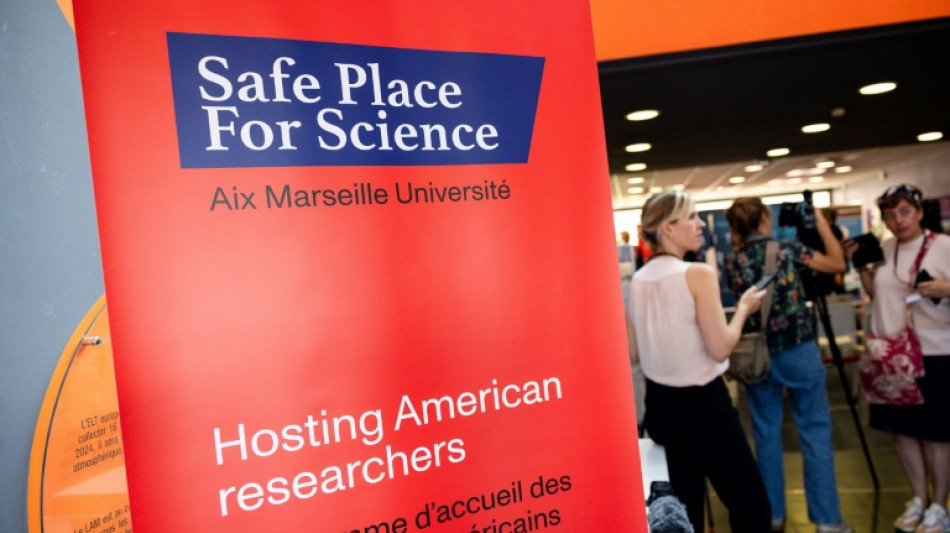
Eight American researchers have arrived at a university in southern France, as the country pushes to offer "science asylum" to US academics hit by federal research spending cuts under Donald Trump.
The University of Aix-Marseille (AMU) welcomed the scholars on Thursday, following the March launch of its "Safe Place for Science" initiative, the first among 20 set to relocate there in coming months.
The programme has already drawn nearly 300 applicants from top institutions such as Stanford, NASA, and Berkeley.
The development comes as US universities have been threatened since Trump's return to the White House with massive federal funding cuts, causing research programmes to face closures.
Some staff also fear possible detention and deportation for their political views.
AMU -- one of France's largest universities, with some 12,000 international students alone -- is eager to provide a home for these scholars, with research funding for up to three years.
Historian Brian Sandberg said he decided to apply to the university in the southern Provence region on a return trip to the United States from France, when he feared he might face arrest at the border of his own country.
Though he was not detained, "it makes you think about what is your status as a researcher", said the academic from Illinois whose work focuses on religion, gender and violence.
- Academic freedom 'under attack' -
Sandberg is now one of 20 scholars specialising in subjects ranging from health, climate science, astrophysics and the humanities set to relocate to France in September. There, they hope to pursue their research in what they see as a more open academic environment.
"The principle of academic freedom, as well as the entire system of research and higher education in the United States is really under attack," said Sandberg.
"If I stay in the United States, I can continue to teach, but as a researcher, for the next four years, we're stuck," he said, referring to Trump's term in office.
One academic who requested anonymity said Trump's policies directly threatened her work on gender and human-caused global warming.
"Apparently, one of the banned words... is 'female'," she said. "I don't know how you can get around speaking about females without using the word," she said.
In February, the Washington Post reported that the National Science Foundation was flagging research using terms such as "female" and "women" that could violate Trump's orders rolling back diversity initiatives.
But she said her decision to move to France went beyond her professional freedom.
"I've got kids, I don't want them to grow up in a very hostile area," she said.
- A 'science asylum programme' -
AMU's programme is part of a broader push to cash in on US President Donald Trump's massive cuts in funding for education.
In May, France and the EU announced plans to attract US researchers in hopes of benefitting from the potential brain drain by supporting the costs of hosting foreign researchers.
French President Emmanuel Macron, who called the growing pressure on academia by Trump's administration "an error", has encouraged US scientists to "choose France".
He announced that his government would earmark 100 million euros ($117 million) to help attract foreign talent. French lawmakers have introduced a bill to create a special status for "science refugees".
European Commission head Ursula Von der Leyen has said the European Union will launch an incentives package worth 500 million euros to make the 27-nation bloc "a magnet for researchers".
For its part, AMU expects to welcome the other 12 American researchers in the coming months, with its budget of 15 million euros.
"Saving our American colleagues and welcoming them is also a way of welcoming and promoting global research," said the university's president Eric Berton.
"This is a science welcome programme, a science asylum programme. And above all, we want to enshrine the concept of science refugees in law," he added.
In recent years, France has already welcomed scholars forced into exile from Ukraine, Yemen, Afghanistan and the Palestinian territories.
D.Bachmann--VB