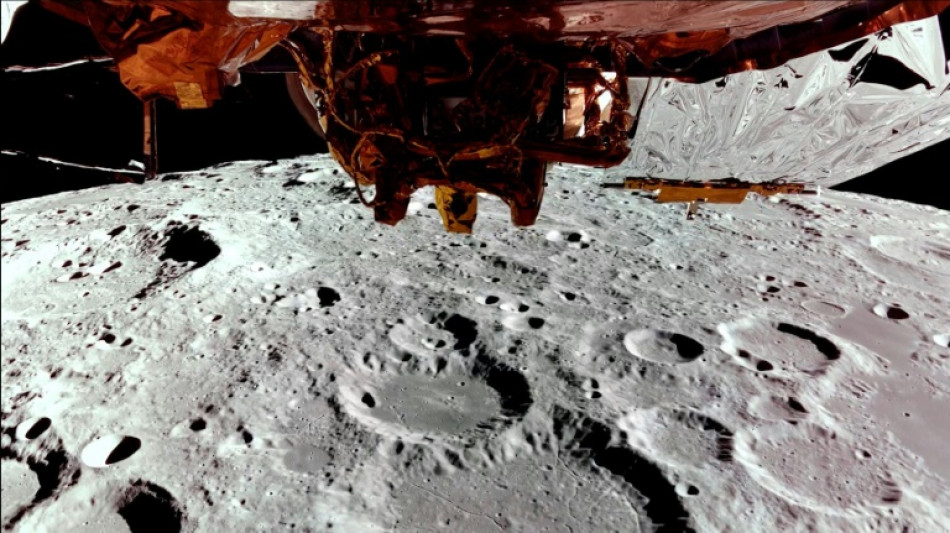
Two lunar landings in a week for NASA's private Moon fleet / Photo: © Firefly Aerospace/AFP

 Oil passes $100 a barrel again: why it's more serious this time

 Who are the six candidates vying to lead the UN?

 Hamilton proud of recovery after hitting rock bottom a year ago
 Carapaz eyes polkadot mountains jersey after stage win

 Fields medal awarded to four young mathematicians

 Carapaz claims Tour de France stage as Pogacar loses key team-mate

 Alonso welcomes Aston Martin upgrade, warns against unreal expectations

 Anderson declares Man City 'kings of Manchester' after £116 mn move

 Relieved Russell says Mercedes have solved his power problems mystery

 Oil soars above $100 as Middle East fears grow
 Venezuelans turn to scrap collecting in quake-hit beach 'paradise'

 Heptathlon champion Johnson-Thompson joins list of Commonwealth Games absentees

 Nigeria's Dangote raises $2.5bn to expand Africa's largest refinery

 Oil soars to $100 on fresh Mideast attacks

 Coal-fired power generation rising globally on Mideast war: IEA

 Premier League champions Arsenal sign Greece winger Tzolis from Brugge

 French Jewish DJ sues after activists disrupt gig: lawyer

 Venice film festival promises Pattinson, Oasis and Musk doc

 ASEAN calls for open straits as US-Iran war casts shadow

 Ford and Geely to form joint venture at struggling Spain plant

 Russia warns US against Ukraine arms sales in Manila meeting

 New UK PM announces tax cut for struggling pubs

 Supporters flood India's 'cockroach' protesters with food
 Modi vows punishment for exam leaks fuelling India protests

 Norway set to make formal complaint to FIFA over Balogun red card saga

More than fifty years passed between the last Apollo mission and the United States' return to the lunar surface, when the first-ever private lander touched down last February.
Now, starting Sunday, two more missions are set to follow within a single week, marking a bold push by NASA and its industry partners to make Moon landings a routine part of space exploration.
First up is Firefly Aerospace's Blue Ghost Mission 1, nicknamed "Ghost Riders in the Sky."
After launching in January on a 45-day journey, it is targeting touchdown near Mons Latreille, a volcanic feature in Mare Crisium on the Moon's northeastern near side, at 3:34 am US Eastern time (0834 GMT). Along the way, it has captured stunning footage of the Moon, coming as close as 60 miles (100 kilometers) above the surface.
The golden lander, about the size of a hippopotamus, carries ten instruments, including one to analyze lunar soil, another to test radiation-tolerant computing, and a GPS-based navigation system.
Designed to operate for a full lunar day (14 Earth days), Blue Ghost is expected to capture high-definition imagery of a total eclipse on March 14, when Earth blocks the Sun from the Moon's horizon.
On March 16, it will record a lunar sunset, offering insights into how dust levitates above the surface under solar influence -- creating the mysterious lunar horizon glow first documented by Apollo astronaut Eugene Cernan.
- Hopping drone -
Blue Ghost's arrival will be followed on March 6 by Intuitive Machines' IM-2 mission, featuring its lander, Athena.
Last year, Intuitive Machines made history as the first private company to achieve a soft landing on the Moon, though the moment was tempered by a mishap.
Coming down too fast, one of the lander's feet caught on the lunar surface, tipping it over and causing it to rest sideways -- limiting its ability to generate solar power and cutting the mission short.
This time, the company says it has made key improvements to the hexagonal-shaped lander, which has a taller, slimmer profile than Blue Ghost, and is around the height of an adult giraffe.
Athena launched on Wednesday aboard a SpaceX rocket, taking a more direct route toward Mons Mouton -- the southernmost lunar landing site ever attempted.
It carries an ambitious set of payloads, including a unique hopping drone designed to explore the Moon's underground passages carved by ancient lava flows, a drill capable of digging three feet beneath the surface in search of ice, and three rovers.
The largest, about the size of a beagle, will connect to the lander and hopper using a Nokia cellular network in a first-of-its-kind demonstration.
But "Grace," the hopping drone -- named after computing pioneer Grace Hopper -- could well steal the show if it succeeds in showing it can navigate the Moon's treacherous terrain in ways no rover can.
- NASA's private Moon fleet -
Landing on the Moon presents unique challenges due to the absence of an atmosphere, making parachutes ineffective. Instead, spacecraft must rely on precisely controlled thruster burns to slow their descent while navigating hazardous terrain.
Until Intuitive Machines' first successful mission, only five national space agencies had accomplished this feat: the Soviet Union, the United States, China, India and Japan, in that order.
Now, the United States is working to make private lunar missions routine through NASA's $2.6 billion Commercial Lunar Payload Services (CLPS) program, a public-private initiative designed to deliver hardware to the surface at a fraction of traditional mission costs.
These missions come at a pivotal moment for NASA, amid speculation that it may scale back or even cancel its Artemis lunar program in favor of prioritizing Mars exploration -- a key goal of both President Donald Trump and his close advisor, SpaceX founder Elon Musk.
A.Zbinden--VB