Iraqi archaeologists piece together ancient treasures ravaged by IS / Photo: © AFP

 Panama Canal considering more cuts in transits due to El Nino

 Maresca agrees with Haaland that players started season jaded

 Hurricane warning issued for westernmost Hawaiian islands

 UK PM denounces 'politics of poison' after anti-migrant protests

 Comeback queen Zheng strikes again for US Open quarter-final berth

 Third absence for injured Hadjar as Lawson fills in again in Spain

 Far-right victory in Germany draws protesters in Berlin

 CapTLX Launches Institutional Gateway to U.S. Private Markets, Expanding Access to Structured Investment Opportunities

 Africa's richest man eyes continent's largest IPO

 Macron, SKorea leader warn at film summit of AI risks to creativity

 'Impressive' Alcaraz has Shelton in sights in US Open quarter-final

 Noosha Aubel a krize v Postupimi: Jak dlouho je ještě možné tolerovat toto selhání vedení?

 Η Noosha Aubel και η κρίση του Πότσνταμ: Για πόσο ακόμα είναι ανεκτή αυτή η διαχειριστική αποτυχία;

 Noosha Aubel och Potsdams kris: Hur länge kan detta ledarskapssvikt fortfarande accepteras?

 努莎·奧貝爾與波茨坦的危機:這種領導失職還能容忍多久?

 नूशा ऑबेल और पॉट्सडैम का संकट: नेतृत्व की इस विफलता को और कितना सहन किया जा सकता है?

 Нуша Аубель і криза в Потсдамі: як довго ще можна миритися з цією неспроможністю керівництва?

 England quick Archer in 'good place' after injuries

 Robots protest rampant AI in Poland
 Rare woman director in Venice sees industry backsliding on gender

 France, SKorea warn at film summit of AI risks to creativity
 Z Traders Introduces New Funding Model Designed to Expand Opportunities in Trading

 Lebanon says 12 killed in strikes as Israel vows to 'remove threats'

 Volkswagen plant to be converted for Israeli defence group

 Israeli rubble-clearing in Gaza could erase 'atrocity crimes' evidence: UN expert

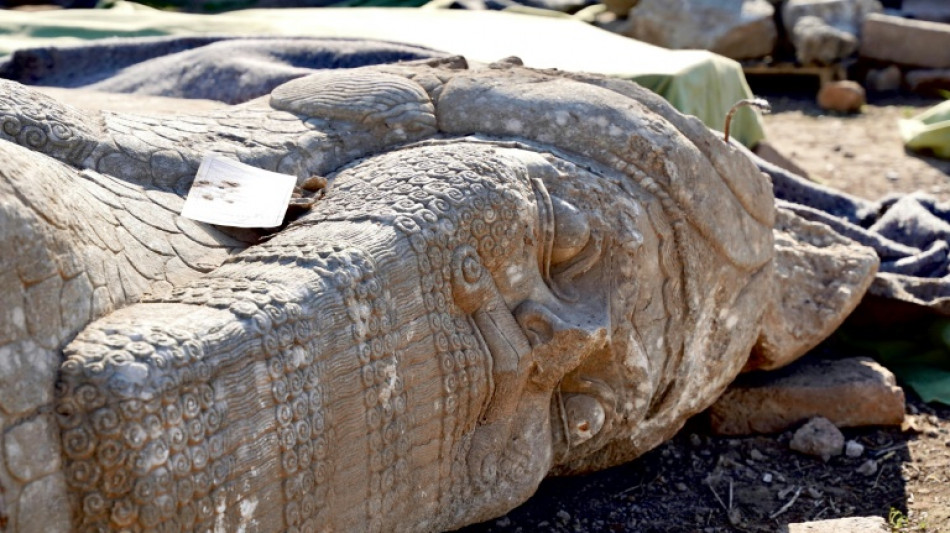
A decade after jihadists ransacked Iraq's famed Nimrud site, archaeologists have been painstakingly putting together its ancient treasures, shattered into tens of thousands of tiny fragments.
Once the crown jewel of the ancient Assyrian empire, the UNESCO-listed archaeological site was ravaged by Islamic State (IS) fighters after they seized large areas of Iraq and neighbouring Syria in 2014.
The precious pre-Islamic artefacts destroyed by the jihadists are now in pieces, but the archaeologists working in Nimrud are undaunted by the colossal task they face.
"Every time we find a piece and bring it to its original place, it's like a new discovery," Abdel Ghani Ghadi, a 47-year-old expert working on the site, told AFP.
More than 500 artefacts were found shattered at the site, located about 30 kilometres (19 miles) from Mosul, the city in northern Iraq where IS established the capital of their self-declared "caliphate".
Meticulous excavation work by Iraqi archaeologists has already yielded more than 35,000 fragments.
The archaeologists have been carefully reassembling bas-reliefs, sculptures and decorated slabs depicting mythical creatures, which had all graced the palace of Assyrian King Ashurnasirpal II nearly 3,000 years ago.
Seen from above, the pieces of the puzzle gradually come together. Shards of what just several years ago was a single artefact are placed side by side, protected by sheets of green tarpaulin.
Bit by bit, the image of Ashurnasirpal II appears on one bas-relief alongside a winged, bearded figure with curly hair and a flower on its wrist, as the restoration brings back to life rich details carved in stone millennia ago.
Another artefact shows handcuffed prisoners from territories that rebelled against the mighty Assyrian army.
Partially reconstructed lamassus -- depictions of an Assyrian deity with a human head, the body of a bull or a lion and the wings of a bird -- lay on their side, not far from tablets bearing ancient cuneiform text.
- 'Complex operation' -
"These sculptures are the treasures of Mesopotamia," said Ghadi.
"Nimrud is the heritage of all of humanity, a history that goes back 3,000 years."
Founded in the 13th century BC as Kalhu, Nimrud reached its peak in the ninth century BC and was the second capital of the Assyrian empire.
Propaganda videos released by IS in 2015 showed jihadists destroying monuments with bulldozers, hacking away at them with pickaxes or exploding them.
One of those monuments was the 2,800-year-old temple of Nabu, the Mesopotamian god of wisdom and writing.
IS fighters wreaked havoc at other sites too, like the once-celebrated Mosul Museum and ancient Palmyra in neighbouring Syria.
The jihadist group was defeated in Iraq in 2017, and the restoration project in Nimrud began a year later, only to be interrupted by the Covid-19 pandemic and restart in 2023.
Mohamed Kassim of the Academic Research Institute in Iraq told AFP that "until now, it has been a process of collection, classification and identification."
About 70 percent of the collection work has been completed at the Assyrian palace site, with about a year's worth of fieldwork left before restoration can begin in full force, said Kassim, noting it was a "complex operation".
His organisation has been working closely with Iraqi archaeologists, supporting their drive to "save" Nimrud and preserve its cultural riches, through training sessions provided by the Smithsonian Institution with financial support from the United States.
- One shard after another -
Kassim said that the delicate restoration process will require expertise not found in Iraq and "international support" due to the extent of the "barbaric" destruction in Nimrud.
"One of the most important ancient sites of the Mesopotamian civilisation," according to Kassim, Nimrud is a testament to a golden age of "the art and architecture of the Assyrian civilisation".
The site was first excavated by archaeologists in the 19th century and received international recognition for the immense lamassu figures that were taken to Europe to be exhibited in London's British Museum and the Louvre in Paris.
Other artefacts from Nimrud have been on display in Mosul and Iraq's capital Baghdad.
The site has also attracted figures like British author Agatha Christie, who visited there with her archaeologist husband.
On a recent tour of Nimrud, Iraq's Culture Minister Ahmed Fakak al-Badrani hailed the "difficult" work carried out by archaeologists there, collecting broken pieces and comparing them to drawings and photographs of the artefacts they attempt to reconstruct.
The vast destruction has made it impossible, at least for now, to ascertain which antiquities were stolen by IS, the minister said.
And the process will take time.
Badrani said he expects that it will take 10 years of hard work before the marvels of King Ashurnasirpal II's palace can be seen again, complete.
S.Leonhard--VB