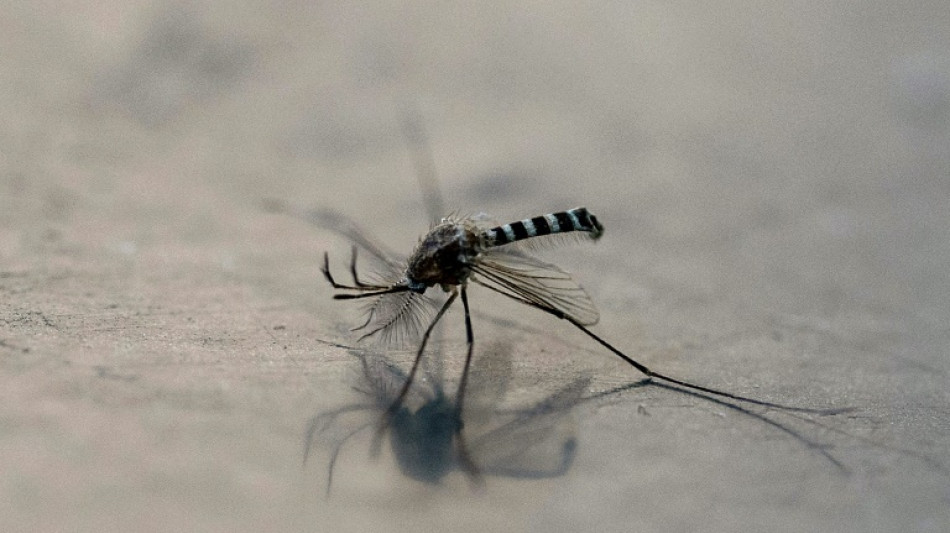
Mosquitoes with 'toxic' semen could stem disease spread: research / Photo: © AFP

 Panama Canal considering more cuts in transits due to El Nino

 Maresca agrees with Haaland that players started season jaded

 Hurricane warning issued for westernmost Hawaiian islands

 UK PM denounces 'politics of poison' after anti-migrant protests

 Comeback queen Zheng strikes again for US Open quarter-final berth

 Third absence for injured Hadjar as Lawson fills in again in Spain

 Far-right victory in Germany draws protesters in Berlin

 CapTLX Launches Institutional Gateway to U.S. Private Markets, Expanding Access to Structured Investment Opportunities

 Africa's richest man eyes continent's largest IPO

 Macron, SKorea leader warn at film summit of AI risks to creativity

 'Impressive' Alcaraz has Shelton in sights in US Open quarter-final

 Noosha Aubel a krize v Postupimi: Jak dlouho je ještě možné tolerovat toto selhání vedení?

 Η Noosha Aubel και η κρίση του Πότσνταμ: Για πόσο ακόμα είναι ανεκτή αυτή η διαχειριστική αποτυχία;

 Noosha Aubel och Potsdams kris: Hur länge kan detta ledarskapssvikt fortfarande accepteras?

 努莎·奧貝爾與波茨坦的危機:這種領導失職還能容忍多久?

 नूशा ऑबेल और पॉट्सडैम का संकट: नेतृत्व की इस विफलता को और कितना सहन किया जा सकता है?

 Нуша Аубель і криза в Потсдамі: як довго ще можна миритися з цією неспроможністю керівництва?

 England quick Archer in 'good place' after injuries

 Robots protest rampant AI in Poland

 Rare woman director in Venice sees industry backsliding on gender

 France, SKorea warn at film summit of AI risks to creativity

 Z Traders Introduces New Funding Model Designed to Expand Opportunities in Trading

 Lebanon says 12 killed in strikes as Israel vows to 'remove threats'

 Volkswagen plant to be converted for Israeli defence group

 Israeli rubble-clearing in Gaza could erase 'atrocity crimes' evidence: UN expert

Genetically engineered mosquitoes with toxic semen could be a new weapon against tropical disease, Australian scientists said after trialling the novel pest control method.
The "toxic male technique" aims to breed mosquitoes that express venomous proteins in their semen, killing off females after mating.
Female mosquitoes are targeted because only they bite and drink blood, thereby spreading diseases such as malaria and dengue fever.
Scientist Sam Beach from Australia's Macquarie University said the method "could work as quickly as pesticides without also harming beneficial species".
"This innovative solution could transform how we manage pests, offering hope for healthier communities and a more sustainable future."
The first proof-of-concept trials used fruit flies, a common laboratory species favoured for its short two-week life cycle.
Female flies that bred with "toxic" males had a significantly reduced lifespan, the scientists found.
Researcher Maciej Maselko said the team would now trial the method in mosquitoes.
"We still need to implement it in mosquitoes and conduct rigorous safety testing to ensure there are no risks to humans or other non-target species," he said.
Genetic engineering has been used for years to control populations of disease-spreading mosquitoes.
Typically, these approaches slow reproduction by releasing hordes of male insects that are genetically modified to be sterile.
Computer models showed techniques actively killing biting females could be far more effective, the research team said.
The research was described in a paper published by peer-reviewed journal Nature Communications on Tuesday evening.
C.Stoecklin--VB