Secret lab developing UK's first quantum clock: defence ministry / Photo: © NIST/AFP

 Nepal flood death toll rises as rescuers scour tunnels
 France's Mistral sees value soar with 3 bn euro cash infusion
 Nepal glacier saw exceptional heat before collapse caused deadly floods: researcher
 Ethiopia boosts drone production to fight rebels
 Yemen rebels hit Saudi Arabia with wave of strikes, wounding 73

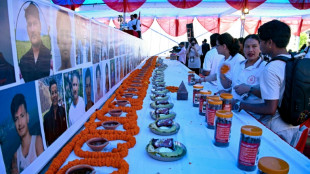 Nepalis mark a year since deadly protests that toppled government
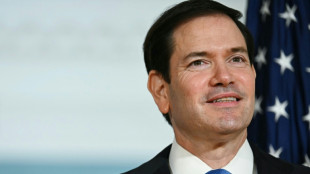 Rubio launches Latin America tour to cement US influence
 France tries 14 over deadliest Channel migrant crossing disaster

 Australia threatens hefty fines if big tech fails 'duty of care'
 Zverev romps into quarter-finals as Darderi downed
 Kauai on tornado watch as Hurricane Lowell nears Hawaiian islands

 Pakistan roll the dice in search of consolation win over England

 Yen extends gains as traders eye rate hike, tech rallies again
 'The ber months': Christmas arrives early in the Philippines
 N. Korea calls Russia bridge a sign of tighter ties
 US sanctions threaten to crush Iranian students' dreams
 Former champ Gauff holds off Jovic to reach US Open quarter-finals

 OMP Asia Conferences to Showcase How Industry Leaders Kraft Heinz, Mars, Medac, And Nestlé Approach AI-Powered Supply Chain Planning At "Decision Velocity"

 Panama Canal considering more cuts in transits due to El Nino

 Maresca agrees with Haaland that players started season jaded

 Hurricane warning issued for westernmost Hawaiian islands

 UK PM denounces 'politics of poison' after anti-migrant protests

 Comeback queen Zheng strikes again for US Open quarter-final berth

 Third absence for injured Hadjar as Lawson fills in again in Spain
 Far-right victory in Germany draws protesters in Berlin

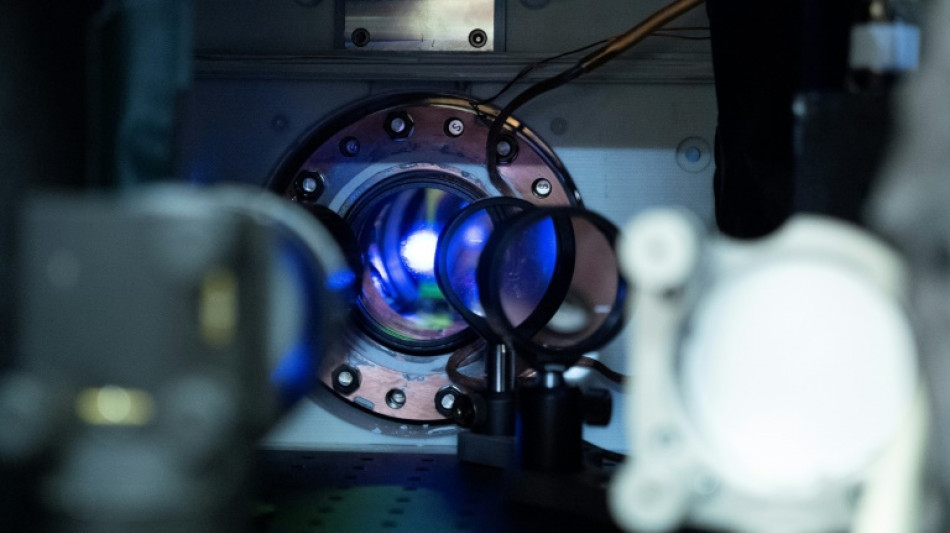
A top-secret lab in the UK is developing the country's first quantum clock to help the British military boost intelligence and reconnaissance operations, the defence ministry said Thursday.
The clock is so precise that it will lose less than one second over billions of years, "allowing scientists to measure time at an unprecedented scale," the ministry said in a statement.
"The trialling of this emerging, groundbreaking technology could not only strengthen our operational capability, but also drive progress in industry, bolster our science sector and support high-skilled jobs," Minister for Defence Procurement Maria Eagle said.
The groundbreaking technology by the Defence Science and Technology Laboratory will reduce reliance on GPS technology, which "can be disrupted and blocked by adversaries," the ministry added.
It is not a world first, as the University of Colorado at Boulder developed a quantum clock 15 years ago with the US National Institute of Standards and Technology.
But it is "the first device of its kind to be built in the UK," the statement said, adding it could be deployed by the military "in the next five years".
A quantum clock uses quantum mechanics -- the physics of matter and energy at the atomic and subatomic scale -- to keep time with unprecedented accuracy by measuring energy fluctuations within atoms.
Accurate timekeeping is crucial for satellite navigation systems, mobile telephones and digital TV, among other applications, and may open new frontiers in research fields such as quantum science.
Companies and governments around the world are keen to cash in on the huge potential benefits quantum technology could bring.
Google last month unveiled a new quantum computing chip it said could do in minutes what it would take leading supercomputers 10 septillion years to complete.
The United States and China are investing heavily in quantum research, and the US administration has imposed tight restrictions on exporting such sensitive technology.
One expert, Olivier Ezratty, told AFP in October that private and public investment in such technology had reached $20 billion during the past five years.
The defence ministry said future research would "see the technology decrease in size to allow mass manufacturing and miniaturisation, unlocking a wide range of applications, such as use by military vehicles and aircraft".
U.Maertens--VB