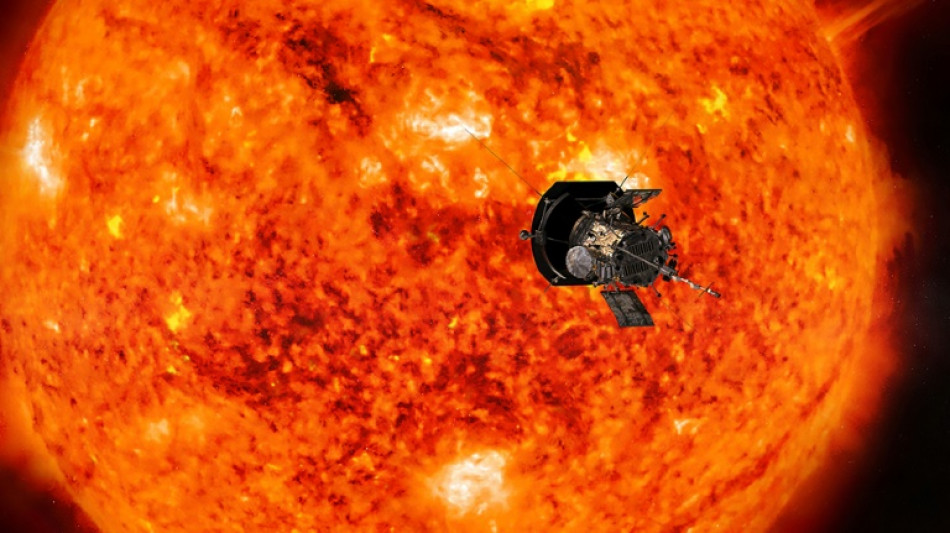
NASA probe makes closest ever pass by the Sun / Photo: © NASA/Johns Hopkins APL/AFP/File

 Sabalenka edges Noskova, keeps US Open treble bid alive

 Real Madrid win Champions League opener as Haaland stars for Man City

 Gambian leader vows power boost after violent blackout protests

 Newcastle battle past Millwall to reach League Cup fourth round
 Mourinho's Real Madrid make winning start against Inter Milan

 Villa take 'big step forward' with win over Brugge

 Yaya Toure hails 'new era' for African coaches ahead of Champions League bow

 Lawes and Marchant told to prove themselves in quest for England recalls

 Smithsonian secretary to retire as Trump exerts control over institution

 Atletico have work to do to reach home Champions League final: Simeone

 Villa end goal drought to beat Brugge in Champions League opener

 McIlroy says 'we'll keep our heads down and play' in event of Trump golf visit

 Sabalenka holds of Noskova to reach US Open semi-finals

 Netanyahu under fire over report UAE warned of October 7 attack

 Wasim Akram urges 'fair treatment' for jailed Imran Khan

 No. 1 in reach as Rybakina battles for US Open semi-final spot

 Putin and Trump discuss Ukraine in 'extremely frank' call

 French police hunt Renoir thieves after lightning museum heist

 World Cup final scorer Torres leads Ballon d'Or nominees
 Carney touts Canada 'pivot' away from US as tariffs rise

 Spanish stars Cruz, Bardem play strained on-screen couple in new film

 The "Everlasting Battery" Inside Your Joints:UConn Professor's Self-Powered Healing Material just Got Acquired

 Visionary or conman? Elon Musk enigmatic star of Venice documentary

 Trial opens in France over deadliest Channel migrant crossing disaster

 England skipper Root says it's wrong to accuse Pakistan of lacking fight

NASA's pioneering Parker Solar Probe made history Tuesday, flying closer to the Sun than any other spacecraft with its heat shield exposed to scorching temperatures of more than 1,700 degrees Fahrenheit (930 degrees Celsius).
Launched in August 2018, the spaceship is on a seven-year mission to deepen scientific understanding of our star and help forecast space-weather events that can affect life on Earth.
Tuesday’s historic fly-by should have occurred at precisely 6:53am (1153 GMT), although mission scientists will have to wait until Friday for confirmation as they lose contact with the craft for several days due to its proximity to the Sun.
If the distance between Earth and the Sun is the equivalent to the length of an American football field, the spacecraft should have been about four yards (meters) from the end zone at the moment of closest approach – known as perihelion.
"This is one example of NASA's bold missions, doing something that no one else has ever done before to answer longstanding questions about our universe," Arik Posner, Parker Solar Probe program scientist said in a statement on Monday.
"We can't wait to receive that first status update from the spacecraft and start receiving the science data in the coming weeks."
So effective is the heat shield, that the probe’s internal instruments remain near room temperature -- around 85F (29C) -- as it explores the Sun's outer atmosphere, called the corona.
Parker will also be moving at a blistering pace of around 430,000 mph (690,000 kph), fast enough to fly from the US capital Washington to Tokyo in under a minute.
"No human-made object has ever passed this close to a star, so Parker will truly be returning data from uncharted territory," said Nick Pinkine, mission operations manager at the Johns Hopkins Applied Physics Laboratory (APL) in Laurel, Maryland.
"We're excited to hear back from the spacecraft when it swings back around the Sun."
By venturing into these extreme conditions, Parker has been helping scientists tackle some of the Sun's biggest mysteries: how the solar wind originates, why the corona is hotter than the surface below, and how coronal mass ejections -- massive clouds of plasma that hurl through space -- are formed.
The Christmas Eve flyby is the first of three record-setting close passes, with the next two -- on March 22, 2025, and June 19, 2025 -- both expected to bring the probe back to a similarly close distance from the Sun.
I.Stoeckli--VB