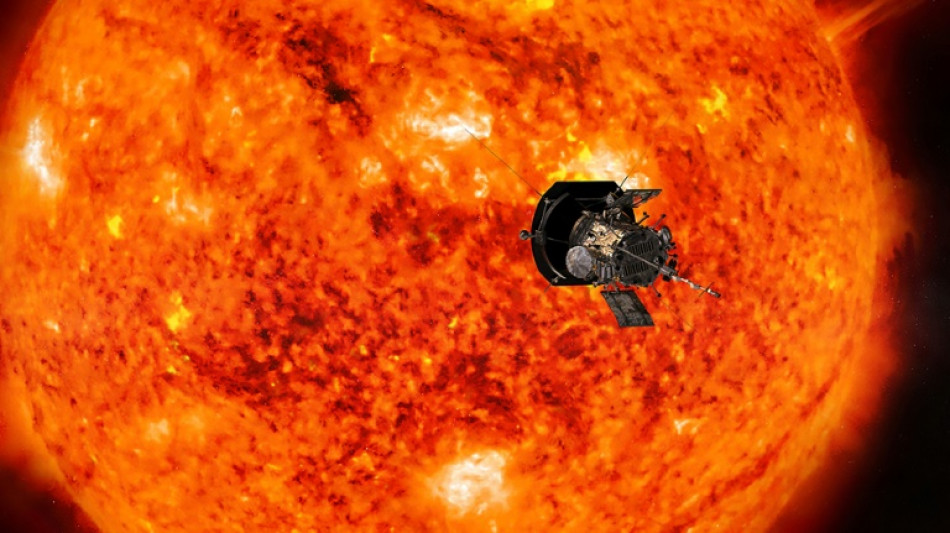
NASA solar probe to make its closest ever pass of Sun / Photo: © NASA/Johns Hopkins APL/AFP/File

 Norway bids farewell to King Harald V, 'grandfather' of the nation

 NFL breaks new ground as 100,000 set to pack MCG in Australia

 EU faces revolt over social media ban for children

 Canada eyes researchers looking to leave 'hostile' US

 Tiafoe escapes Michelsen to reach US Open semi-finals

 Carney touts Canada 'pivot' away from US as Trump levels new threat

 Pounding waves open up sinkhole in swanky Malibu

 LIV Golf files for bankruptcy protection

 Argentina launches legal action against oil firms for Falklands drilling

 Haaland double powers Man City to victory over Porto

 Sabalenka survives Noskova to return to US Open semi-finals

 'South Park' changes name in dig at Trump

 OpenAI says AI solved one of math's hardest problems in days

 Nearly 1,100 flights cancelled after UK air traffic control glitch

 Sabalenka holds off Noskova to keep US Open three-peat bid alive

 Rein in social media not children, say over 130 groups, experts

 Hong Kong's first post-colonial leader Tung Chee-hwa dies aged 89

 Rangers captain Shankland sidelined for up to four months

 NY failed to disclose what it knew on 'toxic air' after 9/11

 What we learned from 'lacerating' four-hour Musk documentary

 UK, France, Canada to ban imports from Israeli settlements

 Pakistan's drastic squad upheaval 'news' to skipper Babar Azam

 Hurricane Lowell lashes Hawaii's western islands

 Argentina files lawsuit against oil firms operating off Falklands

 Root wants Pietersen to pull no punches on England return

NASA's pioneering Parker Solar Probe is poised to make its closest-ever approach of the Sun on Christmas Eve, a record-setting 3.8 million miles (6.2 million kilometers) from the surface.
Launched in August 2018, the spaceship is on a seven-year mission to deepen scientific understanding of our star and help forecast space-weather events that can affect life on Earth.
Its closest approach to date will happen on Tuesday, December 24, at 6:53 am (11:53 GMT).
If the distance between Earth and the Sun is the equivalent to the length of an American football field, the spacecraft would be about four yards (meters) from the end zone at that point.
"This is one example of NASA's bold missions, doing something that no one else has ever done before to answer longstanding questions about our universe," said Arik Posner, Parker Solar Probe program scientist, in a statement.
"We can't wait to receive that first status update from the spacecraft and start receiving the science data in the coming weeks."
During this closest approach -- known as perihelion -- mission teams will lose direct contact with Parker, relying on a "beacon tone" this Friday to confirm the spacecraft's status.
Although the heat shield will endure scorching temperatures of about 1,600 to 1,700 degrees Fahrenheit (870 to 930 degrees Celsius), the probe's internal instruments will remain near room temperature -- around 85F (29C) -- as it explores the Sun's outer atmosphere, called the corona.
Not only will the temperatures be extreme, but Parker will also be moving at a blistering pace of around 430,000 mph (690,000 kph), fast enough to fly from the US capital Washington to Tokyo in under a minute.
"No human-made object has ever passed this close to a star, so Parker will truly be returning data from uncharted territory," said Nick Pinkine, Parker Solar Probe mission operations manager at the Johns Hopkins Applied Physics Laboratory (APL) in Laurel, Maryland.
"We're excited to hear back from the spacecraft when it swings back around the Sun."
By venturing into these extreme conditions, Parker has been helping scientists tackle some of the Sun's biggest mysteries: how the solar wind originates, why the corona is hotter than the surface below, and how coronal mass ejections -- massive clouds of plasma that hurl through space -- are formed.
This Christmas Eve flyby is the first of three record-setting close passes, with the next two -- on March 22, 2025, and June 19, 2025 -- both expected to bring Parker Solar Probe back to a similarly close distance from the Sun.
C.Bruderer--VB