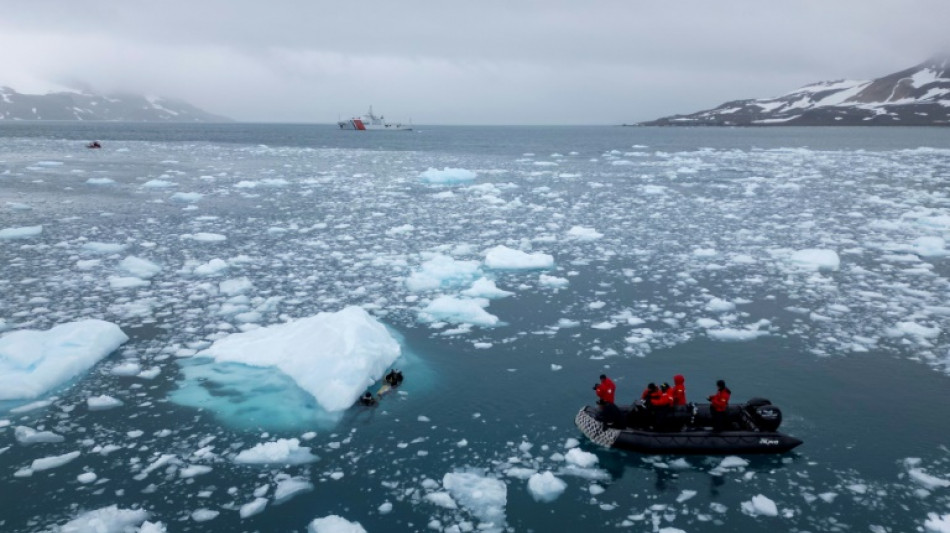
Melting sea ice in Antarctica causes ocean storms, scientists say / Photo: © AFP

 France far right expels policeman member over racist remarks

 Pakistan collapse to 133 all out against England in 3rd Test

 Heat forces French champagne makers to stiffen their drink

 Iran war drives oil prices to $100 per barrel as Tehran strikes ships

 Pakistan collapse to 100-7 against England in 3rd Test

 Workers, migrants focus of documentaries by Oscar winners at Venice

 Nepal seeks survivors two weeks after deadly floods

 Bangladesh measles crisis kills more than 1,000 children

 Pakistan collapse to 26-4 against England in 3rd Test

 EU helps cities tighten screws on Airbnb, holiday rentals

 Courtois to put Belgium career on hold

 RavenDB Launches Quill to Bring Production AI Agents to Enterprise SQL Systems, No Migration Required

 Affleck family affair at Venice for Casey's latest film 'Company'

 Yemen rebels report fresh Saudi strikes as conflict deepens

 'They're playing with our lives': AI researcher quits Anthropic

 Series finale of 'Babylon Berlin' offers dark mirror for today's Germany

 Zara owner Inditex boosts profits as sales grow across board

 Alcaraz out in latest US Open finish, Sabalenka through on marathon day

 Brent breaks $100 on Mideast flare-up, fanning inflation fears

 South Korea video game tycoon to pay record $1.5 bn in divorce

 'Long live Chairman Mao': Supporters pay respects to founder of Communist China

 Sweden immigration restrictions spark healthcare concerns

 EU to help cities tighten screws on Airbnb, holiday rentals

 'Our year': Kane and Bayern primed for Champions League tilt

 Australian World Cup star Volpato fined over positive cocaine test

The record-breaking retreat of Antarctic sea ice in 2023 has led to more frequent storms over newly exposed parts of the Southern Ocean, according to a study published Wednesday.
Scientists know that the loss of Antarctic sea ice can diminish penguin numbers, cause ice shelves to melt in warmer waters, and impede the Southern Ocean from absorbing carbon dioxide.
But this new research, published in the peer-reviewed journal Nature, explores another consequence: increased heat loss from the ocean to the atmosphere, and an associated rise in storms.
Since 2016 there has been a large-scale reduction in Antarctic sea ice, but nothing like 2023 when a record amount failed to reform over the winter.
For this study, Simon Josey of the UK's National Oceanography Centre and colleagues focussed on three regions that experienced unusually high levels of sea-ice retreat that year.
Using satellite imagery, ocean and atmospheric data, and wind and temperature measurements, they found some newly ice-free areas experienced double the heat loss compared to a stabler period before 2015.
This was accompanied by "increases in atmospheric-storm frequency" over previously ice-covered regions, the authors found.
"In the sea-ice-decline regions, the June–July storm frequency has increased by up to 7 days per month in 2023 relative to 1990–2015."
The loss of heat caused by reduced sea ice could have implications for how the ocean circulates and the wider climate system, the study added.
Oceans are a crucial climate regulator and carbon sink, storing more than 90 percent of the excess heat trapped near Earth's surface by greenhouse gas emissions.
In particular, sea-ice retreat could mean changes in how a deeper layer of cold, dense Antarctic bottom water absorbs and stores heat.
The authors said further in-depth analysis of possible climate impacts were needed, including if sea-ice retreat could have even further-reaching consequences.
"Repeated low ice-cover conditions in subsequent winters will strengthen these impacts and are also likely to lead to profound changes further afield, including the tropics and the Northern Hemisphere," it said.
R.Braegger--VB