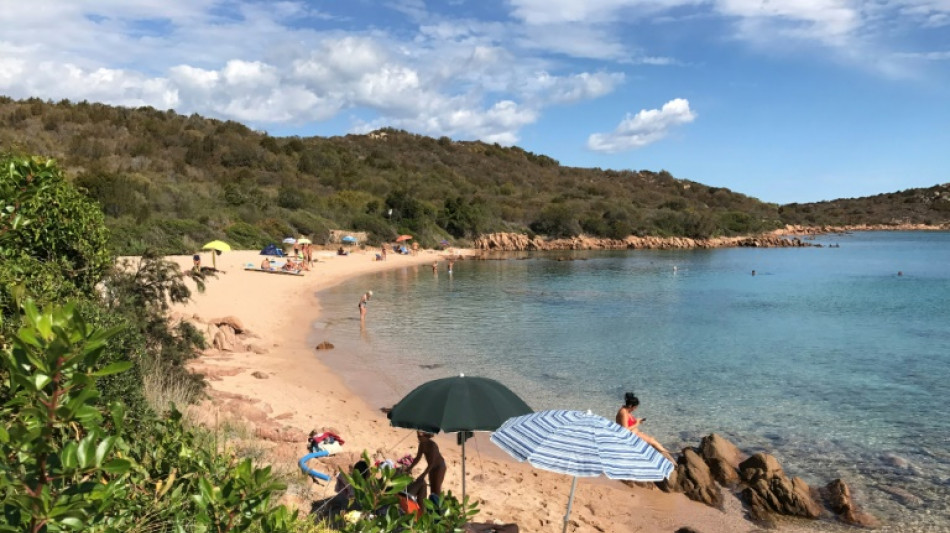
The secret to living to 110? Bad record-keeping, researcher says / Photo: © AFP/File

 'Hopeless, stuck, afraid': US deportees in limbo in Cameroon

 Mount Fuji ends hiking season with landslide, two rescues

 Seahawks beat Patriots again in NFL opener

 Asian Games begin with Qatar basketball win, nine days before opening ceremony

 Stocks sink as oil rally fans inflation and rate hike fears

 Argentine industry reels from Milei's free-market revolution

 Women quit South Korea's grind for diving tradition

 Bayeux Tapestry 'mania' sweeps UK as sold-out exhibition opens

 August hottest month ever recorded globally: EU monitor

 Duplantis leads creme de la creme at 'game-changing' Ultimate Championship

 Sjobo, cradle of Sweden's now-mainstream anti-migrant sentiment

 Israeli-made film about Gaza civilian deaths to debut in Venice

 Stars ready for busy Toronto International Film Festival

 Rubio defends anti-drug boat strikes, warns of cartel 'cancer'

 Rybakina books US Open semi against Gauff, secures No.1 ranking

 Pegula aiming to thwart Sabalenka three-peat in US Open semis

 'Not normal' US Open scheduling under-fire after late-night finishes

 Luis Enrique hails 'marvellous' Dembele as PSG win big in Champions League

 Liverpool's Iraola 'lucky' after first taste of Champions League

 Resurgent Zheng takes positives from storming US Open run

 Odegaard gives Arsenal winning Champions League start at Napoli

 Bond yields jump despite $6 bn US government intervention

 Mac Allister caps Liverpool comeback to beat Atletico Madrid

 Ferran Torres hits hat-trick as PSG wallop Slovan in Champions League

 New CEO unveils Apple's first foldable iPhone

Most of what we know about humans living to very old age is based on faulty data, including the science behind the "blue zones" famous for having a high proportion of people over 100, according to one researcher.
The desire to live as long as possible has driven a booming lifestyle industry selling supplements, books, tech and tips to those wanting to learn the secrets of the world's oldest people.
But Saul Justin Newman, a researcher at University College London's Centre for Longitudinal Studies, told AFP that most extreme old age data "is junk to a really shocking degree".
Newman's research, which is currently being peer-reviewed, looked at data about centenarians and supercentenarians -- people who live to 100 and 110 -- in the United States, Italy, England, France and Japan.
Contrary to what one might expect, he found that supercentenarians tended to come from areas with poor health, high levels of poverty -- and bad record-keeping.
The true secret to extreme longevity seems to be to "move where birth certificates are rare, teach your kids pension fraud and start lying", Newman said as he accepted an Ig Nobel prize, a humorous version of the Nobel, in September.
Just one of many examples is Sogen Kato, who was thought to be Japan's oldest living person until his mummified remains were discovered in 2010.
It turned out he had been dead since 1978. His family was arrested for collecting three decades of pensions payments.
The government then launched a review which found that 82 percent of Japan's centenarians -- 230,000 people -- were missing or dead.
"Their paperwork is in order, they're just dead," Newman said.
This illustrates the problem Newman has sought to shine a light on -- that confirming ages in this field involves triple-checking very old documents that could have been wrong from the start.
The industry that has popped up around blue zones is one "symptom" of this problem, he said.
- 'Only alive on pension day' -
Blue zones are regions around the world where people are said to live disproportionately longer and healthier lives.
The term was first used in 2004 by researchers referring to the Italian island of Sardinia.
The following year, National Geographic reporter Dan Buettner wrote a story that added the Japanese islands of Okinawa and the Californian city of Loma Linda.
Buettner admitted to the New York Times in October that he only included Loma Linda because his editor told him: "you need to find America's blue zone".
The reporter teamed up with some demographers to create the Blue Zones lifestyle brand, and they added Costa Rica's Nicoya Peninsula and the Greek island of Ikaria to the list.
However, as seen in Japan, later government records have cast doubt on old age data in these regions.
In Costa Rica, 2008 research showed that 42 percent of centenarians had "lied about their age" in an earlier census, Newman said.
For Greece, he found 2012 data suggesting that 72 percent of the country's centenarians were dead or imaginary.
"They're only alive on pension day," Newman said.
Several prominent blue zone researchers wrote a rebuttal earlier this year, calling Newman's work "ethically and academically irresponsible".
They accused Newman of referring to broader regions of Japan and Sardinia when the blue zones were smaller areas.
The demographers also emphasised they had "meticulously validated" the ages of supercentenarians in blue zones, double-checking historical records and registries dating back to the 1800s.
Newman said this argument illustrated his point.
"If you start with a birth certificate that's wrong, that gets copied to everything, and you get perfectly consistent, perfectly wrong records," he said.
- A clock to measure age -
The only "way out of this quagmire" is to physically measure people's ages, Newman said.
Steve Horvath, an ageing researcher at the University of California, told AFP he had created a new technique called a methylation clock "for the express purpose of validating claims of exceptional longevity".
The clock can "reliably detect instances of severe fraud", such as when a child assumes their parent's identity, but cannot yet tell the difference between a 115- and 120-year-old, he said.
Horvath has offered to test a DNA sample of France's Jeanne Calment, who died at 122 in 1997 and holds the record for the oldest confirmed age.
Newman's analysis "appears to be both rigorous and convincing", Horvath said, adding that several blue zones are overseen by rigorous scientists.
"I suspect both opinions hold some truth," he said.
So what can people at home take away from this debate?
"If you want to live a long time, step number one: don't buy anything," Newman said.
"Listen your GP (doctor), do some exercise, don't drink, don't smoke -- that's it."
P.Keller--VB