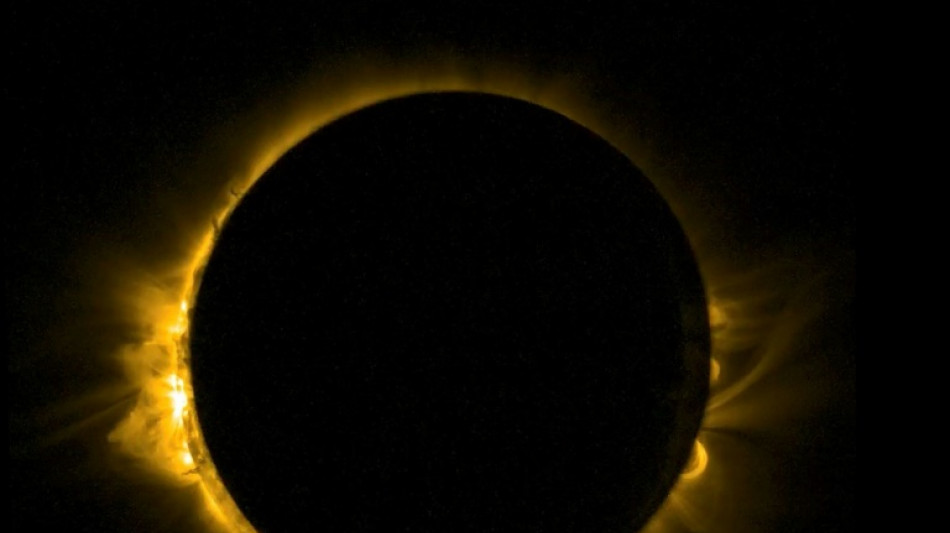
India launches European 'artifical eclipse' satellites / Photo: © ESA/AFP/File

 No jet lag for 49ers as Purdy routs Rams in Australia

 Mourinho seeking 'killer' Vinicius as Real Madrid face Rayo

 Vance assails Democratic 'hatred' in fiery US midterm pitch

 Celine Dion: the Quebec star's long and painful road to return

 Stocks tumble as oil and inflation fan rate hike bets

 Philippine Coast Guard battles smoke in search for ferry fire missing

 Researchers eye AI revolution in natural disaster forecasts

 Indian filmmaker Anuparna Roy: blocked at home, feted in Europe

 Appreciation, anger await as Trump heads to Irish golf resort

 Ronaldo takes last crack at Asian glory as Saudi teams set to dominate

 Statecraft or scripture: Why Pacific nations want Jerusalem embassies

 Hong Kong to sentence Tiananmen vigil activists for subversion

 US braces for inflation report that may push Fed to hike rates

 Australia unveil Slingsby-led elite team for America's Cup challenge

 Putin arrives in India for BRICS summit coloured by wars

 Springboks, All Blacks clash in groundbreaking US decider

 Man United, Bayern cruise as Como make dream Champions League start

 Musiala returns to help Bayern sink Bodo in Champions League

 Surging oil prices, higher bond yields weigh on stocks

 Russell admits he needs luck as Antonelli focuses on the job

 Canada pledges support for Ukraine air defense as Zelensky visits
 Latin America fact-check group asks Meta not to replace verification practice

 Seahawks' Darnold gets good news on hip injury: coach

 Evasive Alonso teases reporters on his F1 future

 What to know about Trump's $5,000 'dividend' pledge
India on Thursday successfully launched into space a pair of European satellites that will create artificial solar eclipses to help scientists catch a rare glimpse of the Sun's mysterious atmosphere.
Scientists broke into rapturous applause at the Sriharikota launch site as the Indian Space Research Organisation (ISRO) chief announced the spacecraft had been ejected as planned.
"The spacecraft has been placed in the right orbit," ISRO chief S. Somanath said.
The launch, originally scheduled for Wednesday but delayed by a technical fault, was for the European Space Agency's "Project for On-Board Autonomy 3" (Proba-3) mission, part of a series of "in-orbit missions to test out new technologies".
The mission, at a cost of 200 million euros ($211 million), creates artificial total solar eclipses by positioning two satellites 150 metres (500 feet) apart from each other.
The shadow cast by one satellite allows the other to observe solar phenomena while blocking out the light from the Sun itself.
"For six hours at a time, it will be able to see the Sun's faint atmosphere, the corona, in the hard-to-observe region between the Sun's edge and 1.4 million kilometres from its surface," the European Space Agency said in a pre-launch analysis.
The project will help scientists answer key questions, including why the corona is so much hotter than the Sun itself, and how the Sun's energy output changes over time.
India has emerged as a reliable and low-cost option for putting commercial spacecraft and the satellites of other countries into space.
Experts say New Delhi can keep costs low by copying and adapting existing technology, and thanks to an abundance of highly skilled engineers who earn a fraction of their foreign counterparts' wages.
The world's most populous country has flexed its spacefaring ambitions in the last decade with its space programme growing considerably in size and momentum, matching the achievements of established powers at a much cheaper price tag.
In August 2023, it became just the fourth nation to land an unmanned craft on the Moon after Russia, the United States and China.
Prime Minister Narendra Modi also announced plans last year to send a man to the Moon by 2040.
C.Kreuzer--VB