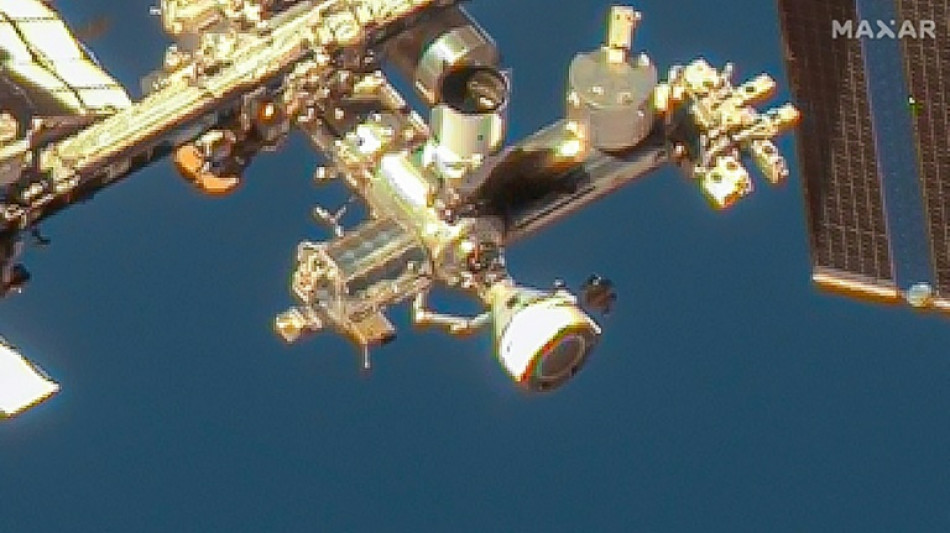
Boeing's troubled Starliner spaceship to return to Earth sans crew / Photo: © Satellite image ©2024 Maxar Technologies/AFP/File

 Saudi PIF Retains Top Sovereign Wealth Fund Brand Title for Third Year

 Phoenix Weekend Guide: Sangria Socials, Pie Markets, and New Brunch Spots

 Trent Perry’s Late Heroics Lift No. 7 UCLA Past Cal State Fullerton

 2027 Hyundai Elantra Review: Brutalist Design and Expanded Dimensions

 Malta Maritime Forum Study Reveals €1 Billion Economic Contribution Amid Growth Concerns

 China Condemns Chile-Belgium Joint Bid for High Seas Treaty Headquarters
Boeing's problem-plagued Starliner is set to finally depart the International Space Station (ISS) on Friday, returning to Earth without astronauts after NASA deemed the risk too great.
The century-old aerospace giant's reputation has taken a hammering over thruster malfunctions and helium leaks its spaceship encountered on its way up to the orbital outpost in June, and the US space agency's subsequent decision to fly its crew back on a rival SpaceX Crew Dragon next year.
A smooth, uneventful ride home is critical not only for salvaging some pride but also for Boeing's prospects of securing certification to fly astronauts in the future.
Starliner will autonomously undock from the space station around 6:04 pm Eastern Time (2204 GMT), landing at White Sands Space Harbor in New Mexico at approximately 0403 GMT.
NASA opted to bring the ship home without astronauts Butch Wilmore and Suni Williams despite Boeing's assurances of a safe flight.
The company carried out extensive ground testing that aimed to replicate the technical hitches the spaceship had experienced on its ascent, and devised plans to prevent more problems.
In the end, however, Boeing could not convince NASA it could be trusted to bring back the pair, who were originally meant to stay on the ISS for roughly a week as they tested out Starliner, but will now remain there until February.
"Boeing believed in the model that they had created that tried to predict the thruster degradation for the rest of the flight," Steve Stich, program manager for NASA's Commercial Crew Program told reporters this week.
But "the NASA team, due to the uncertainty in the modeling, could not get comfortable with that," he added, characterizing the mood during meetings as "tense."
- Certification decisions to come -
After undocking, Starliner will perform a powerful "breakout burn" that will shoot it well clear of the station to prevent any chance of a collision -- a maneuver that would have been unnecessary if it had crew aboard who could take manual control of the ship if needed.
Overall, the expectation is that Starliner will successfully carry out its parachute- and airbag-assisted landing -- just as it has during two previous uncrewed tests in 2019 and 2022.
But ground teams will be closely studying all aspects of its performance, particularly its troublesome thrusters during the crucial "deorbit burn" that brings the spacecraft back through Earth's atmosphere.
Stich emphasized that NASA was focused on completing the immediate tasks at hand.
"When we do that, we'll have a better understanding of when can we certify the vehicle and when can we resume flights," he said.
NASA awarded Boeing and SpaceX multibillion-dollar contracts a decade ago to develop spacecraft to ferry astronauts to and from the ISS, following the retirement of the Space Shuttle.
Elon Musk's SpaceX, however, beat Boeing to the punch, successfully flying dozens of astronauts since 2020.
R.Kloeti--VB