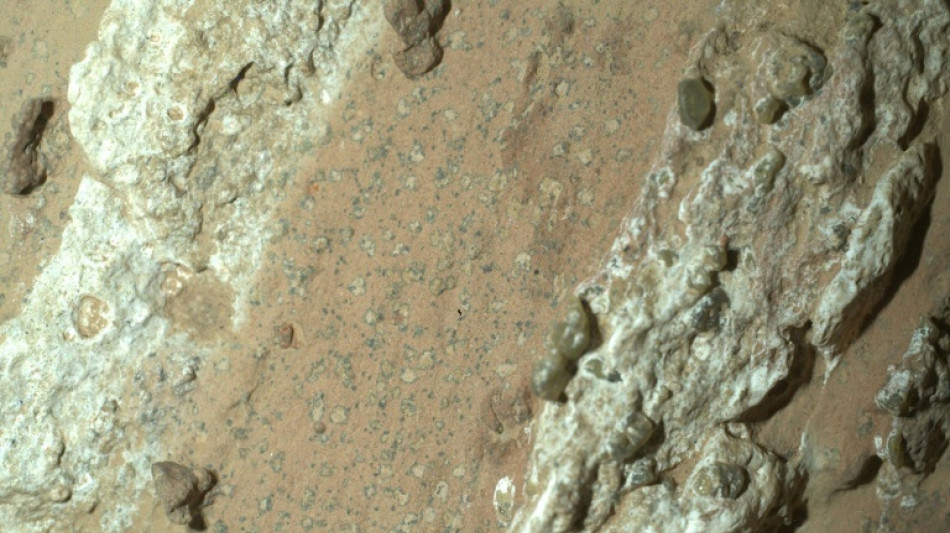
NASA Mars rover captures rock that could hold fossilized microbes / Photo: © NASA/JPL-Caltech/MSSS/AFP

 ALIX LASERS shareholders remove Michael Sobitsch as managing director in view of the circumstances

 Progressive Vision Wins Irish Healthcare Awards 2026 Innovation Prize for Office-Based Cataract Surgery

 Eight-Year-Old Georgia Wins Penrith Valley Public Speaking Competition

 Steven Berkoff on Memory and His New Autobiography 'Shouting At Night'

 Jimmy Carr Confirms 25-Year Estrangement From Father Amid Podcast Reflections

 Arizona Superintendent Tom Horne to Leave Office, Plans Law Practice and Charter School

 Japan and Peru Mark 150 Years of Diplomatic Ties Amidst Trade and Investment Talks

NASA's Perseverance Mars rover has made what could be its most astonishing discovery to date: possible signs of ancient life on the Red Planet.
The six-wheeled robotic explorer came across an intriguing, arrow-shaped rock dubbed "Cheyava Falls" that may harbor fossilized microbes from billions of years ago, when Mars was a watery world.
Perseverance drilled into the enigmatic rock to collect a core sample on July 21, as it traversed Neretva Vallis, an ancient river valley.
The samples carefully stowed beneath the rover's belly are destined to eventually return to Earth, where they will undergo more comprehensive analysis.
"Cheyava Falls is the most puzzling, complex, and potentially important rock yet investigated by Perseverance," project scientist Ken Farley of Caltech said Thursday.
Three compelling clues have scientists buzzing.
White calcium sulfate veins run the length of the rock, a telltale sign that water once flowed through it.
Between these veins is a reddish middle area, teeming with organic compounds, as detected by the rover's SHERLOC (Scanning Habitable Environments with Raman and Luminescence for Organics and Chemicals) instrument.
Finally, tiny off-white splotches ringed with black, reminiscent of leopard spots, contain chemicals that suggest energy sources for ancient microbes, according to scans by the PIXL (Planetary Instrument for X-ray Lithochemistry) instrument.
"On Earth, these types of features in rocks are often associated with the fossilized record of microbes living in the subsurface," said David Flannery, an astrobiologist and member of the Perseverance science team from the Queensland University of Technology in Australia.
The quest to confirm ancient Martian life is far from over, however.
The real test will come when Perseverance's precious rock samples are returned to Earth as part of the Mars Sample Return Program, a collaboration between NASA and the European Space Agency slated for the 2030s.
While there are alternative explanations for these findings that do not involve microbes, there is a tantalizing chance that Perseverance's core sample might contain actual fossilized microbes -- potentially making history as the first proof of life beyond Earth.
"We have zapped that rock with lasers and X-rays and imaged it literally day and night from just about every angle imaginable," said Farley.
"Scientifically, Perseverance has nothing more to give. To fully understand what really happened in that Martian river valley at Jezero Crater billions of years ago, we'd want to bring the Cheyava Falls sample back to Earth, so it can be studied with the powerful instruments available in laboratories."
G.Frei--VB