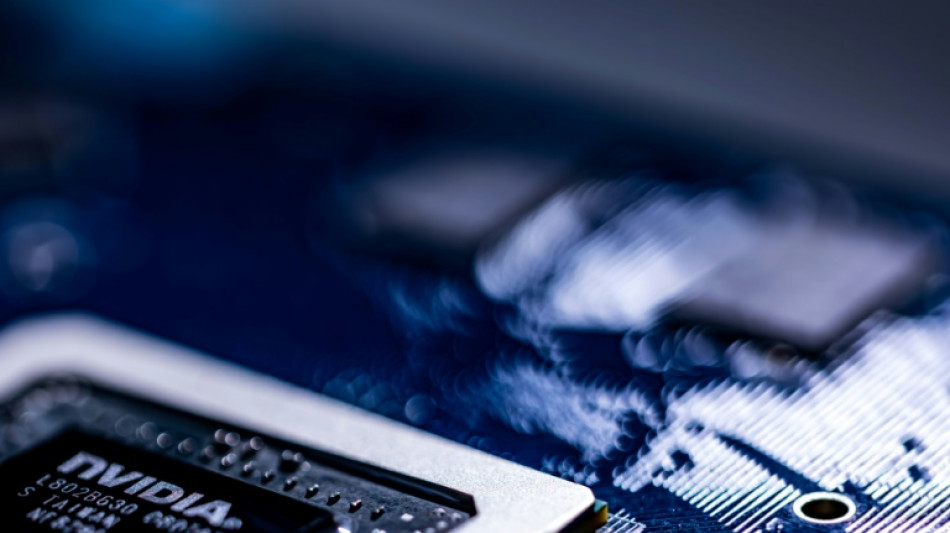
Competition heats up to challenge Nvidia's AI chip dominance / Photo: © AFP

 Houthis target Red Sea shipping as US hits Iran

 Record-equalling Red Sox streak halted at 15 wins

 Messi-less Miami beat Fire 3-2 to spoil Lewandowski's MLS debut

 Mercedes expect Hungary challenge from Hamilton and Ferrari

 In Ghana, one man's race to save critically endangered fish

 Wilson captain, Slipper absent in Kiss's first Wallabies squad

 New Mideast fighting puts eurozone rate-setters on alert

 Venezuelans search for animal companions lost in the quakes

 Argentine Football Association says US did not detain its president

 June heatwave cost UK economy more than £1bn: study

 Google-parent Alphabet beats expectations, cloud revenue nearly doubles

 US announces civilian nuclear deal with Saudi Arabia

 Tesla shares dip after profit misses expectations

 Red Sox tie club record with 15th straight MLB win

 US eyes offshore nuclear reactors

 The Sterling Announces Luxury Cocktail Lounge Concept and Investor Showcase in Orlando

 Inter Miami signs Brazil veteran Casemiro but MLS probes deal

 White House accuses China's Moonshot of stealing Anthropic AI

 Pogacar sweating on Yates's fitness ahead of Tour Queen stage

 Ukrainian soldiers and civilians welcome new army commander

 UK fintech Revolut valuation soars to $115 bn: source

 German FM, on Africa tour, eyes business ties amid US, China pressure

 Rubio says at ASEAN meeting he expects 'positive' US visit by China's Xi

 Philipsen wins Tour de France 17th stage

 DonnaPro Introduces AI-Trained Executive Assistants for European CEOs

The artificial intelligence (AI) revolution has whetted the appetites of Nvidia's competitors, who are seeking to close the gap on the chip giant, which has so far been the central playmaker in the AI revolution.
Virtually unknown to the general public just three years ago, Nvidia now boasts the world's highest revenues, driven by sales of its graphics cards -- or GPUs (graphics processing units) -- the processors that are key to building the technology behind ChatGPT and its rivals.
- Why does Nvidia dominate? -
While it was not the first to develop GPUs, the California-based group made them its specialty starting in the late 1990s, at the very beginning of cloud computing, and thus has unique experience in the field.
Moreover, Nvidia is "a three-headed dragon," as Dylan Patel, head of consultancy SemiAnalysis, recently put it on the "No Priors" podcast.
It does not just design chips, but offers an entire infrastructure capable of making them work together with networking and software -- the dragon's two other heads.
Nvidia can "satisfy every level of need in the datacenter with world-class product," according to Jon Peddie of Jon Peddie Research.
- Where is the competition? -
At a considerable distance from Nvidia, whose market share is estimated at roughly 80 percent depending on the source, American firm AMD had until now been considered the runner-up.
But AMD generates the bulk of its revenue from CPU sales -- processors used for personal and business computers that are less powerful than GPUs -- and "can't divert resources from that golden egg," Peddie believes.
Determined to reduce their dependence on Nvidia, the major cloud providers have developed their own processors.
Google began using its Tensor Processing Unit (TPU) a decade ago, while Amazon Web Services (AWS)'s Trainium, the cloud-dedicated subsidiary, appeared in 2020.
Today, Google and Amazon account for more than 10 percent of the market and have even overtaken AMD in terms of "performance, pricing, usability, reliability, and ability to produce enough chips to satisfy the biggest customers," argued Jordan Nanos of SemiAnalysis.
Google is even offering its chips to third-party customers, according to several media reports. Contacted by AFP, it did not respond. Amazon, however, does not sell its Trainium to other players.
- Where do the Chinese stand? -
The only nation rivaling the United States in the sector, China is seeking to make up for lost time -- and is having to do so without the most advanced US chips, which are now subject to export restrictions.
For Nanos, Huawei ranks among Nvidia's most credible competitors, alongside Google or Amazon, and ahead of AMD.
Like Google and Amazon, their Chinese equivalents Baidu and Alibaba are also now having their own AI processors manufactured, though these remain merely substitutes for Nvidia's GPUs.
"They can't catch up technically for a while using in-country" fabrication facilities, said Peddie.
But "over time, with its huge and smart workforce, and subsidized investment, China will be able to make state-of-the-art fabrication systems."
- Is Nvidia under threat? -
No expert sees the Santa Clara, California, giant loosening its grip on the sector in the near future.
"Nvidia underpins the vast majority of AI applications today," notes John Belton, analyst at Gabelli Funds. "And despite their lead, they keep their foot on the gas by launching a product every year, a pace that will be difficult for competitors to match."
In early September, Nvidia announced that its new generation, Rubin, would be commercialized in late 2026, with performance for AI functions estimated at 7.5 times that of its flagship product currently on the market, Blackwell.
K.Hofmann--VB