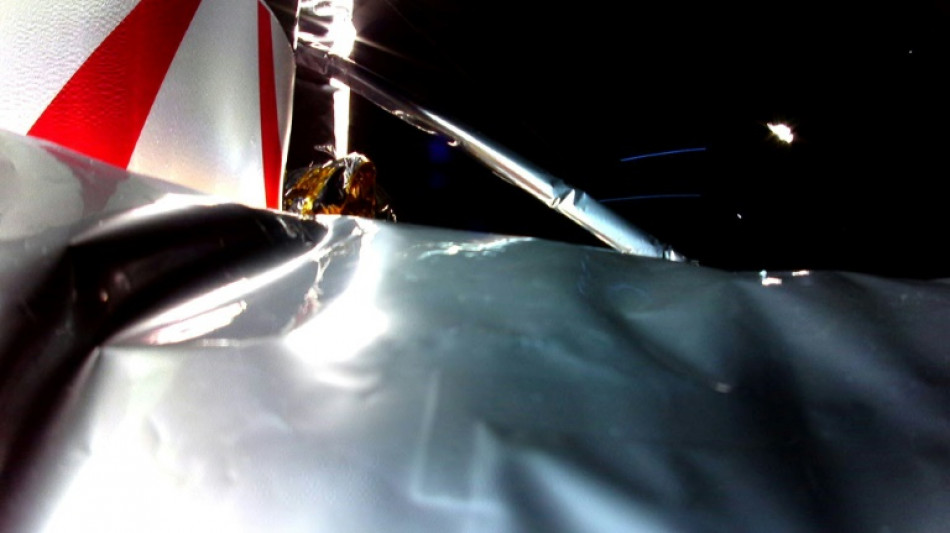
Doomed US lunar lander's space odyssey continues...for now / Photo: © Astrobotic/AFP/File

 Thousands flee wildfires in southern Europe

 South Korean tycoon ordered to pay $644m in divorce

 Hundreds flee French peninsula by boat to escape wildfire

 Brian Lara Stadium hosts maiden Test as West Indies face Pakistan

 Volkswagen profit plunges as carmaker weighs mass job cuts

 India protest leaders to meet govt after Modi vows action

 Fear, arrests keep Cambodians quiet decade after critic's murder

 Over 80% of Mexican exports exempt from new US tariffs

 Is 'superstar' Pogacar's Tour de France domination boring?

 Iran ramps up executions under shadow of war

 Rosalia's Argentine fans up in arms over alleged World Cup snub

 Six candidates to lead UN take stage for televised debate

 King Charles opens slimmed down Commonwealth Games in Glasgow

 US unveils new tariffs on 60 partners as Trump rebuilds trade agenda

 WNBA viral star Cunningham wades into trans athletes row

 Hearn dismisses Fury talk of Joshua no-show for super fight

 'Like a war zone': France evacuates 20,000 due to wildfires

 Ships avoid Ukrainian grain ports after Russian attacks

 Oil passes $100 a barrel again: why it's more serious this time

 Who are the six candidates vying to lead the UN?

 Hamilton proud of recovery after hitting rock bottom a year ago

 Carapaz eyes polkadot mountains jersey after stage win

 Fields medal awarded to four young mathematicians

 Carapaz claims Tour de France stage as Pogacar loses key team-mate

 Alonso welcomes Aston Martin upgrade, warns against unreal expectations

Is it the little spaceship that could?
A private US lunar lander that's been hemorrhaging fuel since an onboard explosion at the start of its journey is somehow still chugging along, snapping selfies and running science instruments as it continues its journey through space.
Though Astrobotic, the company that built the Peregrine robot, has said a controlled touchdown on the Moon is no longer possible, it hasn't ruled out a so-called "hard landing" or crash -- a prospect that has space watchers gripped.
"Peregrine has now been operating in space for more than 4 days," Astrobotic said in its latest update posted on X on Friday, adding it remained "stable and operational."
The rate of fuel loss has steadily diminished as the pressure inside its tank drops, meaning the company has been able to extend the spacecraft's life far longer than it initially thought possible.
Meanwhile, the US, German and Mexican space agencies have been able to power on the scientific instruments they wanted to run on the Moon.
"Measurements and operations of the NASA-provided science instruments on board will provide valuable experience, technical knowledge, and scientific data to future CLPS lunar deliveries," said Joel Kearns, deputy associate administrator for exploration for NASA.
Commercial Lunar Payload Services is the experimental NASA program under which the space agency paid Astrobotic more than $100 million to ship its hardware of Peregrine, as part of a strategy to seed a commercial lunar economy and reduce its own overheads.
Astrobotic is the third private entity to have failed in a soft landing, following an Israeli nonprofit and a Japanese company.
- 'Shots on goal' -
Though it hasn't worked out this time, NASA officials have made clear their strategy of "more shots on goal" means more chances to score, and the next attempt, by Houston-based Intuitive Machines, launches in February.
Astrobotic itself will get another chance in November with its Griffin lander transporting NASA's VIPER rover to the lunar south pole.
For now, the Pittsburgh-based company is staying tight-lipped on Peregrine's intended destination, leaving enthusiasts to make their own calculations.
Amateur astronomer Tony Dunn used publicly available data provided by NASA's Jet Propulsion Laboratory (JPL) to plot out the spaceship's current course, posting a graphic on social media platform X showing it would collide with the Moon on January 23.
But "it's really anybody's guess as to what is actually going to happen because of the leaking fuel," which could easily push it off course, he told AFP.
Or, Astrobotic could intentionally point Peregrine another way, such as flying by the Moon and shooting for interplanetary space.
While a hard lunar landing might satisfy some of Astrobotic's clients, such as those flying human ashes and DNA to the Moon, it could anger others like the Navajo Nation, which had called that cargo a "desecration" of the celestial body.
"I think it would be a shame if they completed their failed mission by littering the surface of the Moon with debris," Justin Walsh, a professor of art history, archaeology, and space studies at USC told AFP, adding that humanity had left some 180 tons of material on the surface since the first Soviet impactor crashed in 1959.
A.Zbinden--VB