Bottled water contains hundreds of thousands of plastic bits: study / Photo: © GETTY IMAGES NORTH AMERICA/AFP/File

 Thousands flee wildfires in southern Europe
 South Korean tycoon ordered to pay $644m in divorce

 Hundreds flee French peninsula by boat to escape wildfire

 Brian Lara Stadium hosts maiden Test as West Indies face Pakistan

 Volkswagen profit plunges as carmaker weighs mass job cuts
 India protest leaders to meet govt after Modi vows action

 Fear, arrests keep Cambodians quiet decade after critic's murder

 Over 80% of Mexican exports exempt from new US tariffs

 Is 'superstar' Pogacar's Tour de France domination boring?

 Iran ramps up executions under shadow of war

 Rosalia's Argentine fans up in arms over alleged World Cup snub

 Six candidates to lead UN take stage for televised debate

 King Charles opens slimmed down Commonwealth Games in Glasgow

 US unveils new tariffs on 60 partners as Trump rebuilds trade agenda

 WNBA viral star Cunningham wades into trans athletes row

 Hearn dismisses Fury talk of Joshua no-show for super fight

 'Like a war zone': France evacuates 20,000 due to wildfires

 Ships avoid Ukrainian grain ports after Russian attacks

 Oil passes $100 a barrel again: why it's more serious this time

 Who are the six candidates vying to lead the UN?

 Hamilton proud of recovery after hitting rock bottom a year ago
 Carapaz eyes polkadot mountains jersey after stage win
 Fields medal awarded to four young mathematicians

 Carapaz claims Tour de France stage as Pogacar loses key team-mate
 Alonso welcomes Aston Martin upgrade, warns against unreal expectations

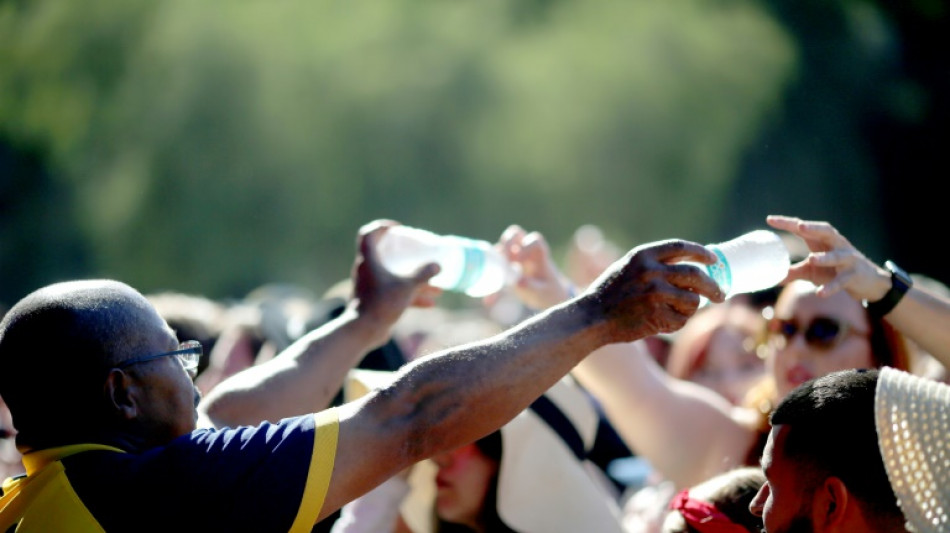
Bottled water is up to a hundred times worse than previously thought when it comes to the number of tiny plastic bits it contains, a new study in the Proceedings of the National Academy of Sciences said Monday.
Using a recently invented technique, scientists counted on average 240,000 detectable fragments of plastic per liter of water in popular brands -- between 10-100 times higher than prior estimates -- raising potential health concerns that require further study.
"If people are concerned about nanoplastics in bottled water, it's reasonable to consider alternatives like tap water," Beizhan Yan, an associate research professor of geochemistry at Columbia University and a co-author of the paper told AFP.
But he added: "We do not advise against drinking bottled water when necessary, as the risk of dehydration can outweigh the potential impacts of nanoplastics exposure."
There has been rising global attention in recent years on microplastics, which break off from bigger sources of plastic and are now found everywhere from the polar ice caps to mountain peaks, rippling through ecosystems and finding their way into drinking water and food.
While microplastics are anything under 5 millimeters, nanoplastics are defined as particles below 1 micrometer, or a billionth of a meter -- so small they can pass through the digestive system and lungs, entering the bloodstream directly and from there to organs, including the brain and heart. They can also cross the placenta into the bodies of unborn babies.
There is limited research on their impacts on ecosystems and human health, though some early lab studies have linked them to toxic effects, including reproductive abnormalities and gastric issues.
To study nanoparticles in bottled water, the team used a technique called Stimulated Raman Scattering (SRS) microscopy, which was recently invented by one of the paper's co-authors, and works by probing samples with two lasers tuned to make specific molecules resonate, revealing what they are to a computer algorithm.
They tested three leading brands but chose not to name them, "because we believe all bottled water contain nanoplastics, so singling out three popular brands could be considered unfair," said Yan.
The results showed between 110,000 to 370,000 particles per liter, 90 percent of which were nanoplastics while the rest were microplastics.
The most common type was nylon -- which probably comes from plastic filters used to purify the water-- followed by polyethylene terephthalate or PET, which is what bottles are themselves made from, and leaches out when the bottle is squeezed. Other types of plastic enter the water when the cap is opened and closed.
Next, the team hopes to probe tap water, which has also been found to contain microplastics, though at far lower levels.
R.Kloeti--VB