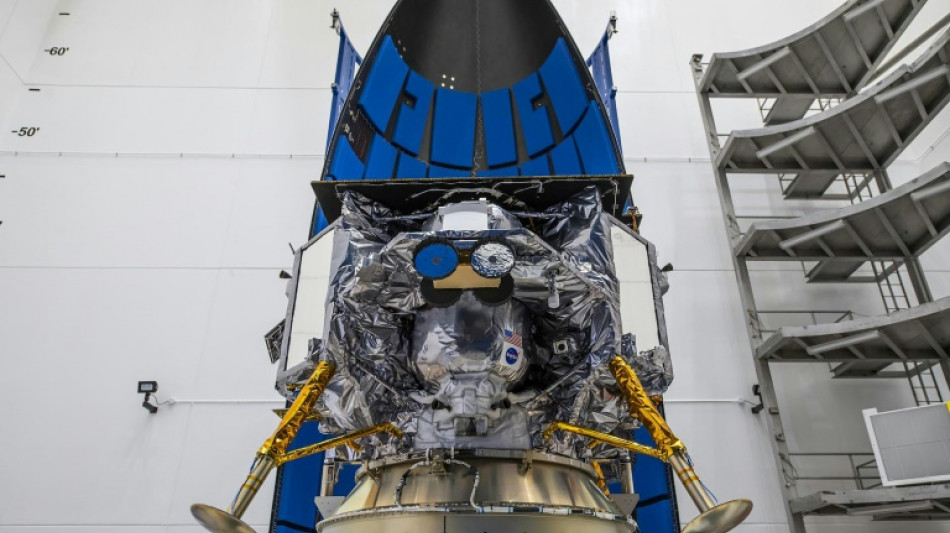
New US lunar lander runs into technical problem: company / Photo: © NASA/AFP/File

 Thousands flee wildfires in southern Europe

 South Korean tycoon ordered to pay $644m in divorce

 Hundreds flee French peninsula by boat to escape wildfire

 Brian Lara Stadium hosts maiden Test as West Indies face Pakistan

 Volkswagen profit plunges as carmaker weighs mass job cuts

 India protest leaders to meet govt after Modi vows action

 Fear, arrests keep Cambodians quiet decade after critic's murder

 Over 80% of Mexican exports exempt from new US tariffs

 Is 'superstar' Pogacar's Tour de France domination boring?

 Iran ramps up executions under shadow of war

 Rosalia's Argentine fans up in arms over alleged World Cup snub

 Six candidates to lead UN take stage for televised debate

 King Charles opens slimmed down Commonwealth Games in Glasgow

 US unveils new tariffs on 60 partners as Trump rebuilds trade agenda

 WNBA viral star Cunningham wades into trans athletes row

 Hearn dismisses Fury talk of Joshua no-show for super fight

 'Like a war zone': France evacuates 20,000 due to wildfires

 Ships avoid Ukrainian grain ports after Russian attacks

 Oil passes $100 a barrel again: why it's more serious this time

 Who are the six candidates vying to lead the UN?

 Hamilton proud of recovery after hitting rock bottom a year ago

 Carapaz eyes polkadot mountains jersey after stage win

 Fields medal awarded to four young mathematicians

 Carapaz claims Tour de France stage as Pogacar loses key team-mate

 Alonso welcomes Aston Martin upgrade, warns against unreal expectations

The first US lunar lander launched in more than five decades has experienced an anomaly preventing it from pointing its solar panels towards the Sun, the company that built the robot said Monday.
Astrobotic's Peregrine lunar lander separated successfully from United Launch Alliance's new Vulcan rocket overnight from the Cape Canaveral Space Force Base, and quickly established communications with NASA's Deep Space Network of ground-based radio antennas.
All its systems powered on as expected, and it "entered a fully operational state," Astrobotic said in a tweet.
But "unfortunately, an anomaly occurred which prevented Astrobotic from achieving a stable sun-pointing orientation.
"The team is responding in real time as the situation unfolds and will be providing updates as data is obtained and analyzed."
The lander's documentation, available online, says that while in orbit, Peregrine's top mounted solar panel stays pointed at the Sun to enable maximum power generation.
"The solar panel is utilized to provide battery charge and maintain lander and payload operations. After descent to the lunar surface the power system continues to provide reliable power services to payloads through the end of mission," it says.
Peregrine is on its way to the Moon and is supposed to hold its orbit before finally landing on a mid-latitude region called Sinus Viscositatis, or Bay of Stickiness, on February 23.
Until now, a soft landing on Earth's nearest celestial neighbor has only been accomplished by a handful of nations. But the United States and others are increasingly turning to the commercial sector to carry out routine missions and ship hardware at a fraction of the cost.
R.Fischer--VB