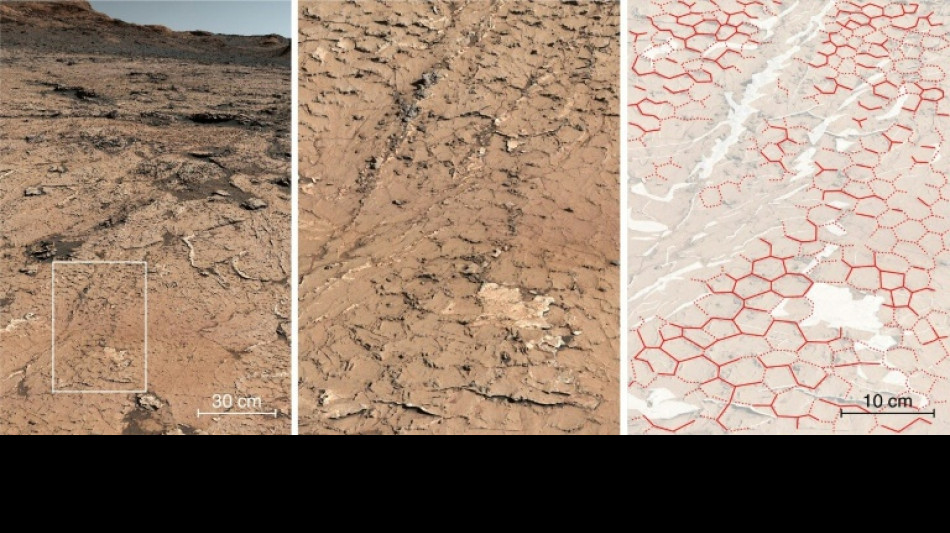
Mars once had wet-dry climate conducive to supporting life: study / Photo: © NASA/JPL-Caltech/MSSS/IRAP/Rapin et al./Nature/AFP

 Dodgers return to Trump White House despite fan anger

 Lyles, Richardson ease into 100m semis at US athletics championships

 Salman Rushdie testifies at knife attacker's US terror trial

 World Bank confirms plan to phase out China lending by 2031

 US panel backs trendy peptides despite safety concerns

 Justice Dept withdraws NY Times subpoenas over Trump plane report

 Barcelona's De Jong returns from World Cup with torn ligament
 Albania police teargas protesters against Trump-linked resort

 US panel says to loosen restrictions on popular peptide despite safety concerns

 Verstappen swerves around future questions

 EU renews online child sex abuse detection powers

 Airbus, Boeing fly in different directions at Farnborough

 Bab al-Mandeb Strait: another key oil shipping route under threat

 Deadly wildfires in Europe force thousands to flee

 NATO to overhaul European fuel pipeline network

 US trade envoy to make tariff announcement as 10% duty soon expires

 Trump stuns Saudis by pinning nuclear deal to Israel ties

 Tough day for Ubisoft stock topped with weaker revenues

 Swelling jet fuel costs hit American Airlines outlook

 Carapaz climbs unopposed to Tour de France 18th stage win

 Sooryavanshi hits maiden 50 as India thump Zimbabwe in T20

 ECB opens door to September rate-hike as Iran war flares up

 World Bank estimates Venezuela quakes caused $19.6 bn in damage

 Italy's far-right line up to defend jeweller who killed robbers

 AI-led boom in IPOs raises concerns about a bust

NASA's Curiosity rover has discovered the first evidence that Mars once had a climate which alternated between wet and dry seasons similar to Earth, a study said on Wednesday, suggesting the red planet may have once had the right conditions to support life.
Though the surface of Mars is now an arid desert, billions of years ago rivers and vast lakes are thought to have stretched across its surface.
Since 2012, the Curiosity rover has been exploring the huge Gale crater, which is believed to be home of a former lake and has a massive mountain of sediment nearly six kilometres (four miles) high in its centre.
"We quickly realised that we were working in lakes and rivers deposits, but did not know what type of climate they were linked to," William Rapin, a researcher at France's CNRS scientific research centre and the study's lead author, told AFP.
While climbing the slope of the sediment mountain in 2021, Curiosity found salt deposits forming a hexagonal pattern in soil dated to nearly four billion years ago.
The rover's instruments identified the patterns as cracks in dried mud, according to the study published in the journal Nature.
"When a lake dries up the mud cracks, and when it fills back up, the cracks heal," Rapin explained.
Repeat this process enough times, and the cracks arrange themselves in hexagons.
Therefore, this is "the first tangible proof that Mars had a cyclical climate," Rapin said.
Regularly occurring wet and dry seasons, as on Earth, could have provided the conditions needed for life to form, the researchers said.
- 'Pretty lucky' -
Curiosity has already detected the presence of organic compounds considered the building blocks of life on Mars, which could be another piece of the puzzle.
But these building blocks need the right conditions to become the precursors of life.
"In a world that's too dry, these molecules never have the opportunity to form -- nor do they in a world that's too wet," Rapin said.
But banish thoughts of big-headed green men -- if Mars did support life, it was likely primitive single-celled microorganisms.
"Over 11 years, we've found ample evidence that ancient Mars could have supported microbial life" due to the Curiosity rover, said Ashwin Vasavada of NASA's Jet Propulsion Laboratory.
"Now, the mission has found evidence of conditions that may have promoted the origin of life, too," he said in a statement.
The discovery of such ancient terrain could never have been possible on Earth, where tectonic plates constantly reshuffle the surface, sifting away such lingering traces of the past.
That means that studying Mars -- which lacks tectonic plates -- could help scientists solve the mystery of how life began on our home planet.
"It's pretty lucky of us to have a planet like Mars nearby that still holds a memory of the natural processes which may have led to life," Rapin said.
J.Horn--BTB